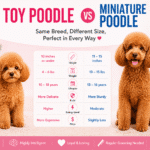
Quick answer: A Toy Poodle and a Miniature Poodle are the exact same breed — the AKC just draws the line at height. A Toy Poodle stands 10 inches or under at the shoulder and weighs 4–6 lbs. A Miniature Poodle stands between 11 and 15 inches and weighs 10–15 lbs. Same coat, same colors, same intelligence, same general personality — the real decision comes down to how small you actually want to go, and what that means for their health, energy, and daily life.
If you’ve spent the last hour with ten tabs open trying to figure out whether a Toy or a Miniature Poodle is right for you, you’re not alone — and honestly, most of what’s out there online just repeats the same three sentences about height and calls it a day. We wanted to actually answer the question properly: what does that size difference *mean* for you day to day? Does it change their health risks? Their energy level? How much they cost? We pulled all of that together here, in plain language, so you can make the call with confidence.
Are Toy and Miniature Poodles Actually the Same Breed?
Yes — and this is the part almost nobody explains clearly upfront. The American Kennel Club recognizes exactly one Poodle breed. It just comes in three official size varieties: Standard, Miniature, and Toy. There’s no separate bloodline, no different genetics, no distinct breed standard for temperament or coat. A litter of Miniature Poodle puppies could, in theory, produce a puppy small enough to be classified as a Toy, and vice versa — size is measured at maturity, not predicted from birth.
So when people ask “what’s the difference between a toy poodle and a mini poodle,” the honest answer is: mostly just a ruler. Everything else — the curly hypoallergenic coat, the sharp intelligence, the loyal and people-focused personality — comes from the same shared Poodle genetics.
Size & Weight Chart
Here’s where the two actually part ways in a way you can measure:
| Variety | Height at Shoulder | Weight |
|---|---|---|
| Toy Poodle | 10 inches or under | 4 – 6 lbs |
| Miniature Poodle | 11 – 15 inches | 10 – 15 lbs |
| Standard Poodle (for reference) | Over 15 inches | 40 – 70 lbs |
Notice the gap: a Toy Poodle can weigh a third of what a Miniature Poodle weighs, even though on paper they only look “one size apart.” That difference matters more than people expect once you get into daily handling, home safety, and even how they play with kids or other pets — a Toy Poodle is genuinely a fragile-feeling little dog, while a Miniature Poodle has noticeably more sturdiness to it.
Coat, Colors & Appearance
Side by side, without a tape measure, most people genuinely cannot tell a Toy and Miniature Poodle apart in a photo. Both have the same dense, curly, low-shedding coat that made the breed famous for being allergy-friendly. Both come in the full range of Poodle colors — black, white, apricot, cream, silver, blue, red, brown, and café-au-lait — with no color restricted to one size over the other.
The one place appearance genuinely differs is proportion. Because a Toy Poodle is so much smaller in every dimension, its features — muzzle, ears, legs — can look slightly more delicate and “teacup-like,” while a Miniature Poodle’s slightly larger frame gives it a bit more of the elegant, athletic silhouette the breed is known for in the show ring.
Temperament Differences (Yes, There Are a Few)
Both sizes are famously intelligent, eager to please, and deeply bonded to their people — Poodles are consistently ranked among the smartest dog breeds, and that holds true across every size. But owners and breeders do report a few subtle differences worth knowing:
- Toy Poodles tend to be more sensitive and can be a bit more reactive to loud noises, sudden movements, or rough handling. Their small size also means they’re more prone to “small dog syndrome” if they aren’t given consistent, calm training from an early age.
- Miniature Poodles tend to strike a slightly more balanced, confident temperament — playful and alert like the Toy, but a bit less nervy, and generally a little more tolerant of the bumps and noise of an active household.
- Both can develop separation anxiety if left alone for long stretches, since this is a breed that genuinely wants to be near you, not just fed and walked.
Health & Lifespan
Poodles as a whole are a long-lived, relatively healthy breed — but size does shift the specific risks a little:
| Factor | Toy Poodle | Miniature Poodle |
|---|---|---|
| Average lifespan | 10 – 18 years | 13 – 16 years |
| Injury risk | Higher — fragile bones, jumping off furniture | Lower, sturdier build |
| Common conditions to screen for | Progressive retinal atrophy, Legg-Calve-Perthes disease, luxating patella | Progressive retinal atrophy, hip evaluations, ear infections |
The single biggest practical difference here is injury risk. Because a Toy Poodle weighs about as much as a can of soup, jumping off a couch or being underfoot near an active toddler carries real risk of a fracture — something that simply isn’t as much of a concern with the sturdier Miniature Poodle. If you have young, boisterous kids or other larger pets in the house, that’s genuinely worth factoring into the decision, not just an afterthought.
Exercise & Training Needs
Both sizes are active, mentally sharp dogs that need more than a five-minute yard visit to stay happy — but the daily time commitment does shift slightly:
- Toy Poodle: around 20–25 minutes of walking or play a day, split into shorter sessions since their tiny legs tire faster.
- Miniature Poodle: around 30–40 minutes a day, with a bit more stamina for games like fetch and structured training.
- Training: both varieties are famously easy to train thanks to their intelligence and food motivation — positive reinforcement works beautifully on either size, and both do well with puzzle toys and mental enrichment on rainy days when a walk isn’t practical.
Grooming Requirements
Grooming needs are essentially identical between the two — this is one area where size truly doesn’t change much:
- Brushing: every other day at minimum to prevent matting, since the curly coat traps loose hair instead of shedding it out.
- Professional grooming: every 4–6 weeks for a trim, regardless of size.
- Bathing: every 3–4 weeks, using a gentle, moisturizing shampoo to protect the coat’s texture.
- Shedding: minimal for both — a major reason Poodles are a go-to recommendation for allergy-prone households.
Price Comparison: Toy vs Miniature Poodle
Prices genuinely vary by region, breeder, and bloodline, but here’s a realistic range based on current market data:
| Source | Toy Poodle | Miniature Poodle |
|---|---|---|
| Reputable breeder | $1,200 – $3,500+ | $2,000 – $3,500 |
| Rescue or adoption | $100 – $500 | $100 – $500 |
| First-year total cost | $1,500 – $3,000 | $1,800 – $3,500 |
Toy Poodles occasionally command a premium over Minis simply because demand for the very smallest size tends to run high — but the honest driver of price in either size is breeder reputation and health testing, not the number on the scale. Rock-bottom prices on either size are a red flag worth asking hard questions about, not a bargain.
Where Does the Standard Poodle Fit In?
Since “standard vs miniature poodle” is another common search, it’s worth a quick mention: the Standard Poodle is the original size the breed was built on — over 15 inches tall and 40–70 lbs, originally developed as a water retrieving dog in Germany before being refined in France. Toy and Miniature Poodles were later developed from the same bloodline specifically so people in cities and smaller homes could enjoy the breed’s intelligence and coat without needing the space a Standard requires. Temperament-wise, Standards tend to be the most energetic and athletic of the three, with Miniatures landing in the middle and Toys being the calmest indoors, though all three share that same sharp Poodle brain.
Mini Poodle vs Mini Goldendoodle
If you’re also weighing a Mini Poodle against a Mini Goldendoodle, the comparison comes down to purity versus blend. A Miniature Poodle is a purebred dog with a predictable coat, size, and temperament from litter to litter. A Mini Goldendoodle is a crossbreed — part Golden Retriever, part Poodle — which tends to bring a slightly more outgoing, eager-to-please energy and a softer, wavier coat, but with a bit less predictability in exactly how a puppy will turn out as an adult. If a hypoallergenic, low-shedding coat is your top priority, the purebred Miniature Poodle is the more reliable bet; if you want a bit more Golden Retriever warmth and playfulness, the Goldendoodle cross is worth a look.
So Which One Should You Choose?
Here’s the honest, no-fluff way to decide:
- Choose a Toy Poodle if: you live in a small apartment, want the smallest possible lap dog, don’t have young kids or large dogs in the home, and you’re comfortable with a bit more careful handling day to day.
- Choose a Miniature Poodle if: you want the same intelligence and low-shedding coat but with more physical durability, a household with kids or other pets, or you simply want a dog that can keep up with slightly more active play.
- Either way: you’re getting one of the most trainable, loyal, and allergy-friendly companion breeds available — the “right” choice really is about lifestyle fit, not one being better than the other.
How to Buy a Toy or Miniature Poodle the Right Way
- Ask to see both parents in person or by video call to get a realistic sense of the size your puppy will grow into.
- Request health clearances for eyes (PRA) and, for Toys especially, patella evaluations.
- Get everything in writing: a health guarantee, vaccination records, and a clear return policy.
- Ask about early handling and socialization — puppies exposed to gentle handling and household noise from birth settle into new homes far more easily.
- Be cautious of unusually low prices, which often signal skipped health testing on the parents.
At PuppyHeaven, every Toy and Teacup Poodle puppy is vet-checked, up to date on age-appropriate vaccinations and deworming, and comes with a health guarantee, microchipping, and a starter kit to make those first few days at home easier. We also offer live video calls so you can meet a puppy — and often the parents — before committing, along with financing and nationwide delivery from our Las Vegas, NV and Sunrise, FL locations. If you’re also considering a low-shedding designer mix, our Maltipoo and Cavapoo litters — both Poodle mixes — are worth browsing side by side before you decide.
Frequently Asked Questions
What is the difference between a toy poodle and a miniature poodle?
Height and weight. A Toy Poodle is 10 inches or under and weighs 4–6 lbs; a Miniature Poodle is 11–15 inches and weighs 10–15 lbs. They’re the same breed and share the same coat, colors, and general temperament.
Which is better, a toy poodle or a mini poodle?
Neither is objectively “better” — it depends on your lifestyle. Miniature Poodles are sturdier and better suited to homes with kids or other pets, while Toy Poodles are the smallest option for apartment living with adults.
Do toy poodles live longer than miniature poodles?
On average, Toy Poodles can live slightly longer (up to 18 years in some cases), though both varieties are considered long-lived, healthy dogs when bred responsibly.
Are toy poodles more fragile than mini poodles?
Yes. Their smaller bone structure makes Toy Poodles more prone to injury from falls or rough play, which is worth considering in homes with young children or larger pets.
Do toy and miniature poodles shed?
Both shed minimally and are widely considered hypoallergenic-friendly, since their curly coat traps loose hair rather than releasing it around the house.
How much exercise do toy and miniature poodles need?
Toy Poodles typically need about 20–25 minutes of activity a day, while Miniature Poodles benefit from closer to 30–40 minutes given their slightly greater stamina.
Is a mini poodle the same as a toy poodle genetically?
Yes — both are the same breed and can even appear within the same litter. Size classification happens once a dog reaches its adult height, not at birth.
How much do toy and miniature poodles cost?
Generally $1,200–$3,500 for a Toy Poodle and $2,000–$3,500 for a Miniature Poodle from a reputable breeder, with health testing and lineage being the main price drivers.
Are toy poodles good with kids?
They can be, but their small, delicate size makes supervised interaction essential — a Miniature Poodle is often recommended as the sturdier choice for households with young children.
What’s the difference between a mini poodle and a mini goldendoodle?
A Miniature Poodle is a purebred dog with a predictable, low-shedding coat, while a Mini Goldendoodle is a Poodle-Golden Retriever cross with a softer, wavier coat and slightly more variability from puppy to puppy.
Ready to find your Toy or Miniature Poodle?
PuppyHeaven has specialized in teacup and toy breeds for over 21 years, with more than 30,000 happy placements across our Las Vegas, NV and Sunrise, FL locations. Every puppy is vet-checked, comes with a health guarantee, microchipping, and a starter kit — with financing and nationwide delivery available. Browse our Available Puppies today, or compare against our Maltipoo and Cavapoo litters to see which fits your family best.