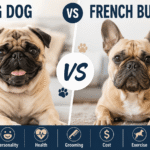
If you’ve spent any time scrolling through cute dog videos, you’ve probably stopped on a Pug or a French Bulldog and thought, “I need one of those.” Both breeds have that squished, wrinkly, impossible-not-to-love face. Both fit in a purse (well, almost). And both have a fan base that borders on obsession.
But here’s the thing nobody tells you upfront: these two breeds are not the same dog with a different haircut. A Pug and a French Bulldog live pretty different daily lives once they’re actually in your house — different energy, different health bills, different grooming routines, and honestly, different personalities entirely.
We’ve been placing puppies with families for over 21 years at Puppy Heaven, out of our boutiques in Las Vegas, NV and Sunrise, FL, and the Pug-vs-Frenchie question is one of the ones we get asked the most, right at the counter, almost every week. So instead of giving you the recycled “both are great, good luck” answer you’ll find everywhere else, we sat down and actually broke this down properly — real weight ranges, real cost numbers, real health talk, and the stuff people usually only find out after they’ve already brought the puppy home.
Quick heads up before we dive in: both of these breeds are what vets call “brachycephalic,” which is a fancy word for flat-faced. That single fact drives almost every difference on this page, so keep it in the back of your mind as you read.
The Fast Answer: Pug vs French Bulldog At a Glance
If you’re in a hurry (no judgment, puppy shopping is exciting), here’s the whole comparison in one table. We’ll unpack every row below.
| What You’re Comparing | Pug | French Bulldog |
|---|---|---|
| Weight | 14–18 lbs | 17–28 lbs |
| Height | 10–13 inches | 11–13 inches |
| Body build | Round, soft, curled tail | Stocky, muscular, straight tail |
| Ears | Small, folded down | Large, upright “bat ears” |
| Coat colors | Fawn or black, basically two options | Huge range — fawn, brindle, cream, black, blue, lilac, pied |
| Shedding | Surprisingly heavy, year-round | Light to moderate |
| Personality vibe | Clingy, goofy, food-obsessed, “shadow dog” | Playful but more independent, chill housemate |
| Trainability | Motivated by food, but stubborn and easily distracted | Also stubborn, but often quicker to house-train |
| Lifespan | 12–15 years | 10–14 years |
| Typical price | Generally lower | Usually the pricier of the two, sometimes significantly |
| Health risk level | High — breathing, eyes, PDE | High — breathing, spine (IVDD), allergies |
Neither dog “wins” this table outright — that’s the honest answer. It really comes down to which set of trade-offs fits your life. Let’s get into the details that actually matter once the puppy is home.
Where These Two Breeds Actually Came From
The Pug is the older breed by a long shot. We’re talking roughly 2,000+ years of history, tracing back to imperial China, where Pugs were kept by emperors and treated like tiny royalty themselves — some accounts even describe them as being guarded by soldiers. Their wrinkles weren’t just cute to Chinese breeders; the wrinkle pattern on a Pug’s forehead was said to resemble the Chinese character for “prince,” which only added to their prestige.
The French Bulldog’s story is much younger and a lot more blue-collar. English lace workers in the 1800s bred small “toy bulldogs” as companions, and when the Industrial Revolution pushed many of those workers to Normandy, France, they brought their little bulldogs along. Once in France, the breed was crossed with local ratters and terriers, and the now-famous bat ears started showing up. Parisian high society — including plenty of well-known artists and socialites of the era — fell in love with the look, and the “Frenchie” as we know it was born.
So one breed comes from ancient Chinese palaces, the other from French factory towns and Parisian salons. Neither history tells you which dog to pick, but it does explain a lot about their personalities — Pugs were bred purely to be companions and lap-warmers, while Frenchies had a bit of working-dog scrappiness mixed into their gene pool early on.
Looks: How to Tell Them Apart in Two Seconds
People genuinely mix these two up in photos, so here’s the fastest way to tell them apart without even needing to see the whole body:
- Look at the ears first. If they’re standing straight up like little bat wings, that’s a Frenchie. If they’re folded down flat against the head, that’s a Pug.
- Check the tail. A Pug’s tail curls tightly over its back like a little cinnamon roll. A French Bulldog’s tail is short and straight, sometimes with a slight kink, but it never curls.
- Notice the body shape. Pugs are rounder and softer-looking all over. Frenchies look like they hit the gym — broader chest, more visible muscle, a stockier frame.
- Count the colors. If the dog is anything other than fawn or black, it’s not a purebred Pug. French Bulldogs come in a huge range — brindle, cream, blue, lilac, pied, and more.
Both breeds are brachycephalic, meaning they share that pushed-in, flat-faced look, deep facial wrinkles, and big expressive eyes. But once you know the ear and tail trick, you’ll never confuse them again.
Personality: The Part That Actually Matters Most
Here’s where a lot of comparison articles get lazy and just say “both are affectionate,” and technically that’s true, but it completely misses how differently these two breeds show love.
Pugs are shadow dogs. They will follow you from the kitchen to the bathroom to the bedroom and back, and they genuinely seem confused about why you’d want to be in a different room than them. This isn’t neediness for the sake of it — Pugs were bred for centuries to do exactly one job, which was to be someone’s constant companion. If you work from home, want a dog that naps on your lap during Zoom calls, or just like feeling like the center of someone’s universe, a Pug delivers that in spades. The flip side: Pugs can struggle with being left alone for long stretches, and some develop real separation anxiety if that need for closeness isn’t met.
French Bulldogs are more like a chill roommate who happens to adore you. They’re still affectionate, still silly, still love a good couch cuddle — but they’re generally more comfortable entertaining themselves for a bit if you need to step away. Many Frenchie owners describe their dog as having a “big personality in a small, calm package” — playful in bursts, then perfectly happy to nap nearby rather than on you.
Neither temperament is better. It genuinely depends on whether you want a dog that’s constantly plugged into you (Pug) or one that loves you deeply but doesn’t need to be touching you every waking minute (Frenchie).
Training: Which One Listens Better?
Neither breed is going to win obedience trials, and honestly, that’s part of their charm. Both are intelligent enough to learn quickly, but both can be selectively stubborn — meaning they’ll do the trick perfectly for a treat and then act like they’ve never heard the command five minutes later.
Pugs respond incredibly well to food-based training because, let’s be blunt, Pugs love food more than almost anything else in life. That’s a training superpower and a weight-management headache rolled into one — you have to portion treats carefully or a Pug will happily train you into giving out way too many snacks.
French Bulldogs, according to most trainers and long-time owners, tend to pick up house-training a little faster than Pugs on average, and they often do well with short, game-like training sessions rather than long drilled repetition. Both breeds absolutely need positive reinforcement — treats, praise, play — because harsh corrections just shut them down or make them dig in their heels harder.
Socialization matters just as much as commands for both breeds. Puppies that meet lots of new people, sounds, and situations early on tend to grow into far more confident, easygoing adult dogs — this is something our team walks every new Puppy Heaven family through before they ever take a puppy home.
Exercise Needs: Don’t Expect a Jogging Partner From Either
If your dream dog is a hiking buddy, neither of these breeds fits that dream — and that’s actually a safety issue, not just a preference thing. Because both Pugs and French Bulldogs have shortened airways, they simply can’t cool themselves down the way a longer-snouted dog can. Overheating is a real, serious risk for both breeds, especially in warm climates.
Both do best with short daily walks — think two 15-to-20-minute strolls rather than one long trek — plus some indoor play and mental stimulation like puzzle toys or a good game of fetch down the hallway. Summer walks should happen early morning or after sunset, never during peak heat. Watch for heavy panting, gums turning pale or blue, or your dog suddenly slowing to a stop — those are all signs to get your pup into shade and water immediately.
Between the two, Pugs are a bit more prone to overheating quickly if they’re carrying extra weight (which happens often, given how food-motivated they are), while French Bulldogs can tire out fast if their airway is on the more restricted side. Neither breed needs — or can safely handle — a ton of vigorous exercise, which actually makes both excellent apartment dogs.
Grooming: The Shedding Surprise Nobody Warns You About
This is one of the biggest myths about both breeds — people assume short hair means low maintenance, and that’s only half true.
Pugs shed. A lot. Despite that short, smooth coat, Pugs are famous in the grooming world for leaving hair absolutely everywhere, year-round, with a heavier shed twice a year. A weekly brushing with a rubber curry brush helps enormously, but be ready for hair on your couch, your clothes, and probably your coffee.
French Bulldogs shed noticeably less. Their single-layer coat means a lot less hair around the house — a quick weekly brush usually keeps things under control.
Where the two breeds are equally demanding is facial wrinkle care. Both Pugs and Frenchies have skin folds that trap moisture, dirt, and bacteria if you ignore them. A quick wipe-down of those folds a few times a week — and always drying them completely afterward — prevents painful skin infections. Frenchies also need their upright ears checked regularly since that open shape can let debris and moisture collect. Add in routine nail trims and you’ve got the full grooming picture for both breeds.
Health: The Conversation Every Responsible Owner Needs to Have
We’re not going to sugarcoat this section, because we think you deserve the real picture before you commit — and any breeder who glosses over it isn’t doing you any favors.
Both breeds share the same core risk: Brachycephalic Airway Syndrome, a group of breathing complications tied directly to their flat-faced structure — narrowed nostrils, an elongated soft palate, and a smaller windpipe than a normal-nosed dog. This is why heat management, weight control, and avoiding overexertion aren’t optional extras — they’re core parts of owning either breed.
Beyond that shared risk, each breed has its own specific concerns worth knowing:
Pug-specific health watch points:
- Obesity — Pugs gain weight easily, which worsens breathing and joint stress
- Eye problems — their large, prominent eyes are more prone to injury, ulcers, and dryness
- Pug Dog Encephalitis (PDE) — a serious inflammatory brain condition unique to the breed
- Hip dysplasia in some lines
French Bulldog-specific health watch points:
- Intervertebral Disc Disease (IVDD) — spinal issues linked to their compact build
- Skin allergies, which tend to show up more often than in Pugs
- Higher rates of needing surgical airway correction in more severely affected dogs
- Increased sensitivity to anesthesia, which matters for any future surgery
Here’s the part that matters more than any list of conditions: how a puppy is bred determines an enormous amount of this risk. A responsible breeder who health-tests parent dogs, avoids breeding from lines with known airway or spinal problems, and prioritizes moderate, functional structure over extreme flat-faced looks will produce measurably healthier puppies. This is exactly why every puppy that leaves our care has already been vet-checked, and why we walk every family through what to expect long-term, rather than just handing over a puppy and waving goodbye.
Lifespan: A Few Years Can Mean a Lot
Pugs typically live 12 to 15 years, while French Bulldogs typically live 10 to 14 years. That gap isn’t huge, but it’s not nothing either, and it usually comes down to how well breathing issues and weight are managed over the dog’s lifetime. Genetics, diet, preventive vet care, and how closely you manage warm-weather activity all play a real role in how long — and how comfortably — either breed lives.
Cost: What You’ll Actually Spend
This is usually the deciding factor for a lot of families, so let’s be straightforward about it. French Bulldogs are, almost across the board, more expensive than Pugs — sometimes considerably more, depending on coat color and rarity. Blue, lilac, and merle Frenchies in particular can command a much higher price tag than a standard fawn or brindle puppy. Pugs tend to sit at a more moderate, more predictable price point by comparison.
But the purchase price is only chapter one of the cost story. Both breeds come with ongoing expenses that add up over the years: quality food, routine vet visits, dental care, skin and ear products, and — because of those shared brachycephalic risks — the possibility of needing more intensive (and more expensive) veterinary care down the line than a dog with a normal-length snout. Pet insurance is worth genuinely considering for either breed for exactly this reason.
Good news if the upfront cost feels like a hurdle: we don’t think a payment plan should be the reason a family misses out on the puppy they’ve fallen in love with. Puppy Heaven offers flexible puppy financing, with approval often coming back in as little as five minutes, so you can bring your puppy home now and spread the cost out over time.
Apartment Living and Life With Kids
Good news here — both breeds are genuinely excellent choices for apartment life. Neither needs a yard, neither is a heavy barker compared to a lot of small breeds, and both are content with indoor time paired with short daily walks. If you live in a condo, a downtown apartment, or a smaller home, either breed can thrive.
Both also tend to do well with children when they’re properly socialized and the interactions are supervised — small dogs and small kids should always be introduced with some adult guidance, simply because either dog can get hurt from rough handling given their compact, sometimes delicate builds. Beyond that, Pugs’ people-focused nature and Frenchies’ easygoing attitude both tend to make them patient, family-friendly companions.
So… Pug or French Bulldog? Here’s How to Decide
Forget trying to find the “objectively better” breed — it doesn’t exist here. Instead, ask yourself these questions:
Choose a Pug if you…
- Want a dog glued to your side all day
- Are usually home or work remotely
- Don’t mind extra vacuuming
- Want a slightly more budget-friendly price point
- Love a goofy, food-motivated clown of a dog
Choose a French Bulldog if you…
- Prefer a calmer, more independent companion
- Want minimal shedding around the house
- Like having lots of coat color and pattern options
- Can comfortably budget for a higher upfront cost
- Want a sturdy, muscular little dog with a bold look
If you’re still torn, that’s completely normal — plenty of families walk into our boutiques having gone back and forth for weeks. Spending time with both breeds in person, holding them, watching how they react to you, often settles the decision faster than any article can.
Frequently Asked Questions
Are French Bulldogs healthier than Pugs?
Not really — both carry meaningful brachycephalic health risks, and each has its own separate concerns on top of that (PDE for Pugs, IVDD for Frenchies). The health of any individual puppy depends far more on breeding quality, weight management, and vet care than on which of the two breeds you pick.
Which breed sheds more, Pug or French Bulldog?
Pugs shed noticeably more than French Bulldogs, despite both having short coats. If shedding is a dealbreaker for your household, a Frenchie is the lower-maintenance option here.
Are Pugs or French Bulldogs easier to train?
Both can be stubborn, but many owners and trainers find French Bulldogs pick up house-training slightly faster. Pugs, on the other hand, are extremely food-motivated, which can make treat-based training sessions go smoothly.
Which is more expensive, a Pug or a French Bulldog?
French Bulldogs are typically more expensive upfront, and rarer coat colors can push the price even higher. Pugs tend to be the more budget-friendly of the two breeds.
Can Pugs and French Bulldogs live in an apartment?
Yes, both breeds are well suited to apartment living. Neither needs a yard, both are relatively quiet, and both are happy with short walks paired with indoor playtime.
Do Pugs or Frenchies do better in hot weather?
Neither breed handles heat well because of their shortened airways. Walks should happen in the cooler parts of the day for both breeds, and owners should always watch closely for signs of overheating.
Ready to Meet Your Puppy?
Whichever breed calls to you, the most important decision isn’t Pug versus Frenchie — it’s choosing a source that actually puts the puppy’s health first. For over 21 years, Puppy Heaven has placed more than 30,000 puppies with families across the country, from our boutiques in Las Vegas, Nevada and Sunrise, Florida. Every puppy we place is vet-checked, up to date on vaccinations, microchipped, and backed by a health guarantee, with a starter kit included to help you get settled from day one.
Browse our current Pug puppies for sale or our available French Bulldog puppies for sale, or take a look through all the breeds we carry if you’re still exploring your options. Want to see a puppy up close before deciding? We offer live video calls so you can meet your future companion face to face before you visit. And if the price tag feels like the only obstacle standing between you and your new best friend, our puppy financing options can help make that happen today rather than “someday.”
Have questions about which breed fits your home best?
Our team talks families through this exact decision every single day. Reach out to us here and we’ll help you find the right match.