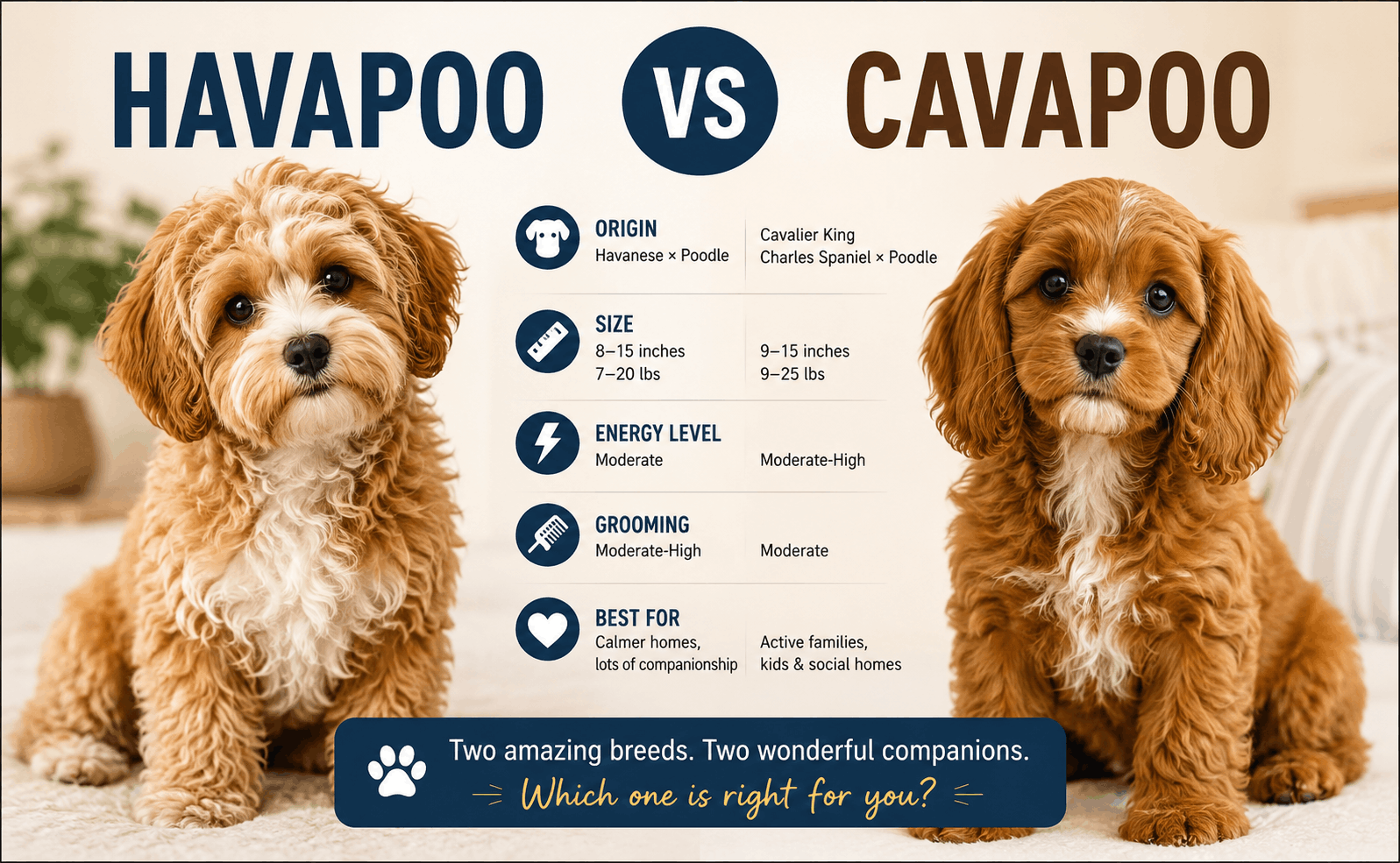
If you’ve landed here, you’re probably trying to decide between a Havapoo vs Cavapoo, and honestly, it’s easy to see why. One look at these adorable puppies and you’ll likely fall in love with both. They’re small, fluffy, affectionate, and full of personality, making either breed a wonderful companion. But while both are fantastic family dogs, there are some important differences that can make one a much better fit for your lifestyle. This guide will help you compare Havapoo vs Cavapoo in a simple, practical way so you can confidently choose the perfect puppy for your home.
But there IS a right answer for you. And it usually comes down to three things nobody tells you up front: how much alone-time your household can realistically offer, how much shedding and drool you can tolerate, and what kind of energy you want greeting you at the door every day. We’re going to walk through every one of those, plus the things most comparison articles skip entirely — real monthly costs, breeder red flags, and what the first 90 days actually look like with each breed.
Havapoo vs Cavapoo: Quick Comparison Table
| Trait | Havapoo | Cavapoo |
|---|---|---|
| Parent breeds | Havanese × Poodle | Cavalier King Charles Spaniel × Poodle |
| Adult height | 8–15 inches | 9–15 inches |
| Adult weight | 7–20 lbs | 9–25 lbs |
| Lifespan | 12–15 years | 12–15 years |
| Energy level | Moderate | Moderate-high |
| Daily exercise | 20–30 minutes | 30–60 minutes |
| Shedding | Low | Low |
| Grooming needs | Moderate-high (dense coat, mats easily) | Moderate (silkier coat, less matting) |
| Trainability | High, sensitive to tone | High, food/praise motivated |
| Alone-time tolerance | Low — prone to separation anxiety | Moderate — better on its own |
| Barking tendency | Moderate | Moderate |
| Good with kids | Yes, best with gentle handling | Yes, more tolerant of rowdy play |
| Apartment-friendly | Excellent | Very good |
| Common health watch-outs | Patellar luxation, dental crowding | Mitral valve disease, syringomyelia |
| Typical puppy price | $1,800–$4,500+ | $2,000–$5,000+ |
Ranges reflect typical U.S. marketplace pricing and vary by coat color, size, and generation (F1, F1b, F2). See our puppy financing options if you’d rather spread the cost over time.
Meet the Havapoo
The Havapoo pairs the Havanese — Cuba’s cheerful, silky-coated national dog — with the Poodle. What you get is a dog that’s a little bit clown, a little bit lapdog, and almost entirely focused on wherever you are in the house. Havapoos were bred to be companions first, and it shows: they don’t do well as “background” pets. They want to be part of whatever’s happening.
Physically, Havapoos usually favor their Havanese parent more than their Poodle side. That means a rounder face, a slightly longer body relative to their height, and big, dark, expressive eyes. Their coats come in an unusually wide range of colors — black, white, silver, tan, chocolate, and multi-color combinations are all common, since the Havanese itself carries more color variation than the Cavalier does.
Havapoo Temperament
Think “shadow dog.” Havapoos bond hard, usually to the whole family rather than one single person, and they’ll follow you from room to room out of genuine desire to be near you — not neediness for its own sake. They’re gentle, rarely aggressive, and typically warm up to strangers within a few minutes rather than being reserved. The tradeoff is that long stretches alone don’t sit well with most Havapoos, especially as puppies.
Havapoo Health
Havapoos are generally a healthy, hardy small breed thanks to hybrid vigor, but a few conditions show up often enough to plan for: patellar luxation (a loose kneecap common in small dogs), dental crowding due to their small jaw, and occasional liver shunt issues inherited from the Havanese line. Routine vet checkups, a quality small-breed diet, and keeping them at a lean weight go a long way toward avoiding all three. Every Havapoo puppy at PuppyHeaven comes with a documented health guarantee and a full vet exam before going home.
Meet the Cavapoo
The Cavapoo crosses the Cavalier King Charles Spaniel — historically a favorite of English nobility — with the Poodle. The result tends to look and act a bit more “put together” as a breed: rounder faces, long floppy ears, soulful eyes, and a temperament that’s outgoing without being frantic.
Cavapoos lean slightly larger than Havapoos on average and often carry more of the Poodle’s athletic build underneath their soft coat. Color-wise, they typically come in blenheim (chestnut and white), ruby, black and tan, tricolor, or solid apricot and cream, following the Cavalier’s classic palette more than the Havanese’s broader range.
Cavapoo Temperament
Cavapoos are the more socially confident of the two. They tend to greet new people and dogs with genuine enthusiasm rather than caution, which makes them a natural fit for families that host often or have a busier household rhythm. They still crave attention and don’t love being left alone for long stretches — but most tolerate a normal workday better than a Havapoo does, provided they get quality time when you’re home.
Cavapoo Health
The condition worth knowing about here is mitral valve disease, a heart condition the Cavalier side is unfortunately prone to — reputable breeders screen breeding dogs’ hearts specifically to reduce this risk, which is why buying from a breeder who provides health testing documentation matters so much with this breed. Syringomyelia (a neurological condition) and luxating patella are the other two to ask about. None of this means a Cavapoo is a “risky” dog — it means health screening on the parents is non-negotiable. Every Cavapoo puppy at PuppyHeaven is vet-checked, microchipped, and backed by our health guarantee before you ever meet them.
Where These Breeds Came From
Neither breed is ancient — both emerged from the North American “designer dog” boom that took off in the late 1990s and early 2000s, when breeders began deliberately crossing Poodles with beloved companion breeds to combine low-shedding coats with warm temperaments. The Havanese brings roughly 500 years of history as Cuba’s national companion dog to the Havapoo, while the Cavalier King Charles Spaniel brings a lineage that traces back to European royal courts of the 1600s. Neither the Havapoo nor the Cavapoo is recognized by the AKC as a standalone breed since both are hybrids, though both are recognized by hybrid registries such as the American Canine Hybrid Club.
Size and Appearance, Side by Side
Both breeds fall into the toy-to-mini category, and the exact size depends heavily on whether a Toy or Miniature Poodle was used in the cross. As a rule, Cavapoos run slightly larger and heavier than Havapoos, though there’s real overlap — a Mini-Poodle Havapoo can easily outsize a Toy-Poodle Cavapoo. If precise adult size matters to you (say, for an HOA weight limit), ask your breeder for the size of both parents rather than relying on breed averages alone.
Facially, this is usually the easiest way to tell them apart in photos: Cavapoos tend to have that classic “puppy dog eyes” Cavalier look with longer, silkier ears, while Havapoos often have a slightly flatter, rounder Havanese face with a puff of fur on top.
Grooming and Shedding
Neither breed sheds heavily, which is the whole point of the Poodle cross — but “low-shedding” isn’t the same as “low-maintenance.” Both need regular brushing (every other day at minimum) to prevent mats, especially behind the ears and in the leg feathering. Havapoo coats, inheriting the Havanese’s dense double-layer texture, tend to mat a little faster than Cavapoo coats, which take after the Cavalier’s silkier single layer.
Plan on a professional groom every 6–8 weeks for either breed if you keep the coat longer, or every 8–10 weeks with a shorter “puppy cut.” Budget roughly $50–$90 per grooming session depending on your region.
Real Monthly Cost of Ownership
This is the section most comparison articles skip entirely — and it’s often the deciding factor for families. Here’s a realistic monthly breakdown once your puppy is grown:
| Expense | Havapoo (est.) | Cavapoo (est.) |
|---|---|---|
| Quality small-breed food | $35–$55 | $40–$60 |
| Grooming (monthly average) | $40–$70 | $35–$60 |
| Pet insurance | $25–$45 | $30–$55 (heart screening raises premiums slightly) |
| Routine vet care (averaged monthly) | $25–$40 | $25–$45 |
| Estimated monthly total | $125–$210 | $130–$220 |
Add the one-time puppy price on top, and most families find flexible financing makes the upfront cost far easier to manage than paying it all at once.
Which One Fits Your Household?
| Your situation | Better fit |
|---|---|
| Someone home most of the day | Either — Havapoo will love it most |
| Full-time office job, dog alone 6–8 hrs | Cavapoo |
| Small apartment, low-key lifestyle | Havapoo |
| Active family, kids, frequent visitors | Cavapoo |
| First-time dog owner wanting simplicity | Either — both are beginner-friendly |
| Senior or retiree wanting a devoted companion | Havapoo |
What Training Actually Looks Like, Week by Week
Both breeds are genuinely easy to train compared to most small dogs, but “easy” still means consistent. Here’s a realistic timeline for either breed:
- Weeks 1–2 at home: Focus entirely on potty schedule and name recognition. Expect accidents — small breeds have small bladders and need trips outside every 1–2 hours as puppies.
- Weeks 3–6: Basic cues (sit, stay, come) click quickly for both breeds thanks to the Poodle intelligence. Keep sessions to 5–10 minutes, multiple times a day.
- Months 2–4: Socialization window — expose your puppy to new people, dogs, sounds, and surfaces now. This matters more for long-term temperament than almost anything else you’ll do.
- Months 4–8: Leash manners and impulse control (particularly for Cavapoos, who can get distracted by new smells and people on walks).
- By 12 months: Most Havapoos and Cavapoos are reliably house-trained and know a solid set of basic commands, provided training stayed consistent.
One behavioral note worth flagging honestly: because both breeds bond so closely with their people, under-socialized puppies of either breed can develop separation anxiety or excessive barking when left alone. The single best prevention is practicing short, calm alone-time in small doses from week one — even five minutes in another room — rather than waiting until it becomes a problem.
Feeding Through Every Life Stage
| Life stage | Feeding guidance |
|---|---|
| Puppy (8 weeks–12 months) | Small-breed puppy formula, 3–4 small meals a day to prevent blood sugar drops common in toy breeds. |
| Adult (1–7 years) | Twice-daily meals of a quality small-breed adult formula; watch portion size closely, since both breeds gain weight easily once neutered/spayed. |
| Senior (7+ years) | Lower-calorie senior formula with joint support (glucosamine/chondroitin) for aging hips and knees. |
Emergency Health Signs to Never Ignore
Most health issues in both breeds are manageable when caught early. Contact your vet right away if you notice any of the following:
- Sudden limping or reluctance to put weight on a back leg (possible patellar luxation)
- Persistent coughing, especially at night or after excitement (possible early sign of mitral valve disease in Cavapoos)
- Yelping when the neck is touched or scratching at the air near the shoulders (possible sign of syringomyelia)
- Loss of appetite lasting more than 24 hours, or repeated vomiting
- Lethargy that doesn’t resolve after rest and water
This list is for awareness, not diagnosis — always consult a licensed veterinarian for any health concern.
Before You Bring One Home: A Real Buying Checklist
- Confirm the breeder health-tests parent dogs — heart clearance is essential for any Cavalier-line breeding dog.
- Ask to see documentation of vet checks, vaccinations, and microchipping before pickup.
- Ask about the generation (F1, F1b, F2) if allergy-friendliness matters to your family — F1b dogs typically shed the least.
- Puppy-proof low cabinets, secure loose cords, and remove small chewable objects — both breeds are curious chewers as puppies.
- Set up a consistent potty schedule from day one; both breeds are food and praise motivated, which makes early training faster than most people expect.
- Ask whether a live video call with the puppy is available before you commit — PuppyHeaven offers this for every puppy, along with nationwide delivery.
Frequently Asked Questions
Is a Havapoo or Cavapoo more hypoallergenic?
Both are considered low-shedding, but neither is 100% hypoallergenic — no dog truly is. F1b generations of either breed (bred back to a Poodle) typically produce the least dander and are the safer bet for allergy-sensitive households.
Which is calmer, Havapoo or Cavapoo?
Havapoos tend to be the calmer, more homebody breed on average, while Cavapoos carry slightly more energy and sociability. Individual personality still varies puppy to puppy.
Do Havapoos or Cavapoos bark more?
Both breeds bark at a moderate level, usually to alert you to visitors or unfamiliar sounds rather than nonstop. Consistent early training curbs excess barking in either breed.
Which breed handles being left alone better?
Cavapoos generally tolerate solo time better than Havapoos, who are more prone to separation anxiety and do best with a household where someone is around most of the day.
Are Havapoos or Cavapoos better with young children?
Both do well with children when properly socialized, but Cavapoos are slightly more tolerant of boisterous play, while Havapoos — being a touch smaller and more delicate — do best with gentler handling and supervision.
Which one costs more to buy?
Prices overlap heavily, but Cavapoos trend slightly higher on average due to strong demand and the additional health screening required on the Cavalier side.
Do Havapoos or Cavapoos need more exercise?
Cavapoos generally need a bit more — 30 to 60 minutes daily — compared to a Havapoo’s 20 to 30 minutes, though both are satisfied with walks and play rather than intense exercise.
Can I get a mini or teacup version of either breed?
Yes — breeding with a Toy Poodle instead of a Miniature Poodle produces a smaller puppy in both lines, though “teacup” sizing should always come with clear parent-size documentation from the breeder to set realistic expectations.
Final Verdict
There’s no losing choice here — both breeds are affectionate, trainable, low-shedding companions that thrive in a huge range of households. Let your daily routine make the call: Havapoo if your life is quieter and someone’s usually home, Cavapoo if your household runs a little busier and more social. Either way, the most important decision isn’t the breed — it’s the breeder. Health testing, vet documentation, and a health guarantee matter more to your dog’s long-term wellbeing than which parent breed is in the mix.
Ready to meet your future companion? Browse our current Havapoo puppies and Cavapoo puppies, or explore our full range of Mini Doodle puppies if you’d like to compare a few more options. Every PuppyHeaven puppy comes vet-checked, microchipped, vaccinated, and backed by our health guarantee — with nationwide delivery and a live video call before you commit. Questions? Reach out to our team — we’ve helped place over 30,000 puppies over 21+ years, and we’re happy to help you make the right choice.