

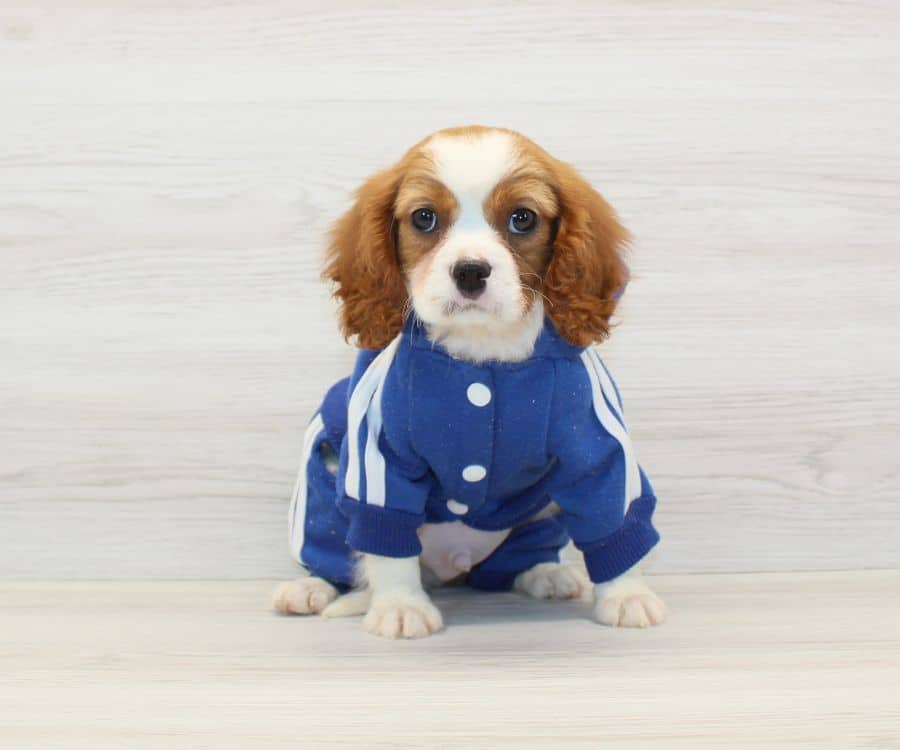
Cavalier King Charles Spaniel Puppies for Sale – The Ultimate Guide
Looking for a companion that’s as royal as it is cuddly? Our Cavalier King Charles puppies for sale offer timeless charm, sweet personalities, and loyal companionship. They’re a favorite among families, seniors, and celebrities alike.

Most “Cavalier King Charles Spaniel puppies for sale” pages are really just a list of ads from breeders you’ll never meet. At Puppy Heaven, every Cavalier puppy below is raised in-house, vet-checked, and available for a live video call before you ever put down a deposit — so you know exactly who and what you’re bringing home.
- Vet-checked, vaccinated & dewormed on schedule
- Health guarantee included with every puppy
- Meet your puppy on a live video call first
- Local pickup in Las Vegas or nationwide delivery/shipping
- Financing available
2. Why Cavaliers Are Unique
Skip the “loyal and affectionate” copy you can find on any breed wiki — here’s what actually sets the Cavalier apart from other toy breeds:
- They were never bred to have a “job.” Most small breeds were bred to guard, alert, or hunt vermin, and that instinct still shows up as barkiness, wariness of strangers, or independence. Cavaliers were bred for one purpose across 300+ years: to be a companion to whoever they’re with. That’s why they attach to people faster and more completely than most toy breeds.
- They’re spaniels first, lapdogs second. Underneath the silky coat is real sporting-dog DNA — a strong nose, a soft retrieving instinct, and genuine enthusiasm for play. That makes them noticeably more “dog-like,” biddable, and easy to train than breeds that were miniaturized purely for looks.
- Low reactivity, low aggression. Cavaliers were selectively bred against guarding and territorial instincts, so they’re unusually tolerant of strangers, other dogs, kids, and even cats — a real behavioral difference from terrier-type or spitz-type toy breeds, not just a personality quirk.
- They read people. Owners and therapy-dog handlers consistently note how closely Cavaliers track human mood and body language — part of why the breed is so often used in emotional-support and therapy roles.
- They flex between lifestyles. A Cavalier is just as content curled up in a studio apartment as trotting alongside you on a moderate hike — few toy breeds are genuinely comfortable at both ends of that spectrum.
3. Why Puppy Heaven (Trust First, Not Sales First)
We’d rather answer ten questions before your deposit than deal with one regret after. Here’s what that looks like in practice:
Full transparency on health. Ask, and we’ll show you the vet records, vaccination schedule, and deworming history for your puppy — before you commit to anything. If a breeder or site won’t show you paperwork, that’s a red flag, not just with us but anywhere you shop.
You meet the actual puppy, not a stock photo. Every Cavalier is available for a live video call so you can see real behavior — how they move, how they react to being picked up, how they respond to their name — before you travel or pay a deposit.
We’re not an anonymous listings site. Puppy Heaven operates real, physical locations in Las Vegas, NV and Sunrise, FL. You can call, text, or WhatsApp a real person, and — where local — visit in person. That’s a different model from classifieds sites that simply aggregate ads from breeders across the country with no vetting.
Health guarantee, in writing. Every puppy leaves us vet-checked and covered by our written health guarantee. Confirm exact guarantee length/terms and link to your Health & Warranty Policy page here.
We don’t disappear after the sale. Questions about feeding, training, or a vet visit six months from now? We’re still here. Confirm and describe your actual post-adoption support offering — e.g., lifetime phone/email support, breeder referral network, etc.
4. Available Cavalier King Charles Spaniel Puppies
Browse our current litter below. Each listing includes real photos, price, gender, and personality notes for that specific puppy — because “cute” isn’t enough information to base a family decision on.
Availability changes as puppies are reserved, so if you don’t see the exact color or gender you’re hoping for, join our waitlist below or check back — new Cavalier litters are added regularly. Every puppy listed is vet-checked, up to date on age-appropriate vaccinations and deworming, and covered by our health guarantee from day one.
(Dynamic product grid renders below this copy.)
5. Breed Snapshot
| Trait | Details |
|---|---|
| AKC Group | Toy Group |
| Origin | England |
| Size | Small / Toy |
| Height | 12–13 inches |
| Weight | 13–18 lbs |
| Lifespan | 12–15 years (heart health has a major influence — see Section 11) |
| Coat | Silky, medium-length, feathered ears/legs/tail |
| Recognized Colors | Blenheim, Tricolor, Ruby, Black & Tan |
| Shedding | Moderate — regular, not seasonal-only |
| Hypoallergenic | No |
| Energy Level | Moderate |
| Trainability | High — eager to please, food and praise motivated |
| Barking Level | Low to moderate; alert barker, not a nuisance barker |
| Good With Kids | Yes, with supervision |
| Good With Other Pets | Yes — one of the more naturally sociable toy breeds |
| Best Suited For | Families, seniors, first-time owners, apartment dwellers |
6. Life With a Cavalier
A Cavalier’s day revolves around wherever you are. Expect a dog that follows you from room to room, naps within arm’s reach while you work, and treats a lap as its natural resting place. Mornings tend to start with an enthusiastic (if brief) burst of zoomies, followed by a walk, and then a long stretch of calm, low-key companionship for the rest of the day.
This is a genuinely “with you” breed — which is a real joy for people who work from home, retirees, and families with someone usually around, and a real consideration for anyone who’s out of the house 10+ hours a day. Cavaliers are prone to becoming attached enough that long stretches alone can be genuinely hard on them (more in Section 8). Evenings are typically quiet: a Cavalier is far more likely to be found asleep on the couch by 8pm than getting into mischief.
They also travel well — small enough for a car ride, a hotel room, or a trip to visit family — which is part of why the breed shows up so often as a companion for people who live an active, mobile lifestyle as much as those who stay close to home.
7. Temperament
- Affectionate without being demanding. Cavaliers seek closeness but settle easily once they have it — they’re not a breed that constantly paws or vocalizes for attention.
- Gentle with strangers. Little to no wariness of new people, which makes them wonderful in social settings but means they will not function as a watchdog.
- Highly biddable. They want to please you, which makes training easier — but it also means they’re sensitive to tone. Harsh corrections tend to shut a Cavalier down rather than correct the behavior; positive reinforcement works far better.
- Playful, not hyper. Enthusiastic during play sessions, but they downshift to calm quickly afterward — a noticeably different energy pattern from more excitable toy breeds.
- Nose-driven outdoors. Their spaniel instincts mean they can get distracted following a scent off-leash — worth knowing before you assume a Cavalier will always come when called in an open space.
- Prone to separation sensitivity. Their biggest attachment to people is also their biggest vulnerability — see Sections 8 and 15 for how to manage this proactively rather than after it becomes a problem.
8. Family Compatibility
Cavaliers are widely considered one of the better toy breeds for family life, but “good with families” looks different depending on the household:
- Families with young children: Generally excellent — patient, non-snappy, and tolerant of noise and activity. Because of their small size, supervise handling so a toddler’s enthusiasm doesn’t turn into an accidental injury to the dog.
- Multi-child or busy households: A Cavalier’s adaptable, easygoing nature holds up well to a full house — they’re not a breed that needs a quiet, controlled environment to thrive.
- Seniors and retirees: A strong match — companionable, low-intensity exercise needs, and a lap-sized dog that’s easy to manage physically.
- Single professionals with long work hours: Worth a second thought. A Cavalier’s need for company is real, and a dog left alone for 9–10+ hours most days is more likely to develop separation-related stress than most other breeds.
- Multi-generational homes: One of the breed’s strongest use cases — Cavaliers tend to bond broadly across a household rather than fixating on just one person.
9. Apartment Living
Cavaliers are one of the more genuinely apartment-suited toy breeds, for reasons beyond just their size:
- Size and weight (13–18 lbs) typically clear most landlord and HOA pet-weight restrictions.
- Indoor energy is manageable — a Cavalier’s exercise needs (Section 14) can largely be met with daily walks plus indoor play; you don’t need a yard.
- Low nuisance-barking risk. They’ll alert-bark at a knock or doorbell, but they’re not a breed prone to constant reactive barking at every sound through a shared wall — a real consideration for apartment/condo living.
- Practical tips: keep a backup pad-training area for bad weather or high-rise living, use non-slip rugs on hardwood/tile (small dogs can strain joints on slick floors), and don’t rely on a balcony as unsupervised outdoor space.
10. Children & Other Pets
With children: Cavaliers are typically gentle, sturdy enough for normal family handling, and rarely show guarding or snapping behavior — but their small frame means rough play (being dropped, stepped on, or squeezed) can genuinely injure them. Supervision with very young children is about protecting the puppy, not just managing the child.
With other dogs: One of the more naturally sociable toy breeds. Because they weren’t bred for territorial guarding, they generally introduce well to resident dogs of any size, though slow, supervised introductions are still the right approach for any new pet.
With cats and small animals: Their retained spaniel instincts mean prey drive toward very small animals (rabbits, birds) is worth watching at first, but Cavaliers typically coexist calmly with cats once introduced properly.
11. Health & Genetics
This is the section most breeders gloss over — we’d rather you have the real picture.
Mitral Valve Disease (MVD) is the single most significant health concern in the breed. It’s a progressive heart condition affecting the mitral valve, and it occurs in Cavaliers at meaningfully higher rates and earlier ages than in most other breeds. Responsible breeding programs address this with annual cardiac evaluations on breeding dogs — ideally by a board-certified veterinary cardiologist — and no breeding before roughly 2.5 years of age, once early-onset cases would have shown up.
Syringomyelia (SM) and Chiari-like malformation (CM) are neurological conditions affecting fluid flow around the brain and spinal cord, also reported at elevated rates in the breed. Signs can include neck sensitivity or scratching near the ear/neck area without direct contact. Serious breeding programs screen stud dogs with MRI where available.
Hip dysplasia and patellar luxation are joint conditions the national breed club recommends screening for via OFA hip and patella evaluations.
Eye conditions, including retinal dysplasia, are why an annual ophthalmologist evaluation is part of the recommended screening panel.
Ear infections are common simply due to the breed’s long, heavy, low-set ears trapping moisture and reducing airflow — a maintenance issue more than a genetic one (see Grooming, Section 12).
Put together, the national breed club’s minimum recommended screening panel for breeding dogs is: a cardiac exam, a hip evaluation, a patella evaluation, and an ophthalmologist eye exam.
What we do: every Puppy Heaven puppy is vet-checked and current on age-appropriate vaccinations and deworming before going home, and is covered by our written health guarantee. If you can state specifics like “our breeding partners provide cardiac and eye clearances on request, say so; if you can’t yet confirm that, don’t claim it. We’d rather you ask us directly for a puppy’s specific health records than take a generic claim at face value — and we encourage a follow-up exam with your own vet within some days of bringing your puppy home.
12. Grooming
- Brushing: 3–4 times per week to prevent matting in the feathering behind the ears, on the legs, chest, and tail.
- Bathing: Every 4–6 weeks, or as needed — over-bathing can dry out the coat and skin.
- Ears: Check and clean weekly. Because of the infection risk noted in Section 11, this is one of the more important routine habits for the breed — dry thoroughly after baths or swimming.
- Nails: Trim every 3–4 weeks.
- Teeth: Brush several times a week; small breeds are prone to dental disease, and dental health is linked to heart health in dogs with cardiac risk.
- Professional grooming: Every 6–8 weeks for a trim, sanitary clean-up, and paw pad maintenance.
13. Nutrition
Feed a high-quality small/toy-breed formula appropriate to life stage — puppy formula until roughly 10–12 months, then a small-breed adult formula, transitioning to a senior formula around age 8 (see Section 11 for why senior wellness visits matter more from that point on).
Portion control matters more for this breed than most. Cavaliers are food-motivated and prone to weight gain, and excess weight isn’t just a cosmetic issue here — added weight puts extra strain directly on the joints (relevant to patellar luxation) and the heart (relevant to MVD). Keeping a Cavalier lean is one of the most genuinely protective things an owner can do, not just a general wellness tip.
- Puppies: 3–4 small meals per day
- Adults: 2 measured meals per day
- Treats: no more than ~10% of daily calories
- Fresh water available at all times
14. Exercise
30–45 minutes per day, split across a walk and some play, is enough for most adult Cavaliers — this is a moderate-energy breed, not a high-drive one.
- Avoid intense exercise in heat or high humidity; small-breed dogs, and especially any Cavalier with even mild MVD, tolerate heat stress poorly.
- Keep off-leash time in enclosed, safe areas — their spaniel nose can override recall once they catch an interesting scent.
- Puppies should not be pushed into forced, repetitive exercise (like long runs or excessive stair use) while growth plates are still open, roughly through 12 months — a common guideline is about 5 minutes of structured exercise per month of age, twice a day, until fully grown.
- Mental stimulation matters as much as physical: puzzle feeders and scent-based games tap into their spaniel instincts and tire them out without physical strain.
15. Training
Cavaliers are genuinely easy to train relative to most toy breeds — they’re biddable, food-motivated, and want to please. A few breed-specific notes:
- Use positive reinforcement. Harsh corrections tend to make a Cavalier shut down or become anxious rather than correct the behavior — reward-based training works dramatically better with this temperament.
- Housetraining can take longer than expected, not because Cavaliers are stubborn but because small breeds have small bladders. Consistent scheduling and crate training speed this up significantly.
- The socialization window (roughly 3–14 weeks) is the single highest-leverage period for exposing a puppy to new people, sounds, textures, and calm dogs — habits formed here shape confidence for life.
- Recall training deserves extra attention given their scent-driven distractibility outdoors (see Section 14).
- Build independence deliberately. Because Cavaliers attach so strongly, practicing short, calm separations early (a few minutes in another room, a comfortable crate/mat routine) helps prevent the separation-related anxiety this breed is genuinely prone to later.
16. Choosing the Right Puppy
- Ask for health documentation — parent health clearances or vet records for the puppy — before you get attached to a specific pup. Any breeder should be comfortable with this request.
- Watch temperament, not just looks. During a video call or visit, notice how the puppy reacts to being picked up, to a new sound, or to a sibling — confident and curious versus persistently fearful tells you more than coat color ever will.
- Coat color is cosmetic only. Blenheim, Tricolor, Ruby, and Black & Tan are equally “Cavalier” — there’s no meaningful temperament or health difference by color, despite what some marketing implies.
- Male vs. female differences are minimal and individual in this breed — base your choice on the specific puppy’s personality rather than assumptions about sex.
- Get the guarantee in writing before paying a deposit, and read it before you need it.
- Use the video call. It’s the single best way to confirm the puppy you’re seeing is the actual puppy you’ll receive.
17. Puppy Development
| Age | Stage |
|---|---|
| 0–2 weeks | Neonatal — eyes/ears closed, fully dependent on mother |
| 2–4 weeks | Transitional — eyes open, first steps, milk teeth begin |
| 3–12 weeks | Critical socialization window — the most important stretch for shaping lifelong confidence |
| 8–10 weeks | Typical age puppies go to their new homes |
| 3–6 months | Teething and early adolescence; growth plates still open |
| 6–12 months | Reaching adult size (13–18 lbs), hormonal adolescence, boundary-testing is normal |
| 12–18 months | Physically and emotionally mature |
18. What Makes Our Puppies Different
- Raised in a home, not a kennel run. Our puppies are handled daily from birth and exposed early to normal household sounds and gentle human contact — not isolated until sale.
- Started on potty training before they leave us. Most of our puppies go home already largely pad-trained, which meaningfully shortens the adjustment period for new owners.
- Full vet protocol before going home: vet-checked, age-appropriate vaccinations, deworming on schedule, and covered by our written health guarantee.
- A starter kit comes with every puppy — food, wee-wee pads, and a toy — so your first 24 hours at home aren’t a scramble.
- You see the real puppy first, via live video call, before any commitment.
19. Adoption Process
- Browse available Cavalier puppies above and compare photos, pricing, and personality notes.
- Schedule a video call to meet your puppy directly and ask any questions.
- Reserve your puppy with a deposit (financing available — see our financing page).
- Review and sign the health guarantee and purchase paperwork.
- Choose pickup or delivery — visit our Las Vegas location in person, or arrange nationwide shipping/delivery.
- Bring your puppy home with your starter kit and care guidance in hand.
- Stay in touch — we’re available for questions well after pickup day.
20. Preparing Your Home
Puppy-proofing:
- Secure loose cords, small objects, and anything chewable at floor level (toy breeds face a real choking/foreign-object risk)
- Block stairs and furniture gaps a small puppy could fall through or get stuck in
- Remove toxic houseplants from reachable areas
Supplies checklist:
- Crate sized for a small breed
- Bed, food/water bowls
- Small-breed puppy food
- A harness rather than a collar for leash walks (gentler on a small dog’s neck/trachea)
- Baby gates if needed
- ID tag and microchip registration
Before pickup day:
- Choose a vet in advance and schedule your puppy’s first visit within few days of bringing them home, per our health guarantee terms
- Set up a quiet, contained space for the first few nights — a new home is overwhelming even for a confident puppy
21. Cost of Ownership
Upfront costs
| Item | Estimated Cost |
|---|---|
| Puppy purchase price | $1,800 – $4,500+ (varies by pedigree, color, breeder) |
| Initial supplies (crate, bed, bowls, harness, toys) | $150 – $300 |
| First vet visit/wellness exam | $75 – $150 |
| Spay/neuter (if not already done) | $150 – $500 |
| Microchip | $25 – $50 |
Ongoing annual costs
| Item | Estimated Cost/Year |
|---|---|
| Small-breed food | $300 – $500 |
| Routine vet care & vaccinations | $200 – $400 |
| Professional grooming | $300 – $600 |
| Pet insurance | $300 – $600 |
| Toys, treats, miscellaneous | $100 – $200 |
Given how consistently heart and joint conditions show up in this breed’s health profile (Section 11), pet insurance is worth budgeting for specifically with a Cavalier — more so than with many other small breeds, where it’s a nice-to-have rather than a genuinely protective expense.
Rough total, year one (including puppy price): $3,000 – $6,500+ Rough ongoing annual cost after year one: $1,200 – $2,500
22. FAQs
Are Cavalier King Charles Spaniels good for first-time dog owners?
Yes — their trainability, adaptable size, and even temperament make them one of the more forgiving toy breeds for a first-time owner.
Are Cavaliers hypoallergenic?
No. They shed moderately year-round. No dog breed is truly hypoallergenic, and Cavaliers are not marketed as low-shedding.
Do Cavalier King Charles Spaniels bark a lot?
Generally low to moderate. They’ll alert-bark at a knock or new sound but aren’t known for constant or reactive barking.
How much does a Cavalier King Charles Spaniel puppy cost?
Typically $1,800–$4,500+, depending on pedigree, color, and breeder. See Section 21 for a full cost-of-ownership breakdown.
What is the lifespan of a Cavalier King Charles Spaniel?
Commonly cited at 12–15 years, though heart disease (Section 11) is the leading factor that can shorten that range — which is exactly why health screening and ongoing cardiac monitoring matter so much with this breed.
Are “teacup” Cavaliers real?
Not as an official variety. The standard Cavalier is already toy-sized (13–18 lbs). Puppies marketed as “teacup” and dramatically under that weight are typically undersized outliers, not a recognized type, and extreme miniaturization can carry added health risk rather than being a bonus feature.
Can Cavaliers be left alone during the day?
For short periods, yes — but this is a breed genuinely prone to separation-related stress with long, regular absences (8–10+ hours). If your household is empty most of the day, plan for a dog walker, daycare, or a lot of early independence training.
Do you offer delivery or shipping?
Yes — local pickup is available at our Las Vegas store, and we offer delivery and nationwide shipping across the U.S. and Canada. [Confirm current delivery regions/costs and link to your shipping policy page.
Do you offer financing?
Yes, financing is available for qualified buyers — see our financing page for details.
What health guarantee comes with a Puppy Heaven Cavalier?
Every puppy is vet-checked and covered by our written health guarantee.