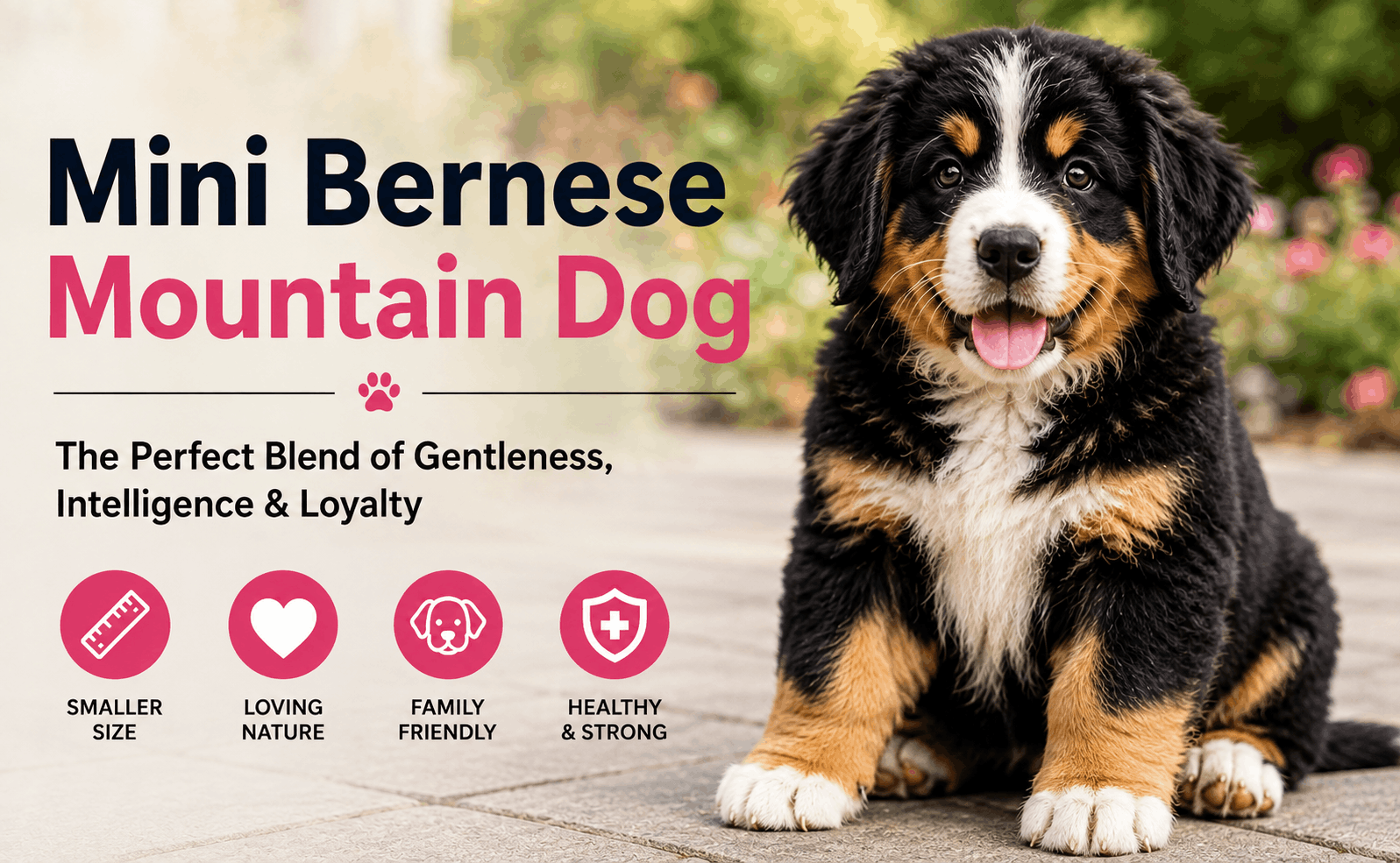
Quick answer: A Mini Bernese Mountain Dog isn’t a “shrunk down” purebred — it’s a crossbreed, usually a Bernese Mountain Dog paired with a Cavalier King Charles Spaniel (sometimes a Poodle or Sheltie). Full grown, most land between 25–50 lbs and 12–20 inches tall, live 10–14 years, and keep the classic black, white, and rust tri-color coat with a much calmer, more manageable size than the 80-115 lb original.
If you’ve fallen in love with the Bernese Mountain Dog’s teddy-bear face and gentle heart but the idea of a 100-pound dog shedding on your couch makes you nervous, you’re exactly who this guide is for. We dug through dozens of breeder sites, vet resources, and owner forums so you don’t have to — and pulled together the one guide that actually answers every question people search for about this breed, in one place, in plain English.
What’s in This Guide
- What Exactly Is a Mini Bernese?
- Where They Came From
- Size, Weight & Growth Chart
- Coat, Colors & Appearance
- Temperament & Personality
- Lifespan & Health
- Price: What They Actually Cost
- Daily Care, Food & Exercise
- Grooming Needs
- Training & Socialization
- Mini Bernese vs Bernedoodle vs Cavapoo
- How to Buy One the Right Way
- Frequently Asked Questions
What Exactly Is a Mini Bernese Mountain Dog?
Here’s the thing almost nobody explains clearly: there is no such thing as a purebred “Mini Bernese Mountain Dog.” The American Kennel Club recognizes exactly one Bernese Mountain Dog, and it’s a big one — the mini version you’re picturing is always the result of deliberate crossbreeding.
Breeders create a Mini Bernese, sometimes called a Bernalier, Mini Berner, or Miniature Bernese, in one of a few ways:
- Cavalier cross: The most common route — a Bernese Mountain Dog bred with a Cavalier King Charles Spaniel, which brings down the size while keeping a similar face and coat.
- Poodle cross: Technically this produces a Mini Bernedoodle rather than a “Mini Bernese” — the names get used interchangeably online, which is a huge source of confusion for buyers, so always ask a breeder exactly which parent breeds are behind a specific litter.
- Runt breeding or a dwarfism gene: A small number of breeders select for naturally smaller purebred Bernese, though this is far less common and can carry its own health considerations.
Whichever path a breeder takes, the goal is the same: keep everything people love about the Bernese — the loyalty, the calm nature, the striking tri-color coat — in a body that fits into an apartment, a condo, or a car back seat without a struggle.
Where the Breed Came From
To understand the mini version, it helps to know the original. The Bernese Mountain Dog is one of four Swiss mountain dog breeds, developed in the farmland around Bern, Switzerland, where they pulled carts, herded cattle, and guarded property for generations. Swiss farmers valued them for being strong enough to work all day and gentle enough to be trusted around children in the evening. The American Kennel Club officially recognized the breed in 1937, and it slowly built a devoted following in the U.S. for exactly that combination — a giant dog with a soft heart.
The miniature version is a much newer idea, part of a broader wave of designer breeding that took off in the 2000s and 2010s as more people started living in apartments and smaller homes but still wanted that classic Bernese look and temperament. Breeders realized that pairing a Bernese with a naturally small, affectionate breed like the Cavalier could deliver 80% of the look with a fraction of the space requirements — and the Mini Bernese was born.
Size, Weight & Growth Chart
This is the number one thing people search for, and it’s also the number one thing that varies the most — because a mixed breed inherits size genes unpredictably from both parents. That said, here’s the range you can realistically expect:
| Measurement | Typical Range |
|---|---|
| Full-grown weight | 25 – 50 lbs |
| Height at the shoulder | 12 – 20 inches |
| Standard Bernese for comparison | 80 – 115 lbs, 23 – 27.5 inches |
| Time to reach full size | 12 – 18 months |
Since this is a mixed breed, the size of a specific puppy depends heavily on which parent it takes after. A puppy with a smaller Cavalier-dominant build might stay closer to 25 lbs, while one that leans toward the Bernese side could push past 50 lbs. Any breeder should be able to show you the size of both parents so you have a realistic expectation before you bring a puppy home — this is one of the first questions you should ask.
Rough growth stages to expect:
- Birth to 2 months: 5–10 lbs, still round and clumsy, mostly sleeping and nursing.
- 3–4 months: 10–20 lbs, this is when the legs start to look “too long” for the body — completely normal.
- 6 months: Often 60–70% of adult weight, coat starting to show its real texture.
- 12 months: Close to full height, may still be filling out muscle and chest depth.
- 18 months: Fully mature, both physically and — usually — a bit more settled mentally.
Coat, Colors & Appearance
The signature look is a tri-color coat — jet black as the base, with rust/tan markings above the eyes, on the cheeks, chest, and legs, and crisp white on the chest, muzzle, and paw tips. Most Mini Bernese keep this pattern faithfully since it’s a dominant, recognizable marking in the Bernese line. Some litters, especially those with more Cavalier influence, may show a slightly wavier coat texture or softer facial features than a purebred Bernese.
Coat length is typically medium — not as long and heavy as a standard Bernese’s double coat, but not short either. It can have a slight wave, especially around the ears and tail, which is usually inherited from the Cavalier or Poodle side.
Temperament: What Living With One Is Really Like
If there’s one word that shows up in almost every conversation about this breed, it’s “velcro.” These dogs bond hard and fast, and they genuinely prefer being near their people to being anywhere else in the house.
- Affectionate to a fault: They aren’t a breed that’s happy being left alone in the yard — they want to be in the room with you, ideally touching you.
- Calm indoors: Compared to high-energy designer breeds, Mini Bernese tend to have an “off switch” once their exercise needs are met for the day.
- Great with kids: Their patience and gentle nature, inherited from both parent breeds, make them a popular pick for families.
- Good with other pets: With early socialization, they typically do well alongside other dogs and cats.
- Can be reserved with strangers: Not usually aggressive, but they may take a little time to warm up to new people — a trait inherited from the Bernese side.
- Prone to separation anxiety: Because they bond so closely, long stretches alone are genuinely hard on this breed. If your household is empty for 9+ hours a day, it’s worth thinking hard about whether the timing is right.
Lifespan & Health Considerations
One of the real advantages of going mini is lifespan. Standard Bernese Mountain Dogs are, unfortunately, one of the shorter-lived large breeds, often living only 7–10 years, largely due to a higher rate of certain cancers in the purebred line. Mixing in a smaller, generally hardier breed like the Cavalier tends to widen the gene pool and can push average lifespan for a Mini Bernese up to roughly 10–14 years, though individual results vary by breeding line.
Health issues to ask a breeder about and to discuss with your vet include:
- Hip and elbow dysplasia — inherited from the Bernese side; ask whether the parents have had hip/elbow screening (such as OFA evaluations).
- Mitral valve disease — a known concern in Cavalier King Charles Spaniels, so cardiac screening on the Cavalier parent matters.
- Von Willebrand’s disease — a clotting disorder that can appear in Bernese lines; reputable breeders test for it.
- Ear infections — floppy ears trap moisture, so regular ear cleaning is part of routine care.
- Weight gain — this breed loves food and doesn’t always self-regulate, so portion control matters more than you’d expect for a “small” dog.
None of this should be alarming — it’s simply the same due-diligence checklist you’d want for any crossbreed. A responsible breeder will happily share health clearances for both parent dogs.
Mini Bernese Mountain Dog Price: What They Actually Cost
Prices vary a lot depending on the breeder, the bloodline, and the region — and this is a spot where a lot of competitor articles either give one vague number or skip the topic entirely. Here’s a realistic breakdown of what buyers report seeing across the market:
| Source | Typical Price Range |
|---|---|
| Casual/backyard breeder | $800 – $1,800 |
| Established specialty breeder | $1,800 – $3,500+ |
| Rare coloring or markings | $3,000 – $4,000+ |
| First-year total cost of ownership | $700 – $1,500 (food, vet visits, supplies) |
A word of caution that’s genuinely worth repeating: the cheapest puppy is rarely the cheapest dog. A low upfront price often means the breeder skipped health testing on the parents, which can translate into thousands of dollars in vet bills — and heartbreak — down the road. Whatever budget you’re working with, ask for documentation of health testing, vaccination records, and a written health guarantee before you commit.
Daily Care, Food & Exercise
Exercise: Moderate is the right word here. A brisk 30–45 minute walk plus some playtime is usually plenty — this isn’t a breed that needs to run for miles, but it does need consistent daily movement to stay at a healthy weight and avoid boredom-driven mischief.
Feeding: A high-quality food formulated for medium-breed dogs works well. Because this breed tends to gain weight easily, measuring meals rather than free-feeding is a smart habit from puppyhood on. Puppies typically eat 3 times a day, tapering to 2 meals a day by around 6 months.
Living space: One of the biggest appeals of the mini version — they genuinely do well in apartments and condos, as long as they’re getting their daily walk. They’re not a breed that needs acres of land to be happy; they need you.
Grooming Needs
- Brushing: 2–3 times a week to manage shedding and prevent mats, more often during seasonal coat blow.
- Bathing: Every 4–6 weeks, or as needed if they’ve been rolling in something they shouldn’t have.
- Ears: Check and clean weekly — floppy ears are prone to trapping moisture and wax.
- Nails: Trim every 3–4 weeks to avoid discomfort when walking.
- Shedding level: Moderate — noticeably less than a standard Bernese, but this is not a hypoallergenic breed unless there’s significant Poodle in the mix.
Training & Socialization
This breed is generally eager to please, which makes early training go smoothly — but they can also inherit a streak of Bernese stubbornness, so consistency matters more than force. Positive reinforcement (treats, praise, short sessions) works far better than harsh correction with this temperament.
Start socialization early: exposure to different people, dogs, sounds, and environments between 8 and 16 weeks makes a real difference in raising a confident adult dog rather than one that’s shy or reactive around strangers. Puppy classes are a great structured way to check this box.
Mini Bernese vs Bernedoodle vs Cavapoo: Which One Fits You?
This is one of the most common points of confusion, so let’s clear it up directly.
| Breed | Parents | Coat | Best For |
|---|---|---|---|
| Mini Bernese | Bernese x Cavalier | Moderate shed, tri-color | Calm, laid-back families |
| Bernedoodle | Bernese x Poodle | Low-shed, curlier, often hypoallergenic | Allergy-prone households |
| Cavapoo | Cavalier x Poodle | Soft, wavy, low-shed | Smaller apartments, first-time owners |
If your top priority is a low-shedding coat for allergies, the Bernedoodle line usually wins out. If you want the smallest possible lap dog with the same gentle energy, a Cavapoo is worth a look. f you want the closest thing to the classic Bernese look and temperament in a body that fits your apartment, the Mini Bernese is the one to focus on. It’s worth browsing our full lineup of Mini Doodles side by side before deciding — seeing the size, coat, and personality differences in person (or on a video call) makes the decision a lot easier than reading specs alone.
How to Buy a Mini Bernese the Right Way
Because this is a crossbreed with no official registry standard, buying one requires a bit more homework than picking up a purebred from a well-documented line. Here’s a straightforward checklist:
- Ask which parent breeds are actually involved. “Mini Bernese” gets used loosely — confirm whether it’s Cavalier, Poodle, or something else.
- Request health clearances for both parents. Hip/elbow screening for the Bernese side, cardiac screening for the Cavalier side.
- Meet the parents (in person or by video call) to get a real sense of the size and temperament your puppy is likely to grow into.
- Get everything in writing. A health guarantee, vaccination records, and a clear return/refund policy protect you if something goes wrong.
- Ask about socialization practices. Puppies raised around household noise, children, and gentle handling settle into new homes far more easily.
- Avoid rock-bottom prices. As covered above, unusually cheap puppies are a red flag for skipped health testing.
At PuppyHeaven, every puppy is vet-checked, up to date on age-appropriate vaccinations and deworming, and comes with a health guarantee, microchipping, and a starter kit to make the first few days at home easier. We also offer live video calls so you can meet a puppy — and often see the parents — before making any commitment, along with financing and nationwide delivery from our Las Vegas, NV and Sunrise, FL locations. You can browse our current Available Puppies to see who’s ready for a new home right now.
Frequently Asked Questions
How big does a Mini Bernese Mountain Dog get full grown?
Most reach 25–50 lbs and stand 12–20 inches tall at the shoulder, though the exact size depends on which parent breed traits dominate.
Is a Mini Bernese Mountain Dog hypoallergenic?
Not typically. Unless there’s significant Poodle in the mix, this breed sheds a moderate amount — noticeably less than a standard Bernese, but it isn’t considered a true hypoallergenic breed.
How long do Mini Bernese Mountain Dogs live?
Typically 10–14 years, which is meaningfully longer than the 7–10 year average for standard purebred Bernese Mountain Dogs.
Are Mini Bernese Mountain Dogs good with kids?
Yes — they’re widely described as gentle, patient, and affectionate, making them a popular choice for families, though any dog-child interaction should still be supervised.
Do Mini Bernese Mountain Dogs bark a lot?
Generally no — they’re not known as an excessively vocal breed, though they may alert-bark at strangers before warming up.
Can a Mini Bernese Mountain Dog live in an apartment?
Yes, quite well, as long as it gets a daily walk and regular attention. Its calmer indoor energy makes it much more apartment-friendly than a full-sized Bernese.
What’s the difference between a Mini Bernese and a Mini Bernedoodle?
A Mini Bernese is typically a Bernese Mountain Dog crossed with a Cavalier King Charles Spaniel, while a Mini Bernedoodle is a Bernese crossed with a Poodle. The Bernedoodle tends to have a curlier, lower-shedding coat.
How much does a Mini Bernese Mountain Dog cost?
Prices generally range from around $800 for casual breeders up to $3,500 or more from established breeders with health-tested bloodlines and rarer coloring.
Do Mini Bernese Mountain Dogs need a lot of exercise?
Moderate exercise — around 30 to 45 minutes of daily activity is usually enough to keep them healthy and content.
What health problems are common in Mini Bernese Mountain Dogs?
Hip/elbow dysplasia, mitral valve disease, and Von Willebrand’s disease are the main concerns to screen for, since they can appear in the Bernese and Cavalier parent lines.
Ready to find your Mini Bernese?
PuppyHeaven has specialized in teacup and toy breeds for over 21 years, with more than 30,000 happy placements across our Las Vegas, NV and Sunrise, FL locations. Every puppy is vet-checked, comes with a health guarantee, microchipping, and a starter kit — with financing and nationwide delivery available. Browse our Available Puppies today, or compare against our Bernedoodle and Cavapoo litters to see which fits your family best.