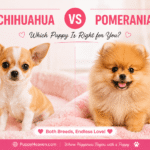
Two small dogs. Two massive personalities. If you’re trying to choose between a Chihuahua and a Pomeranian, you’re not alone — these are two of the most searched toy breeds in the country, and for good reason. Both fit in apartments. Both live long lives. Both think they weigh 80 pounds.
But they are not the same dog. The Chihuahua bonds fiercely to one person and is the lower-maintenance option. The Pomeranian is a social butterfly wrapped in a double coat that needs daily brushing. Pick the wrong one and you’ll spend years explaining to your dog why it needs to stop barking at the mailman (or, well, brushing).
At Puppy Heaven, we’ve matched thousands of families with the right tiny breed over 21+ years. This guide covers everything: size, temperament, grooming, health, training, cost, and who each breed actually suits. By the end, you’ll know exactly which puppy belongs in your home.
1. Chihuahua vs Pomeranian: Quick Comparison
| Trait | Chihuahua | Pomeranian |
|---|---|---|
| Weight | 2–6 lbs (Toy); under 4 lbs (Teacup) | 3–7 lbs (Toy); under 4 lbs (Teacup) |
| Height | 5–8 inches | 6–7 inches |
| Coat Type | Short or long; single or double layer | Dense double coat; always fluffy |
| Grooming | Low (smooth coat) to moderate (long coat) | High — daily brushing needed |
| Shedding | Low to moderate | Moderate to high |
| Temperament | Loyal, bold, one-person dog | Friendly, outgoing, social |
| Barking | Moderate — alert barker | Frequent — vocal and expressive |
| Lifespan | 14–16 years (some reach 18+) | 12–16 years |
| With Kids | Best with older children (8+) | Better with children; still needs supervision |
| With Strangers | Reserved to wary | Friendly and curious |
| Training | Smart but stubborn; needs consistency | Smart but stubborn; needs consistency |
| Exercise | 20–30 min/day | 30–40 min/day |
| Apartment Friendly | Excellent | Excellent |
| Puppy Price (Puppy Heaven) | $2,000–$5,000 | $2,500–$5,500 |
| AKC Group | Toy Group | Toy Group |
| Origin | Mexico | Poland/Germany (Pomerania region) |
2. Size & Appearance: Easier to Tell Apart Than You’d Think
People often lump these two together because both are tiny. But stand them side by side and they look nothing alike.
Chihuahua Appearance
The Chihuahua comes in two head shapes: the apple head (round, domed skull, pronounced stop between the nose and forehead) and the deer head (longer snout, flatter skull, more like a small deer). Apple heads are the AKC standard; deer heads tend to be a bit larger and often have fewer health issues related to the skull.
Their eyes are large, round, and very expressive — one of the most recognizable features of the breed. Ears stand fully erect. The body is compact and fine-boned. Coats come in two varieties: smooth (short) and long-haired, in dozens of color combinations including black, fawn, cream, chocolate, blue, and white.
A standard Chihuahua weighs 2–6 lbs and stands 5–8 inches tall. A Teacup Chihuahua weighs under 4 lbs as an adult.
Pomeranian Appearance
The Pomeranian looks like a small fox wearing a fluffy ball costume. Their most defining feature is the thick double coat that stands away from the body, giving them a perfectly round silhouette. The tail curls up and fans over the back. The face is fox-like with small, alert eyes and two upright ears that often get lost in the fur.
The most common color is orange, but Pomeranians also come in black, white, cream, blue, chocolate, merle, sable, and brindle patterns. Weight sits between 3–7 lbs; height 6–7 inches. A Teacup Pomeranian stays under 4 lbs.
How to Tell Them Apart at a Glance
- If the dog looks like a fluffy ball and you can’t see the body shape: Pomeranian
- If the fur lies closer to the body and the eyes look huge relative to the face: Chihuahua
- If the tail curls flat over the back: Pomeranian (Chihuahua tails curve but don’t fan)
- If the skull is obviously round and domed: Chihuahua (apple head)
3. Temperament & Personality: One-Person Dog vs Social Butterfly
This is the most important difference between the two breeds and the one most likely to determine which one is right for your household.
Chihuahua Temperament
Chihuahuas form an intense, almost obsessive bond with their primary person. Once they’ve chosen you, you are their whole world. They’ll follow you from room to room, curl up on your lap the moment you sit down, and alert bark at anyone who looks at you sideways. That loyalty is beautiful — and it comes with some caveats.
Around strangers, many Chihuahuas are reserved to defensive. They’re not necessarily aggressive, but they are protective. They use barking and posturing to communicate discomfort. With proper early socialization, a Chihuahua puppy grows into a more confident adult — but their base temperament leans toward caution with new people and situations.
Chihuahuas are also one of the few small breeds that commonly do better in single-dog households, or at minimum alongside other Chihuahuas. They can be territorial with dogs they don’t know.
On the positive side: the Chihuahua is deeply affectionate with their person, endlessly entertaining, and surprisingly brave. They do not know or care that they are small. Many Chihuahua owners describe them as the best friend they’ve ever had in a 4-pound body.
Pomeranian Temperament
Pomeranians are the extroverts of the toy breed world. They greet strangers with curiosity rather than suspicion. They enjoy meeting new people, engage with everyone in the household rather than fixating on one person, and tend to integrate better into multi-person families.
Their energy is more “performance art” than the Chihuahua’s intense loyalty. Pomeranians like being watched, talked to, and played with. They are vocal about opinions, quick to bark at sounds, and generally unaware that their size limits what they can realistically take on.
The Pomeranian temperament sits closer to a small Husky or Spitz than a typical lap dog. They are alert, lively, always ready to engage. That social energy is wonderful for active families — and something to manage if you live in a noise-sensitive building.
Head-to-Head: Temperament Summary
| Situation | Chihuahua | Pomeranian |
|---|---|---|
| Bond with primary owner | Intense, exclusive | Strong but shared |
| With strangers | Reserved / cautious | Friendly / curious |
| With multiple family members | Prefers one person | Bonds with whole family |
| Energy level | Moderate to high in bursts | Consistently high energy |
| Separation anxiety | Common | Common |
| Barking trigger | Alert / protective | Social / reactive |
4. Grooming: Big Difference Between These Two Breeds
If you hate brushing dogs, get a smooth-coat Chihuahua. If you don’t mind it (or enjoy it), a Pomeranian’s coat is genuinely beautiful when properly maintained. This is one of the biggest practical differences in daily ownership.
Chihuahua Grooming
Smooth-coat Chihuahua: Minimal grooming. A quick once-over with a rubber grooming mitt once or twice a week is usually enough. They shed lightly year-round with a heavier season in spring and fall. Bathing every 4–6 weeks keeps the coat clean.
Long-coat Chihuahua: Needs brushing several times a week to prevent tangles, especially behind the ears and in the “skirt” (the fur around the chest and legs). Shedding is moderate. Still significantly less work than a Pomeranian.
Both varieties need the same nail trims (every 3–4 weeks), ear cleaning, and — critically — daily tooth brushing. Chihuahuas are especially prone to dental disease due to their crowded small mouths.
Pomeranian Grooming
The Pomeranian’s double coat is its most recognizable feature and its biggest maintenance commitment. Daily brushing is not optional if you want to prevent matting. Use a slicker brush and a metal comb to work through the undercoat, not just the outer layer.
Pomeranians blow their undercoat twice a year, during which shedding is dramatic. A de-shedding tool helps manage this period. Professional grooming every 6–8 weeks for trimming and a full brush-out is the standard for most Pomeranian owners — expect to spend $60–$120 per grooming session depending on your area.
One important note: never shave a Pomeranian’s coat unless directed by a vet. Pomeranians are prone to a condition called “Pom Alopecia X” (Black Skin Disease), and improper shaving can permanently damage coat regrowth. Always work with a groomer who knows the breed.
5. Health & Lifespan: Both Long-Lived, Different Concerns
Both breeds are generally healthy and among the longest-living dogs you can own. The differences show up in what conditions to watch for and budget for.
Chihuahua Health
Chihuahuas live 14–16 years on average, with many reaching 18 or beyond. They are one of the longest-lived dog breeds in the world.
Common health concerns:
- Dental disease — the #1 health issue in Chihuahuas. Small mouth, crowded teeth. Daily brushing and annual professional dental cleanings are essential.
- Patellar luxation — loose kneecaps, common in small breeds. Mild cases managed with joint supplements; severe cases may require surgery.
- Hypoglycemia — especially in Teacup Chihuahuas. Small body mass can’t store glucose. Feed small, frequent meals and watch for lethargy or trembling.
- Hydrocephalus — fluid on the brain, associated with the apple-head skull shape. Reputable breeders screen for this.
- Heart murmurs — more common in seniors. Annual cardiac checks after age 7 are recommended.
- Tracheal collapse — use a harness instead of a collar to reduce neck strain.
- Cold sensitivity — Chihuahuas shiver easily. A sweater or jacket in cooler weather is practical, not just cute.
Pomeranian Health
Pomeranians live 12–16 years. Slightly shorter than Chihuahuas on average, but still an excellent lifespan for a toy breed.
Common health concerns:
- Patellar luxation — shared with Chihuahuas; common in toy breeds generally.
- Tracheal collapse — use a harness, not a collar. This is especially important for Pomeranians.
- Dental disease — same issues as Chihuahuas; small mouths mean crowded teeth.
- Alopecia X (Black Skin Disease) — a Pom-specific condition where the coat falls out and skin darkens. Not fully understood; linked to hormonal imbalance.
- Hypothyroidism — affects energy, coat quality, and weight. Manageable with medication once diagnosed.
- Congestive heart failure — more common in senior Pomeranians. Annual cardiac checks recommended after age 7.
- Eye issues — cataracts and dry eye occur in some lines.
Health Tips That Apply to Both Breeds
- Buy from a breeder who performs health testing on parent dogs
- Schedule dental cleanings under anesthesia annually in senior years
- Keep weight lean — obesity shortens life significantly in both breeds
- Use a harness, not a collar, for all walks and outings
- Enroll in pet insurance early (before conditions develop)
At Puppy Heaven, every puppy comes with a full vet health check, current vaccinations, microchipping, and a written health guarantee before leaving our care. Learn more about our health guarantee and puppy care program.
6. Exercise & Energy: Small Dogs, Real Exercise Needs
Both breeds are often mistaken for purely sedentary lap dogs. They’re not. Both need daily movement to stay healthy and avoid the behavioral problems that come from boredom — excessive barking, destructive behavior, and anxiety.
How Much Exercise Each Breed Needs
Chihuahua: Two short walks daily (10–15 minutes each) plus indoor play is enough. A single 20–30 minute walk is fine on days when indoor play compensates. Chihuahuas love to chase toys, play hide and seek, and wrestle with a rope toy. They tire faster than Pomeranians and are content to nap for long stretches.
Pomeranian: A bit more demanding. Two 15–20 minute walks plus active indoor play is the standard. Pomeranians have more sustained energy than Chihuahuas and may become destructive or bark-heavy if under-exercised. Puzzle toys and training sessions count as mental exercise and are valuable for this breed.
Neither breed should go on long runs or extended hikes — their small bodies, short legs, and susceptibility to overheating make long-distance exercise risky. Watch for signs of overheating in hot weather: excessive panting, drooling, or stumbling.
7. Training & Intelligence: Both Smart, Both Stubborn
A point of confusion: people sometimes assume small dogs are easier to train because bad behavior from a 5-pound animal seems less serious. That’s backwards thinking. The habits you allow a Chihuahua or Pomeranian puppy to develop become permanent personality traits. The good news: both breeds are genuinely intelligent and respond well to training when it starts early.
Chihuahua Training
Chihuahuas are fast learners with sharp memories. They pick up commands quickly — but they also decide quickly whether they feel like following them on a given day. Positive reinforcement (treats, praise, short sessions of 10–15 minutes) works far better than correction-based methods. Chihuahuas become anxious and shut down when trained harshly.
Priority areas for Chihuahua training:
- Socialization with strangers and other dogs — start at 8–12 weeks
- Leash manners — Chihuahuas pull surprisingly hard for their size
- Crate training — reduces separation anxiety significantly
- Bite inhibition — important given their tendency to snap when uncomfortable
Pomeranian Training
Pomeranians are highly trainable and enjoy the challenge. They do well in puppy classes, pick up tricks quickly, and thrive when training feels like a game. The challenge with Pomeranians is barking — they are vocal by nature and training “quiet” takes patience and consistency.
Priority areas for Pomeranian training:
- Bark control — “quiet” command and desensitization to triggers
- Not jumping on people — Poms greet everyone enthusiastically
- Recall (come when called) — important if you ever let them off-leash
- Resource guarding — Poms can be territorial about toys and food
Both breeds benefit from starting training the first week they come home. Check our guide on raising a healthy toy breed puppy for more tips.
8. With Kids & Other Pets
Children
Both breeds are physically fragile. A child who doesn’t know how to handle a small dog can accidentally injure a Chihuahua or Pomeranian — a drop from even waist height can break bones. This is the primary concern with children, not aggression.
Chihuahua + children: Best in households with children 8 and older who understand gentle handling. Chihuahuas are more likely to snap when startled or handled roughly, and their one-person bonding style means they may be cold toward children they don’t see as “their” person. With respectful, older kids who give the dog space on its terms, Chihuahuas can be wonderful companions.
Pomeranian + children: More tolerant of family activity and more interested in everyone in the household. Still fragile; still requires supervision. Pomeranians engage better with children who include them in play, and they’re less likely to snap because their base temperament is more social. Best with children 6+ who have been taught dog etiquette.
In households with toddlers (under 3), we generally recommend waiting until the child is older, or choosing a sturdier small breed. If you’re set on one of these breeds with a young child, always supervise every interaction.
Other Pets
Chihuahuas often do best with other Chihuahuas or similarly sized dogs. They can be territorial with unknown dogs and may pick fights with dogs much larger than themselves, which can end badly. Cats: mixed results depending on individual temperament and early introduction.
Pomeranians integrate more flexibly into multi-pet households. They’re social with other dogs when properly introduced and their early socialization was handled well. Pomeranians may attempt to dominate larger dogs despite the size difference — manage this with proper introductions and supervision early on.
9. Apartment & Small-Space Living
Both breeds are excellent apartment dogs. This isn’t just marketing — it’s one of the genuine strengths of toy breeds. Neither needs a yard. Both can meet their entire exercise requirement in your building hallway and a nearby sidewalk.
The practical differences for apartment dwellers:
- Barking: Pomeranians are louder and more frequent barkers. In thin-walled buildings with noise-sensitive neighbors, this matters. Chihuahuas bark less overall, though they are alert barkers who will respond to sounds in the hallway.
- Shedding: Pomeranian hair ends up on everything. If you have dark furniture and don’t want to lint-roll daily, factor that in.
- Grooming space: Pomeranians need regular brush-out sessions. A small bathroom or grooming mat works fine — they don’t need space, just time.
- ESA and pet policies: Both breeds typically qualify under standard pet size limits. Both can be certified as Emotional Support Animals with appropriate documentation from a licensed mental health professional.
10. Cost: Chihuahua vs Pomeranian Puppy Price & Lifetime Expenses
Cost is a real factor in choosing between these breeds. Here’s an honest breakdown.
Puppy Purchase Price
| Breed / Type | Puppy Heaven Price Range |
|---|---|
| Toy Chihuahua | $2,000–$3,500 |
| Teacup Chihuahua | $3,000–$5,000 |
| Toy Pomeranian | $2,500–$4,000 |
| Teacup Pomeranian | $3,500–$5,500+ |
These prices reflect vet-checked, vaccinated, microchipped puppies from health-tested parents. We also offer 100% financing through our puppy financing program — apply at Puppy Heaven to see options up to $20,000.
Lifetime Cost Comparison
| Expense | Chihuahua (per year) | Pomeranian (per year) |
|---|---|---|
| Food (toy breed formula) | $200–$400 | $250–$450 |
| Routine vet care | $300–$600 | $300–$600 |
| Dental cleanings (senior) | $300–$600 | $300–$600 |
| Professional grooming | $0–$200 (long coat) | $400–$800 |
| Pet insurance | $300–$600 | $400–$700 |
| Toys, accessories | $100–$300 | $100–$300 |
| Annual total (estimate) | $1,200–$2,200 | $1,750–$3,450 |
Over a 14-year lifespan, the grooming difference alone adds up to $4,000–$8,000+ more for a Pomeranian. This doesn’t make the Pomeranian the wrong choice — it just needs to be part of the decision.
Pet insurance note: Both breeds have conditions (dental disease, patellar luxation, tracheal collapse) that can generate significant vet bills. Enrolling in pet insurance before the puppy develops any conditions — ideally the first week home — is strongly recommended for both.
11. Which Is Better: Chihuahua or Pomeranian?
There’s no universally “better” breed here — there’s the right breed for your specific life. Here’s the simplest version of the decision:
Buy a Chihuahua If:
- You live alone or with a partner and want a dog that bonds intensely to you
- You want the lowest grooming maintenance in a toy breed
- You’re looking for the longest possible lifespan
- You don’t mind that your dog will have opinions about your friends
- You want one of the best apartment dogs that exists
- Budget matters — the Chihuahua is less expensive to maintain long-term
Get a Pomeranian If:
- You have a family or household and want a dog that loves everyone equally
- You enjoy grooming or don’t mind paying a groomer regularly
- You want a social dog that will charm visitors rather than side-eye them
- You like a “look at me” dog that draws attention everywhere you go
- You have slightly older children (6+) who want an interactive pet
- You want the “fluffy dog” aesthetic without going up to a larger breed
Get Neither (for Now) If:
- You have children under 3 years old — the fragility risk is real
- You’re away from home 10+ hours a day — both breeds suffer from separation anxiety
- You want a truly quiet dog — both breeds bark
- You want a dog for outdoor running or hiking — neither is built for it
12. What About a Pomchi? (Pomeranian Chihuahua Mix)
If you genuinely can’t decide between the two, the Pomchi is worth considering. A Pomeranian Chihuahua mix combines traits from both parent breeds and can be a wonderful middle-ground companion.
Pomchis typically weigh 5–12 lbs and stand 6–10 inches tall. Their appearance varies significantly depending on which parent they take after. Some Pomchis look almost identical to a small Chihuahua with slightly more coat. Others come out looking like a slightly smaller, more angular Pomeranian.
Temperament: Pomchis tend to have the alertness and loyalty of the Chihuahua with some of the Pomeranian’s social energy mixed in. No two Pomchis are the same, but most are confident, bonding, vocal, and full of personality.
Grooming: Depends on the coat they inherit. Pomchis with more Pomeranian coat need regular brushing; those with more Chihuahua coat are lower maintenance.
Lifespan: 12–15 years on average. Hybrid vigor can sometimes mean fewer breed-specific health issues, though they can still inherit conditions from either parent line.
Interested in a Pomchi puppy? Contact Puppy Heaven to ask about current availability in Las Vegas and Sunrise, FL.
13. Frequently Asked Questions
Is a Chihuahua or Pomeranian better for first-time dog owners?
Both are manageable for first-time owners with the right expectations. The Chihuahua is lower maintenance on grooming and cost. The Pomeranian is more socially forgiving and easier to integrate into multi-person households. Both require early socialization and consistent training — don’t let the small size fool you into skipping obedience work. If you’ve never owned a dog and have young children, neither breed is the ideal first choice; a slightly sturdier small breed like a Shih Tzu or Cavalier King Charles Spaniel may suit better.
Which breed barks less — Chihuahua or Pomeranian?
Chihuahuas bark less overall. They are alert barkers — they bark at triggers and then quiet down. Pomeranians bark more frequently and more expressively; they bark at sounds, at people, at other dogs, and sometimes seemingly at nothing. In apartment buildings with noise restrictions, the Chihuahua is typically the better choice. Both breeds benefit from bark training from puppyhood.
Are Chihuahuas smarter than Pomeranians?
Both breeds are above-average in intelligence for toy breeds. Pomeranians arguably pick up new commands a bit faster; Chihuahuas have exceptional memories and are excellent problem-solvers. In practice, both are “smart but selective” — they know exactly what you want and choose whether to comply. Training with rewards works far better than correction methods for both.
Do Chihuahuas and Pomeranians get along with each other?
Yes, with proper introduction and socialization. Many households keep both breeds happily together. The key is introducing them young and not allowing one dog to resource-guard (food, toys, or people). The Pomeranian’s more social temperament usually makes it the easier of the two to introduce to a new dog in the household.
Which is easier to potty train — Chihuahua or Pomeranian?
Both breeds have a reputation for being challenging to potty train, and that reputation is partly earned. Small bladders mean more frequent bathroom needs, especially as puppies. Crate training combined with a strict schedule (outside immediately after waking, eating, and playing) is the most effective method for both. With consistency, most Chihuahuas and Pomeranians are reliably house-trained by 6 months.
What is the lifespan of a Chihuahua vs Pomeranian?
Chihuahuas live 14–16 years on average, with many individual dogs reaching 18 or beyond. Pomeranians live 12–16 years. Both are among the longest-living dog breeds you can choose. The primary factors influencing lifespan in both breeds are dental health, maintaining a healthy weight, and catching heart conditions early with regular vet checks.
Are Chihuahuas or Pomeranians hypoallergenic?
Neither breed is hypoallergenic. Both shed, and both produce dander that can trigger allergies. Smooth-coat Chihuahuas shed the least of any variety of the two breeds. If allergies are a concern, a truly low-shedding breed like a Maltipoo or Havapoo may be a better fit.
Can a Chihuahua or Pomeranian be left alone during work hours?
Both breeds are prone to separation anxiety, especially if they form a strong bond with one person. Neither should be left alone for 8–10 hours on a regular basis without intervention. Options that help: a second dog for company, a dog walker midday, doggy daycare a few days a week, or gradual alone-time training starting in puppyhood. Crate training reduces anxiety for many dogs of both breeds.
What is a Teacup Chihuahua vs a regular Chihuahua?
A Teacup Chihuahua is simply a Chihuahua that weighs under 4 lbs as a full adult. There is no separate AKC “Teacup” classification — it refers to a size category within the breed. Teacup Chihuahuas are more fragile than standard-weight dogs and require extra care around hypoglycemia and accidental injury. See our full guide on Teacup Chihuahuas for sale.
What is a Teacup Pomeranian?
Same concept: a Teacup Pomeranian is a Pomeranian that reaches 4 lbs or under at full adult size. They carry all the same traits as a standard Pomeranian in a smaller package, with the same fragility considerations that come with very small size. Browse our available Teacup and Toy Pomeranian puppies.
14. Find Your Chihuahua or Pomeranian Puppy at Puppy Heaven
Puppy Heaven has been placing Chihuahua and Pomeranian puppies in loving homes for over 21 years, with 30,000+ placements and boutique locations in Las Vegas, NV and Sunrise, FL.
Every puppy at Puppy Heaven includes:
- Full veterinary health check before placement
- Age-appropriate vaccinations
- Microchipping
- Written health guarantee
- Starter kit to begin life at home
- 100% financing options available (up to $20,000)
- Safe nationwide delivery
- Live video call to meet your puppy before you commit
Ready to find the one?
- Browse Chihuahua Puppies for Sale
- Browse Pomeranian Puppies for Sale
- Contact Us — Las Vegas & Sunrise FL
You can also explore other toy and teacup breeds and designer breed puppies on our full available puppies page.