Two fluffy white dogs walk into a room. One is a purebred with centuries of history and a coat that needs daily attention. The other is a designer hybrid with a Poodle’s brain and a Maltese’s gentle heart. Both are small, both are hypoallergenic, and both will spend most of the day trying to sit on your lap.
But they are not the same dog.
Choosing between a Bichon Frise and a Maltipoo comes down to things most comparison guides skip over — how they handle being alone, which one suits first-time owners better, which has the longer lifespan, and where their real cost differences show up over time. This guide covers all of it.
At Puppy Heaven, we’ve been placing Bichon Frise and Maltipoo puppies for 21+ years. Here’s what we actually know about both breeds.
1. Bichon Frise vs Maltipoo: Quick Comparison
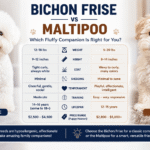
| Trait | Bichon Frise | Maltipoo |
|---|---|---|
| Breed Type | Purebred — AKC recognized | Designer hybrid (Maltese × Poodle) |
| Weight | 12–18 lbs | 5–20 lbs (Toy: 5–10 lbs; Mini: 10–20 lbs) |
| Height | 9–12 inches | 8–14 inches |
| Coat | Tight curls; always white or cream | Wavy to curly; many colors available |
| Shedding | Minimal | Minimal to none |
| Hypoallergenic | Yes | Yes (typically even lower dander than Bichon) |
| Grooming | High — daily brushing; pro groom every 4–6 weeks | Moderate-High — brushing 3–4x/week; pro groom every 6–8 weeks |
| Temperament | Cheerful, gentle, social, sensitive | Playful, affectionate, curious, intelligent |
| Energy Level | Low to moderate | Moderate |
| Barking | Low to moderate | Moderate — alert barker |
| Intelligence | Moderate-high | High (Poodle lineage) |
| Training | Moderate — can be stubborn | Easy — very responsive to positive training |
| With Kids | Good (best with older children) | Good (gentle and playful) |
| With Strangers | Friendly and social | Friendly; may bark first then warm up |
| Lifespan | 14–16 years (some to 18+) | 12–15 years |
| Separation Anxiety | Common — does not like being alone | Common — very people-dependent |
| Apartment Friendly | Excellent | Excellent |
| Puppy Price (Puppy Heaven) | $2,500–$4,500 | $2,800–$5,000+ |
| AKC Recognition | Yes (Non-Sporting Group, since 1973) | No (hybrid breed) |
2. About the Bichon Frise
The Bichon Frise has been charming people for centuries — and it knows it. This breed was a favorite of French royalty in the 16th century, and it carried that confident, crowd-pleasing personality right into modern times. The name means “curly lap dog” in French, which tells you most of what you need to know about the original job description.
The Bichon Frise is a purebred recognized by the American Kennel Club in the Non-Sporting Group since 1973. In 2001, a Bichon named J.R. won the Westminster Dog Show, putting the breed in the national spotlight. It consistently ranks among the AKC’s most popular breeds — and for good reason.
Bichon Frise Key Facts
- Origin: Canary Islands (Spain); refined in France
- Original purpose: Companion dog, court entertainer
- AKC group: Non-Sporting
- Coat: Always white or cream; tight, dense curls; double coat
- Closely related to: Maltese, Havanese, Bolognese, Coton de Tulear
- Best known for: Cheerful temperament, hypoallergenic coat, love of people
The Bichon Frise is one of the most people-friendly dogs in existence. It genuinely loves everyone — family members, strangers, other dogs, children. It’s not a one-person dog. It’s a everyone-in-the-room dog. This is both its greatest strength and its greatest vulnerability: a Bichon left alone for too long is an unhappy Bichon.
3. About the Maltipoo
The Maltipoo is one of the most popular designer breeds in the United States, and it earned that status honestly. It combines the Maltese’s calm, gentle temperament with the Miniature Poodle’s intelligence and low-shedding coat. The result: a small, sharp, cuddly dog that works in almost any home setup.
Maltipoos were first intentionally bred in the United States in the 1990s, part of the same wave of Poodle mixes that gave us the Labradoodle, Goldendoodle, and Cockapoo. The goal was a truly allergy-friendly companion that was also easy to train and live with. The Maltipoo hit that target.
Maltipoo Key Facts
- Origin: United States, 1990s
- Parent breeds: Maltese × Toy or Miniature Poodle
- AKC recognition: Not recognized (hybrid breed)
- Coat: Wavy to curly; very wide color range
- Known for: High intelligence, gentle nature, allergy-friendliness
- Sizes: Toy (5–10 lbs), Miniature/Standard (10–20 lbs), Teacup (under 5 lbs)
The Maltipoo’s biggest advantage over the Bichon Frise is variability in a good way. You can find Maltipoos in a range of sizes and a wide spectrum of colors. You also get slightly more trainability on average, thanks to the Poodle parent. The trade-off is that appearance and personality can vary more from puppy to puppy, since it’s a hybrid rather than a standardized purebred.
At Puppy Heaven, we regularly have both Toy and Teacup Maltipoo puppies available. Browse current litters and book a live video call to meet your puppy before you commit.
4. Size and Appearance: How to Tell Them Apart
Standing next to each other, a Bichon Frise and a Maltipoo can look surprisingly similar — especially if the Maltipoo has a white or cream coat. But there are real differences once you look closely.
Bichon Frise Appearance
The Bichon Frise has a very specific, consistent look. It’s always white or cream (sometimes with buff or apricot tones as a puppy that lighten with age). The coat is tight, velvety, and curly — almost powder-puff in texture. The face is round with large, dark eyes and a gentle, almost cartoon-like expression. The tail curls up over the back. Size is consistent: 9–12 inches tall, 12–18 lbs. There’s very little variation from dog to dog because it’s a purebred with breed standards.
Maltipoo Appearance
The Maltipoo is far more variable. Because it’s a hybrid, appearance depends heavily on which parent the puppy takes after. Some Maltipoos look almost like a small fluffy Poodle — tight curls, longer snout, more angular face. Others favor the Maltese side — silkier, wavier coat, rounder face, softer expression. The coat can be wavy, loosely curled, or tightly curled depending on the individual.
Colors are the Maltipoo’s biggest visual advantage. Unlike the Bichon, which is always white, Maltipoos come in:
- White and cream
- Apricot and gold
- Red and dark orange
- Chocolate brown
- Silver and gray
- Black
- Parti-color (two-toned)
- Phantom (two-toned with a specific pattern)
Size Comparison
| Feature | Bichon Frise | Maltipoo (Toy) | Maltipoo (Miniature) |
|---|---|---|---|
| Weight | 12–18 lbs | 5–10 lbs | 10–20 lbs |
| Height | 9–12 inches | 8–11 inches | 11–14 inches |
| Size consistency | Very consistent | Moderate variation | Moderate variation |
| Color options | White/cream only | Wide range | Wide range |
Bottom line on size: If you want the smallest possible dog, the Toy or Teacup Maltipoo is the better choice. If you want a consistent, predictable size and look, the Bichon Frise delivers that more reliably. Explore our available purebred Bichon Frise puppies and Maltipoo puppies to compare current size and color options.
5. Temperament and Personality: The Biggest Real Difference
Both breeds are loving, friendly, and people-oriented. But they express that personality differently, and those differences matter more than size or color when it comes to daily life.
Bichon Frise Temperament
The Bichon Frise is cheerful. That’s the word that comes up over and over, and it’s accurate. This dog wakes up happy, greets everyone enthusiastically, and approaches life with an optimism that’s almost contagious. It’s social with strangers, good with other animals, and perfectly content being passed from lap to lap at a family gathering.
The Bichon is also sensitive. It picks up on emotions in the household and can become anxious if there’s tension or conflict around it. It doesn’t respond well to harsh training, raised voices, or being left out of family activities. This breed genuinely needs to be included — it’s not a dog that will quietly entertain itself in a back room.
One trait that surprises new Bichon owners: they can be stubborn in training. They’re smart enough to understand what you want; they just occasionally decide they’d rather not. Patience and positive reinforcement matter here more than with some other breeds.
Maltipoo Temperament
The Maltipoo brings a slightly different energy. The Poodle side adds a sharper alertness and more active curiosity. The Maltese side contributes the gentle, affectionate quality that makes this hybrid so easy to live with. The combination produces a dog that’s both snuggly and mentally engaged — happy to cuddle on the couch but also ready to follow you around the house, investigate new things, and play games.
Maltipoos tend to be more trainable than Bichons. They pick up commands faster and stay engaged in training sessions longer. The Poodle’s working-dog intelligence is a real advantage here. That intelligence also means they need more mental stimulation than the Bichon — a bored Maltipoo will find ways to express its dissatisfaction.
Both breeds have a strong watchdog instinct relative to their size. The Maltipoo tends to be more of an alert barker — it will notify you when something is happening. The Bichon barks too, but slightly less frequently and with less urgency on average.
Temperament Comparison Table
| Trait | Bichon Frise | Maltipoo |
|---|---|---|
| Overall energy | Low to moderate | Moderate |
| Affection | Very high | Very high |
| With strangers | Friendly immediately | Friendly; may bark first |
| Training ease | Moderate (can be stubborn) | Easy (Poodle intelligence) |
| Emotional sensitivity | High | Moderate-high |
| Mental stimulation need | Moderate | Moderate-high |
| Barking tendency | Low to moderate | Moderate |
| Separation anxiety risk | High | High |
| Adaptability to new environments | High | High |
6. Grooming: Where the Real Difference Shows Up
This is where most comparison guides give vague answers like “both need grooming.” Here’s the honest version.
Bichon Frise Grooming
The Bichon Frise requires more grooming than almost any small breed. The dense double coat doesn’t shed, but that means hair stays in the coat and mats if you don’t brush it out. Daily brushing with a slicker brush and metal comb isn’t optional — it’s the baseline. Without it, the coat mats close to the skin, which is painful to remove and requires professional intervention.
Professional grooming every 4–6 weeks is standard for a Bichon in full coat. The classic cut keeps the coat rounded and even, which requires skill and takes time. Budget $70–$130 per professional appointment depending on your area. Add nail trims, ear cleaning (Bichons can grow hair inside the ear canal that needs to be plucked), and teeth brushing to the weekly routine.
Bichon Frises are also prone to tear staining — the reddish-brown marks that develop under the eyes. Daily cleaning of the eye area with a damp cloth or pet-safe wipe helps prevent staining. Diet, water quality, and allergies all affect how bad the staining gets.
Maltipoo Grooming
The Maltipoo is slightly easier than the Bichon on grooming — but only slightly. The wavy coat still needs brushing 3–4 times per week. If the Maltipoo takes after the Poodle parent with a tighter curl, matting risk increases and so does brush-out time.
Professional grooming every 6–8 weeks is typical, making it a bit less frequent than the Bichon. The most popular Maltipoo cuts are the puppy cut (even, short all over) and the teddy bear cut (rounded face, medium body). Expect $55–$110 per appointment.
Maltipoos with lighter-colored coats can also experience some tear staining, though generally less severe than in Bichons. The Poodle’s coat type tends to accumulate less eye discharge.
Weekly Grooming Checklist (Both Breeds)
- ☑ Brush coat thoroughly (slicker brush, then metal comb)
- ☑ Wipe around eyes to prevent tear staining
- ☑ Check and clean ears
- ☑ Brush teeth (daily is best; 3–4x/week minimum)
- ☑ Check paw pads and trim between toes if overgrown
- ☑ Nail trim every 3–4 weeks
Vet tip: Start grooming routines the week your puppy comes home, even if there’s barely any coat. A puppy that gets used to being brushed, having its ears touched, and its paws handled becomes an adult dog that tolerates grooming calmly. Starting at 6 months makes everything harder.
7. Shedding and Allergies: How Each Breed Affects Allergy Sufferers
Both breeds are marketed as hypoallergenic, and both genuinely are better options for allergy sufferers than most dogs. But there are real differences worth knowing.
The Bichon Frise has a double coat that sheds minimally — dead hair stays in the coat rather than falling on furniture. This reduces airborne hair significantly. However, it still produces dander (the actual trigger for most dog allergies), and Bichons do produce some saliva protein (Can f 1) that can cause reactions in highly sensitive people.
The Maltipoo, thanks to the Poodle’s genetics, tends to produce even less dander than the Bichon. Poodles are consistently among the most allergy-friendly breeds tested. The Maltipoo inherits that trait. For someone with moderate to severe dog allergies, the Maltipoo is typically the safer choice of the two.
That said, no dog is 100% allergy-proof. If you have serious dog allergies, spend time with the specific puppy before committing — reactions vary between individual dogs even within the same breed.
8. Exercise Requirements: Both Modest, but Not Zero
Neither breed is high-energy, and both are often mistaken for purely sedentary lap dogs. They’re not. Regular movement keeps them physically healthy and mentally calm — a dog that doesn’t get enough exercise tends to bark more, become anxious, and develop destructive habits.
Bichon Frise Exercise Needs
The Bichon Frise is one of the lower-energy small breeds. Two 15–20 minute walks per day covers most adults comfortably. They enjoy indoor play — fetch with a soft toy, hide and seek, chasing a ball down a hallway. They don’t demand intense exercise, but they benefit from consistent daily activity. On especially cold or rainy days, a Bichon is perfectly happy with indoor games as a substitute for walking.
Maltipoo Exercise Needs
The Maltipoo has slightly more sustained energy than the Bichon, partly because of the Poodle’s working-dog background. Two walks of 15–20 minutes each, plus active indoor play and some training sessions, hits the sweet spot. Maltipoos enjoy fetch, tug toys, and puzzle feeders. They benefit more from mental exercise than the Bichon does — 10 minutes of trick training can tire a Maltipoo out more effectively than a walk.
| Activity | Bichon Frise | Maltipoo |
|---|---|---|
| Daily walking need | 20–30 minutes total | 30–45 minutes total |
| Indoor play | Moderate | Moderate to high |
| Mental stimulation need | Moderate | High |
| Dog park suitability | Good (social) | Good (social but watch size) |
| Off-leash safety | Low (recall unreliable) | Moderate (better with training) |
9. Training and Intelligence
Both breeds are intelligent and trainable. But they’re not equally easy to train, and it’s worth being honest about that.
Bichon Frise Training
Bichons learn commands fairly quickly and have good memories. The challenge is motivation. A Bichon that isn’t in the mood doesn’t particularly care that you’ve been working on “sit” for three weeks. Boredom sets in quickly during repetitive sessions. Keep training sessions short (8–10 minutes), fun, and treat-heavy. Never use punishment-based methods — the Bichon’s sensitivity means harsh training creates anxiety, not compliance.
Potty training is the area most Bichon owners struggle with. The breed has a notoriously slow click for house-training — expect the process to take 4–6 months of consistent effort before accidents become rare. Crate training dramatically speeds this up.
Bichon training priority list:
- Potty training — start day one, be patient
- Crate training — reduces separation anxiety significantly
- Socialization with new people and environments — starts at 8 weeks
- Basic commands — sit, stay, come, leave it
- Bark training — they do alert bark; address early
Maltipoo Training
The Maltipoo is genuinely easier to train than the Bichon. The Poodle’s intelligence and eagerness to please come through clearly. Maltipoos pick up commands faster, stay engaged in sessions longer, and tend to generalize training to new situations better. They can learn not just basic obedience but tricks, agility skills, and complex sequences.
Potty training is still important to start immediately, but most Maltipoos house-train faster than Bichons — typically reliable within 3–4 months with consistent crate training and scheduling.
Maltipoo training priority list:
- Bark training — they alert bark and it can become a habit without guidance
- Potty and crate training — start immediately
- Socialization — Poodle intelligence means early experiences shape behavior strongly
- Leash manners — they pull when excited
- Separation anxiety prevention — gradual alone-time training from puppyhood
Vet tip: For both breeds, puppy classes in the first 12–16 weeks of ownership are one of the best investments you can make. Socialization during the developmental window (before 14 weeks) shapes behavior for life. A class also gives you a trainer to ask specific questions about your puppy’s individual quirks.
10. With Kids, Seniors, and Other Pets
With Children
Both breeds can be excellent family dogs with the right children and the right supervision. The main concern with both is physical fragility — a child who doesn’t know how to handle a small dog can accidentally hurt either breed. Neither should be left alone unsupervised with children under 5.
Bichon Frise with kids: The Bichon’s gentle, social nature makes it patient with children. It doesn’t snap easily when handled gently. However, it is sensitive — rough play or being startled can make it anxious. Best with children 6 and older who understand calm, respectful interaction.
Maltipoo with kids: The Maltipoo is playful and engaging with children. Its Poodle intelligence means it can actually participate in interactive games rather than just tolerating attention. It may be slightly more energetic with kids, which kids often love. Best with children 5 and older. Always supervise with Teacup or very small Toy Maltipoos — their tiny bodies are easily injured by enthusiastic toddlers.
With Seniors
Both breeds are excellent companions for older adults. The Bichon’s calmer energy and consistent need for company make it a natural fit for a retiree at home most of the day. The Maltipoo’s slightly higher intelligence provides more entertainment and engagement. Either choice works well — pick based on which temperament feels like a better match for your energy level and lifestyle.
With Other Pets
Both breeds generally get along well with other dogs and cats when properly introduced. The Bichon’s naturally social personality means it usually welcomes animal companions. The Maltipoo does well too, though the Poodle’s slight prey instinct means introductions with cats should be supervised until you know how the individual dog responds.
Both breeds can actually benefit from having a second dog for company, given their tendency toward separation anxiety when left alone.
11. Health and Common Issues
Both breeds are generally healthy small dogs, but they have distinct health profiles worth knowing before you commit.
Bichon Frise Health Issues
Allergies and Skin Issues
The most common health issue in Bichons by a wide margin. Bichons are prone to environmental allergies (pollen, dust mites, mold) and food allergies. Signs: itching, redness, hair loss, chronic ear infections, recurring skin infections. Managing a Bichon with allergies often means identifying triggers through an elimination diet or allergy testing, then managing with a hypoallergenic diet, regular bathing, and sometimes medication. This is a real ongoing cost and effort commitment.
Patellar Luxation
The kneecap slips out of its groove — very common in small breeds. Mild cases are manageable with weight control and joint supplements. Severe cases may require surgical correction ($1,500–$4,000 per knee). Ask your breeder if parent dogs have been screened for this.
Dental Disease
Small mouth, crowded teeth, rapid tartar buildup. Daily brushing is essential. Professional cleaning under anesthesia is typically needed by age 3–5 and annually or biannually after that. Untreated dental disease contributes to heart, kidney, and liver problems — it’s not just cosmetic.
Cataracts and Eye Issues
Bichon Frises are prone to cataracts, which can develop as early as middle age (5–7 years). Signs: cloudy appearance to the eye, bumping into things, reluctance to go out at night. Surgical correction is available but expensive. Annual eye exams are recommended after age 5.
Bladder Stones
Bichons are overrepresented in urinary stone cases. Signs: straining to urinate, blood in urine, frequent accidents. Dietary management helps; some cases require surgery. Annual urinalysis is recommended.
Cushing’s Disease (Hyperadrenocorticism)
More common in Bichons than in many other small breeds. Occurs when the adrenal glands produce too much cortisol. Signs: increased thirst and urination, pot-bellied appearance, hair loss, increased appetite. Manageable with daily medication and regular monitoring.
Portosystemic Shunt (Liver Shunt)
An abnormal blood vessel that bypasses the liver, preventing toxins from being properly filtered. More common in Bichons than in the general dog population. Signs often appear before 12 months: poor growth, neurological symptoms after eating, seizures. Surgical correction is the definitive treatment.
Maltipoo Health Issues
Dental Disease
Shared with the Bichon — all small breeds face this. Daily brushing and regular professional cleanings are non-negotiable.
Patellar Luxation
Also shared — kneecap slippage is common in toy breeds generally. Same management approach as with the Bichon.
Skin Allergies
Inherited from both the Maltese and Poodle sides. Less severe on average than in Bichons, but present in some lines. Same management approach.
Progressive Retinal Atrophy (PRA)
A degenerative eye condition that eventually causes blindness. Inherited from Poodle and Maltese lines. Responsible breeders DNA-test parent dogs for the PRA gene before breeding. Ask your breeder specifically about this.
Epilepsy
The Maltese side carries a slightly elevated risk of idiopathic epilepsy (seizures without identified cause). Not common, but worth knowing about. Signs: sudden collapse, paddling, confusion. Manageable with medication in most cases.
White Shaker Syndrome
A neurological condition more common in small white dogs — Maltese, Bichon Frise, West Highland Terriers, and their crosses. Signs: tremors throughout the body, usually appearing between 6 months and 3 years of age, often triggered by stress or excitement. Manageable with corticosteroids; many dogs improve significantly with treatment.
Health Comparison Summary
| Health Issue | Bichon Frise | Maltipoo |
|---|---|---|
| Allergies / skin | High risk | Moderate risk |
| Dental disease | High risk | High risk |
| Patellar luxation | Moderate risk | Moderate risk |
| Eye issues | Cataracts common | PRA (DNA testable) |
| Bladder stones | Higher risk | Lower risk |
| Cushing’s disease | Elevated risk | Lower risk |
| Liver shunt | Elevated risk | Lower risk |
| Epilepsy | Lower risk | Moderate risk |
| White Shaker Syndrome | Elevated risk | Some risk (if white-coated) |
| Hybrid vigor advantage | No (purebred) | Yes (crossbred) |
Overall health verdict: The Maltipoo tends to have fewer inherited health issues than the Bichon Frise, partly due to hybrid vigor. The Bichon’s allergy and skin issues are particularly common and can be expensive and time-consuming to manage. That said, buying from health-tested parents dramatically reduces risk for both breeds.
12. Lifespan: A Meaningful Difference
The Bichon Frise lives 14–16 years on average, with many reaching 17–18. This is one of the longer average lifespans in the dog world.
The Maltipoo typically lives 12–15 years. Still excellent for a small breed — better than many popular dogs. But the Bichon does have a meaningful edge here.
This difference matters more than people realize when choosing between the two. A Bichon that comes home with you at age 30 will likely still be with you at 45 or 46. A Maltipoo adopted at the same time may be gone by 43 or 44. Over a lifetime of dog ownership, that adds up.
Both breeds benefit from the same longevity practices: consistent dental care, maintaining a healthy weight, regular vet checkups (twice yearly for seniors over 8), and catching conditions like Cushing’s disease or cataracts early when treatment is most effective.
13. Cost: Puppy Price and What You’ll Actually Spend
Puppy Purchase Price
| Source / Type | Bichon Frise | Maltipoo |
|---|---|---|
| Reputable boutique breeder | $1,500–$3,500 | $2,000–$4,000 |
| Puppy Heaven (vet-checked, vaccinated, microchipped) | $2,500–$4,500 | $2,800–$5,000+ |
| Rare color / Teacup Maltipoo | N/A | $3,500–$6,000+ |
| Shelter / rescue adoption | $150–$500 | $100–$600 |
The Maltipoo is typically priced somewhat higher than the Bichon Frise, reflecting demand for designer hybrids and the premium for rare colors and very small sizes. The price gap is meaningful at purchase but often narrows over the lifetime of the dog when you factor in the Bichon’s higher health management costs (especially allergies).
At Puppy Heaven, every puppy includes a full vet health check, current vaccinations, microchipping, a written health guarantee, and a starter kit. We also offer 100% financing up to $20,000 — apply online.
First-Year Cost Breakdown
| Expense | Bichon Frise | Maltipoo |
|---|---|---|
| Puppy purchase | $1,500–$4,500 | $2,000–$5,000+ |
| Spay/Neuter | $200–$500 | $200–$500 |
| Initial vet + vaccines | $150–$350 | $150–$350 |
| Crate, bed, bowls, collar/harness | $150–$300 | $150–$300 |
| Food (year 1) | $250–$500 | $200–$450 |
| Professional grooming | $600–$1,000 | $450–$800 |
| Training classes | $100–$300 | $100–$300 |
| Pet insurance | $350–$700 | $300–$600 |
| Allergy management (if needed) | $300–$1,000+ | $0–$400 |
| Toys, treats, accessories | $100–$300 | $100–$300 |
| First-year total estimate | $3,700–$9,450+ | $3,650–$8,200+ |
Ongoing Monthly Cost (After Year One)
| Monthly Expense | Bichon Frise | Maltipoo |
|---|---|---|
| Food | $40–$70 | $30–$60 |
| Professional grooming | $70–$120 | $55–$100 |
| Routine vet (averaged monthly) | $35–$65 | $30–$55 |
| Pet insurance | $30–$60 | $25–$55 |
| Allergy management (if applicable) | $20–$80 | $0–$30 |
| Treats, toys, accessories | $20–$40 | $20–$40 |
| Monthly total estimate | $215–$435 | $160–$340 |
Long-term cost note: The Bichon’s allergy-related expenses can significantly increase monthly costs for affected dogs. Many Bichon owners spend an additional $500–$2,000 per year on allergy management (special food, supplements, medications, veterinary testing). This doesn’t happen with every Bichon, but it’s common enough that it should factor into your planning.
14. Apartment Living
Both breeds excel in apartment living. This isn’t just marketing — it’s one of their most practical strengths. Neither needs a yard. Both can meet their exercise needs with neighborhood walks and indoor play. Both are small enough to be comfortable in studios and one-bedrooms.
The key differences for apartment dwellers:
- Barking: The Maltipoo tends to be a slightly more frequent alert barker. In thin-walled buildings with noise-sensitive neighbors, this matters. Both respond well to bark training, but starting early is important.
- Alone time: Neither breed handles long periods alone well. If you work full-time away from home, plan for a dog walker or doggy daycare for both breeds equally.
- Hair on furniture: Both shed minimally. The Bichon’s coat may produce slightly more hair around the house because of its denser double coat — Maltipoos in tight curls shed almost nothing.
- Building size limits: The Maltipoo’s range (5–20 lbs) gives you more flexibility if your building has strict weight limits. A Toy Maltipoo comes in well under most restrictions.
15. Which Breed Is Right for You?
Choose a Bichon Frise If:
- You want a purebred with an AKC pedigree and predictable, consistent looks
- You want the longest possible lifespan (14–16+ years is exceptional)
- You live alone or with a partner and want a gentle, cheerful constant companion
- You enjoy grooming or are comfortable with daily coat maintenance
- You want the most socially easy-going breed — great with strangers, other pets, children
- You’re a senior or retiree who wants a calm, devoted companion
- You prefer a slightly calmer energy level in the house
Pick a Maltipoo If:
- You have or suspect dog allergies — the Maltipoo is typically better for allergy sufferers
- You want a very small dog (Toy or Teacup sizes go smaller than a Bichon)
- You want more color variety — the Bichon is always white or cream
- You’re a first-time dog owner — the Maltipoo’s trainability makes the learning curve gentler
- You want a more mentally engaged, quick-learning dog
- You have an active family with children who want an interactive playmate
- You’re concerned about health costs — the Maltipoo’s hybrid vigor gives it a slight health edge
Choose Neither (for Now) If:
- You’re away from home 8–10 hours daily with no dog care support — both breeds suffer from separation anxiety
- You have toddlers who are not yet old enough for careful dog handling
- You want a truly wash-and-wear dog — both require meaningful grooming commitment
- Grooming costs are a budget concern — both need professional grooming, and it adds up
16. Frequently Asked Questions
Is a Bichon Frise or Maltipoo better for someone with allergies?
The Maltipoo is generally the better choice for allergy sufferers. The Poodle’s genetics produce even less dander than the Bichon Frise, which already sheds minimally. For moderate to severe dog allergies, the Maltipoo gives you a better chance of a reaction-free home. That said, neither is 100% allergy-proof — always spend time with the specific puppy before committing.
Which lives longer — a Bichon Frise or a Maltipoo?
The Bichon Frise lives longer on average: 14–16 years versus the Maltipoo’s 12–15 years. Many individual Bichons reach 17 or 18 years. If longevity is a priority, the Bichon is the stronger choice. The Maltipoo still has an excellent lifespan for a small breed — just not quite as exceptional as the Bichon’s.
Which is easier to train — Bichon Frise or Maltipoo?
The Maltipoo is easier to train, primarily because of the Poodle’s intelligence and eagerness to please. Maltipoos pick up commands faster, stay engaged in training longer, and respond more consistently to positive reinforcement. Bichons are smart but can be stubborn and lose interest. For first-time owners, the Maltipoo is the more forgiving training experience.
Do Bichon Frises or Maltipoos bark more?
The Maltipoo tends to bark more frequently, particularly as an alert barker when it notices sounds or strangers. The Bichon Frise barks too, but typically with less frequency and urgency. Both respond well to bark training started in puppyhood. In apartments with noise restrictions, the Bichon is the slightly safer choice if barking is a concern.
What’s the price difference between a Bichon Frise and Maltipoo puppy?
Maltipoos typically cost more at purchase: $2,000–$4,000+ from a reputable breeder versus the Bichon’s $1,500–$3,500. At Puppy Heaven, Bichons run $2,500–$4,500 and Maltipoos $2,800–$5,000+. Over the lifetime of the dog, the gap often narrows because Bichons tend to have higher ongoing health and grooming expenses, particularly if allergy issues develop.
Which is better for first-time dog owners?
The Maltipoo is the more first-time-owner-friendly breed. It’s more responsive in training, has slightly fewer serious health complications, and the wide size range means you can find one that fits almost any home. The Bichon is also manageable for first-timers, but the grooming requirement and sensitivity need to be understood going in.
Are Bichon Frises or Maltipoos better with children?
Both are good family dogs with the right children. The Maltipoo’s playfulness and intelligence make it particularly engaging for older children who want an active playmate. The Bichon’s gentle nature is excellent for calmer households. Neither breed is appropriate for very young children (under 3–4) without constant adult supervision due to their small size and fragility.
Which breed is better for seniors?
Both are excellent companions for older adults. The Bichon’s calmer energy and slightly lower exercise needs are a natural fit for seniors with limited mobility. The Maltipoo works well for more active seniors who enjoy engaging with a trainable, curious dog. Either choice is genuinely good — it comes down to personal preference in energy level and the grooming commitment each owner can realistically handle.
Do Maltipoos shed?
Very little to almost nothing. The Maltipoo’s Poodle-derived coat is among the lowest-shedding in the dog world. Even Maltipoos with wavier, less-curly coats shed far less than most breeds. You won’t find fur all over your furniture or clothes, though you will need to brush regularly to prevent the non-shedding coat from matting.
Do Bichon Frises shed?
Minimally. Dead hair stays in the coat rather than falling out, which dramatically reduces visible shedding. The trade-off is that the retained hair must be brushed out regularly — daily brushing is the standard for a Bichon in full coat. Without brushing, the retained hair mats close to the skin.
Can a Maltipoo and Bichon Frise live together?
Yes — this is actually a very common pairing. Both breeds are social, non-aggressive, and companion-oriented. They tend to become close friends rather than rivals, and having a second dog helps with each breed’s separation anxiety. Introduce them on neutral ground and supervise early interactions until they’ve established their dynamic.
Which breed is better for apartment living?
Both are excellent apartment dogs. If barking is a concern due to thin walls or strict rules, the Bichon is the slightly calmer choice. If weight limits are an issue, a Toy Maltipoo gives you more flexibility. Both can fully meet their exercise needs in an apartment with daily walks and indoor play.
How much does it cost to groom a Bichon Frise vs Maltipoo?
Bichon Frise: $70–$130 per professional grooming session, typically every 4–6 weeks — roughly $700–$1,200 per year. Maltipoo: $55–$110 per session every 6–8 weeks — roughly $450–$800 per year. Home brushing is required multiple times per week for both breeds between professional sessions.
What is a Bichpoo? Is it different from a Bichon Frise or Maltipoo?
A Bichpoo (also called Bichon Poo or Poochon) is a cross between a Bichon Frise and a Poodle. It’s a different designer hybrid from the Maltipoo, which crosses a Maltese with a Poodle. The Bichpoo is generally slightly larger than a Toy Maltipoo and shares many traits with both the Bichon Frise and Maltipoo. Ask about Bichpoo availability at Puppy Heaven.
Which breed has fewer health problems?
The Maltipoo has a modest health advantage due to hybrid vigor — crossbred dogs often have more genetic diversity and fewer inherited conditions than purebreds. The Bichon Frise is prone to allergies, Cushing’s disease, bladder stones, and liver shunts more than the Maltipoo. Both breeds share dental disease and patellar luxation risk. Buying from health-tested parents is the most important factor for either breed.
Which is more popular — Bichon Frise or Maltipoo?
The Maltipoo is currently more popular in searches and social media, particularly among younger buyers looking for designer breeds in small sizes and varied colors. The Bichon Frise remains consistently popular as a purebred with AKC recognition and a centuries-long track record. Popularity aside, what matters most is which breed fits your specific household — not which one has more Instagram accounts.
17. Bichon Frise vs Maltipoo: Pros & Cons
Every breed guide talks about the good stuff. Here’s the full picture — honest pros and cons for both breeds, the kind you’d want a friend who’s owned both to tell you over coffee.
Bichon Frise: Pros
| Pro | Why It Matters |
|---|---|
| Exceptionally long lifespan | 14–16 years average, many reaching 17–18. One of the longest-lived small breeds you can own. |
| AKC-recognized purebred | Predictable breed standards. Consistent size, coat type, and temperament across responsible litters. |
| Extremely social and people-friendly | Genuinely welcomes everyone — strangers, children, other animals. One of the least reactive small breeds. |
| Cheerful, stable temperament | Not prone to mood swings. Consistently gentle, playful, and affectionate across the board. |
| Low-shedding coat | Dead hair stays in the coat. Minimal visible shedding on furniture and clothes. |
| Calm energy indoors | Perfectly content with two short walks per day. Doesn’t pace or demand constant activity. |
| Excellent with seniors | Low exercise demand, gentle temperament, and devoted companionship — a natural fit for older adults. |
| Centuries of proven breeding | Long history means temperament and health traits are well-documented and understood. |
Bichon Frise: Cons
| Con | What This Looks Like in Real Life |
|---|---|
| High grooming demand | Daily brushing is non-negotiable. Skip a few days and the coat starts matting. Professional grooming every 4–6 weeks adds $700–$1,200/year. |
| Allergy and skin issues are common | A significant number of Bichons develop environmental or food allergies. Managing them takes time, money, and often a vet dermatologist. |
| Can be stubborn in training | Smart enough to understand what you want. Sometimes decides it doesn’t feel like it. Potty training is notoriously slow — expect 4–6 months. |
| Tear staining is ongoing | Daily eye-area cleaning is part of the routine for most Bichon owners. Without it, rust-colored staining develops under the eyes. |
| Separation anxiety is real | Does not handle being alone for long stretches. Can bark, pace, and become destructive when left regularly for more than 4–5 hours. |
| Higher inherited health risks | Cushing’s disease, bladder stones, liver shunts, and cataracts are all more common in Bichons than in most toy breeds. |
| Always white — no color variety | If you want something other than white or cream, you’ll need a different breed. The Bichon doesn’t come in other colors. |
| Fragile around rough play | Small bone structure means injuries are possible with young children or large dogs who don’t know their own strength. |
Maltipoo: Pros
| Pro | Why It Matters |
|---|---|
| Best-in-class allergy friendliness | Poodle genetics produce very low dander. Among the top choices for people with dog allergies. |
| High intelligence and trainability | Learns commands quickly, stays engaged in training, and generalizes skills to new situations. Great for first-time owners. |
| Wide size range | Toy (5–10 lbs), Miniature (10–20 lbs), and Teacup (under 5 lbs) options let you find the exact size that fits your home and lifestyle. |
| Exceptional color variety | White, cream, apricot, red, chocolate, black, phantom, parti — far more options than the always-white Bichon. |
| Hybrid vigor health advantage | Cross-breeding often reduces inherited health conditions. Maltipoos tend to have fewer severe genetic problems than purebred Bichons. |
| Playful and engaging | The Poodle side adds an active curiosity that makes daily life with a Maltipoo genuinely entertaining. They participate rather than just observe. |
| Adapts to almost any household | Apartment, house, singles, families, retirees — the Maltipoo fits more lifestyle types than almost any other small breed. |
| Lower ongoing health costs | Fewer breed-specific conditions means fewer specialty vet visits and lower average annual health spending compared to Bichons. |
Maltipoo: Cons
| Con | What This Looks Like in Real Life |
|---|---|
| Appearance varies by litter | No two Maltipoo litters are identical. Coat type, size, and face shape depend on which parent the puppy takes after. Less predictable than the Bichon. |
| Alert barking tendency | More frequent barker than the Bichon on average. Needs early bark training — especially in apartments or townhomes with noise limits. |
| Higher purchase price | Designer hybrid demand pushes Maltipoo prices above Bichons at purchase. Rare colors and very small sizes cost even more. |
| Still needs regular grooming | Not as demanding as the Bichon, but the wavy/curly coat does mat without consistent brushing 3–4x per week and pro grooming every 6–8 weeks. |
| Separation anxiety | Shares this challenge equally with the Bichon. Very people-dependent — being alone for long periods causes real distress in both breeds. |
| Shorter lifespan than Bichon | 12–15 years vs the Bichon’s 14–16+. Still excellent, but if maximum longevity matters, the Bichon has the edge. |
| Not AKC recognized | No official breed standard means no papers, no predictable show-quality traits, and varying quality between breeders. Vetting breeders carefully is essential. |
| Needs more mental engagement | The Poodle brain means a bored Maltipoo creates problems. Puzzle toys, training, and interactive play are ongoing needs — not optional. |
18. What to Ask a Breeder Before Buying a Bichon Frise or Maltipoo
Most people spend more time researching a laptop than they do vetting a puppy’s breeder. That’s backwards. The breeder is the single most important factor in whether your puppy is healthy, well-socialized, and what it’s supposed to be — breed paperwork and a cute photo mean nothing if the dog was raised poorly.
Here are the questions that actually matter. For each one, we’ve explained what a good answer looks like and what should make you walk away.
Questions About the Parents and Health Testing
1. What health testing have you done on the parent dogs?
“Vet checked” is not health testing. Responsible breeders screen parent dogs for breed-specific genetic conditions using OFA (Orthopedic Foundation for Animals) certifications, PennHIP evaluations, and DNA panels. For Bichon Frise parents, ask specifically about eye CERF exams (for cataracts), OFA hip and patella evaluations, and heart clearances. For Maltipoo parents, ask about OFA patella and hip evaluations, PRA (Progressive Retinal Atrophy) DNA testing, and cardiac exams. A good breeder is proud to show you documentation. If they can’t, or say it isn’t necessary for “small dogs,” move on.
2. Can I meet the mother (dam) in person or on a video call?
The mother should always be available to see — she’s living with the breeder. Her temperament, size, and coat quality tell you a great deal about what your puppy will be like. An anxious, fearful, or reactive dam is a red flag regardless of what the breeder says about the puppies. The father (sire) may be owned by another breeder, which is normal — but you should still be able to see photos, videos, and health records.
3. How old is the dam, and how many litters has she had?
A responsible breeder does not overbreed their females. For Bichon Frise, AKC guidelines recommend no more than 4–5 litters per female over her lifetime, and breeding should not start before 18 months. A dam bred at every heat cycle, or with more than 5 litters total, is a sign of a for-profit mill operation rather than a care-first breeding program.
4. Has the litter been genetically tested?
DNA testing of individual puppies (or parents) can identify carriers of conditions like Progressive Retinal Atrophy in Maltipoos. Some responsible breeders DNA-test every puppy before sale. This is increasingly the standard at higher-quality programs. Ask what genetic panel was used and request the results in writing.
Questions About the Puppies Themselves
5. How have the puppies been socialized before going home?
The developmental window — 3 to 14 weeks — is when puppies form their foundational view of the world. A puppy raised in a back kennel with minimal human contact during this period will struggle with confidence and anxiety for life, regardless of genetics. A good breeder exposes puppies to household sounds (TV, vacuum, doorbell), different types of people, gentle handling, car rides, and varied surfaces. Ask specifically: have the puppies heard traffic noise? Been held by people other than the breeder? Experienced any car rides? The answers tell you a lot.
6. At what age do puppies go home?
Eight weeks is the minimum — and for small and toy breeds, many experienced breeders prefer 9–10 weeks, as the extra time with the mother and littermates supports healthy bite inhibition and emotional development. Any breeder sending puppies home at 5 or 6 weeks is prioritizing turnover over welfare. Walk away.
7. Can I see where the puppies are raised?
In-person if local; video call if you’re buying from a distance. You’re looking for cleanliness, space, signs of stimulation (toys, different surfaces, enrichment objects), and puppies that are alert and curious rather than withdrawn. You’re also looking at the mother’s living conditions. A breeder who refuses any kind of viewing — even a live video call — has something to hide.
8. Has each puppy had a veterinary exam?
All puppies should have had at least one vet exam, completed age-appropriate vaccinations, and been dewormed before going home. Request a written record — a vaccine card or vet certificate. At Puppy Heaven, every puppy receives a full veterinary health check before placement and leaves with complete documentation. That’s what you should expect from any reputable source.
Questions About the Purchase Process
9. What does your health guarantee cover, and for how long?
A written health guarantee is standard from any reputable breeder. Ask specifically: What conditions are covered? For how long? What does “covered” mean — refund, replacement, or contribution toward vet costs? Two-year coverage for genetic conditions is the baseline to expect. Read the contract carefully before signing. If there’s no written guarantee at all, that’s a significant red flag.
10. What is your return policy if I can no longer keep the dog?
A breeder who cares about their dogs will always take them back — at any age, for any reason. This isn’t just ethical, it prevents dogs from ending up in shelters. A breeder with no return clause is not a responsible breeder. At Puppy Heaven, we maintain lifelong support relationships with our puppy families.
11. What food have the puppies been eating?
A sudden diet change at the same time as leaving home (a stressful transition) causes digestive upset. A good breeder tells you exactly what food the puppies eat and sends a supply home. Transition to a new food gradually over 7–10 days by mixing it with the puppy’s current diet, increasing the ratio slowly.
12. Do you microchip before the puppy leaves?
Microchipping is the most reliable way to reunite a lost dog with its owner and is increasingly expected from quality breeders. Many include it in the purchase price. If the puppy isn’t chipped before going home, make it one of your first vet appointments.
Red Flags to Watch For — Walk Away Checklist
- ✗ Puppies always available with no waitlist (volume production)
- ✗ Refuses any form of viewing — in person or video call
- ✗ Cannot show health testing documentation for parent dogs
- ✗ Wants to meet in a parking lot or neutral location only
- ✗ Sends puppies home before 8 weeks
- ✗ No written health guarantee
- ✗ Asks for payment via wire transfer, gift cards, or Zelle only
- ✗ Unwilling to provide a vet reference or contact info
- ✗ Dam has had more than 5 litters or is under 18 months old
- ✗ Cannot describe what socialization the puppies have received
- ✗ Pressure to decide immediately or “the puppy won’t be available”
Green Flags — Signs of a Quality Breeder
- ✓ Asks you questions about your lifestyle, home, and experience
- ✓ Has a waitlist and is not always immediately available
- ✓ Provides OFA health clearances and DNA test results in writing
- ✓ Welcomes virtual or in-person visits at any point
- ✓ Dam is calm, confident, and healthy when you meet her
- ✓ Puppies are curious, alert, and responsive to people
- ✓ Sends food home with the puppy and a transition plan
- ✓ Takes dogs back at any age if the owner can no longer keep them
- ✓ Provides a written purchase agreement and health guarantee
- ✓ Stays in touch after the puppy goes home
At Puppy Heaven, every puppy is vet-checked, vaccinated, microchipped, and comes with a written health guarantee before leaving our boutiques. We encourage every family to schedule a live video call to meet their puppy before committing. Contact us with any questions — we’re happy to answer all of them.
19. Bichon Frise vs Maltipoo: Daily Life & Lifestyle Comparison
The size comparison and the health chart are useful. But what people really want to know is: what does it actually feel like to own one of these dogs? What does a Tuesday look like? This section answers that.
A Typical Day with a Bichon Frise
6:30 AM: The Bichon is already awake and sitting near your head, watching you. They don’t need to bark to get your attention — they just make their presence felt, politely but persistently. Once you’re up, they follow you to the kitchen and sit near the coffee machine like a small, white guardian.
7:00 AM: Morning walk — 15 to 20 minutes is plenty. The Bichon moves at a medium pace, sniffs thoroughly, and greets every person you pass. Children especially get an enthusiastic response. Back home, breakfast takes about 2 minutes to prepare (small breed kibble, roughly half a cup). Coat check: quick 5-minute brush while they’re calm from the walk.
9:00 AM – 12:00 PM: The Bichon settles near wherever you are. If you’re working from home, they’ll be under your desk or on the sofa nearby. They’re not demanding during this time — just present. If you leave for work, this is when a dog walker or someone checking in becomes important. Four or more hours alone stretches the Bichon’s comfort zone.
12:00 PM: Midday check-in or dog walker visit if you’re away. A short play session — throw a soft toy down the hall a few times — resets them for the afternoon.
5:30 PM: Evening walk, slightly longer — 20 to 25 minutes. The Bichon is happy to explore the neighborhood at a relaxed pace. If you pass other dogs, most encounters go smoothly. The Bichon rarely initiates confrontation.
7:00 PM – 10:00 PM: Couch time. The Bichon will be on the sofa beside you or on your lap within minutes of you sitting down. This is where they shine. They’re content to watch TV with you, sit through a phone call, or just be warm and present. Brush session before bed: 5–10 minutes. Teeth brushing ideally daily. Done.
Grooming day (every 4–6 weeks): Drop-off at the groomer, pick up 2–4 hours later. The Bichon usually comes back looking like a fresh cotton ball and acts deeply pleased with itself for the rest of the day.
A Typical Day with a Maltipoo
6:30 AM: The Maltipoo is already running a quick lap around the bedroom. They’ve been awake for ten minutes and are ready. They communicate this not with waiting but with action — jumping on and off the bed, bringing you a toy, doing a small spin near the door.
7:00 AM: Morning walk — the Maltipoo moves a little faster than the Bichon and is more likely to pull toward things that interest it. An alert bark at a passing cyclist or a new smell isn’t unusual. Back home, breakfast, and then: training time. Even 5 minutes of command work (sit, stay, touch) makes a visible difference in a Maltipoo’s afternoon behavior. A mentally stimulated Maltipoo is calmer.
9:00 AM – 12:00 PM: The Maltipoo is nearby but not necessarily quiet. It may bring you toys to throw. It’s more likely to nudge your arm or paw at your laptop than the Bichon. Interactive puzzle feeders — the kind where the dog has to work the food out of compartments — are genuinely useful during this period and can occupy a Maltipoo for 15 to 20 minutes at a stretch.
12:00 PM: Same as the Bichon — a midday visit or short play session helps. Without it, the Maltipoo’s afternoon can get louder and more restless.
5:30 PM: Evening walk — slightly more energetic than the Bichon’s version. A trip to a dog park, if available, is genuinely enjoyed. The Maltipoo plays with other dogs enthusiastically but checks back in with its owner regularly (classic Poodle trait — they don’t wander far).
7:00 PM – 10:00 PM: Mix of couch time and play. The Maltipoo is affectionate in the evening but more interactive than the Bichon — it wants to play tug or fetch a toy before settling. Once settled, it’s a genuinely warm lap dog. Evening brush session: 10 minutes. Dental care. Done.
Grooming day (every 6–8 weeks): Slightly less frequent than the Bichon. The most popular styles are the puppy cut and the teddy bear cut. The Maltipoo usually comes back from the groomer looking adorable and acts completely normal — these dogs don’t have the Bichon’s level of coat-based self-consciousness.
Lifestyle Match Table
| Lifestyle Type | Better Fit | Why |
|---|---|---|
| Work-from-home solo owner | Either — slight edge to Bichon | Bichon is calmer and less demanding during quiet work hours |
| Full-time office worker (8+ hrs away) | Neither (get a dog walker) | Both breeds develop anxiety with long daily isolation |
| Retired couple at home most days | Bichon Frise | Lower energy, longer lifespan, devotedly companion-focused |
| Active family with older kids | Maltipoo | More playful and interactive; kids enjoy training it tricks |
| First-time dog owner | Maltipoo | Faster potty training, more responsive to commands, slightly forgiving |
| Someone with dog allergies | Maltipoo | Lower dander output due to Poodle genetics |
| Apartment with noise restrictions | Bichon Frise | Slightly less frequent barking; easier to manage in quiet buildings |
| Apartment with pet weight limits | Toy or Teacup Maltipoo | Can stay under 5–8 lbs; Bichon typically 12–18 lbs |
| Owner who travels occasionally | Maltipoo (slight edge) | Adapts slightly better to new environments; less velcro-clingy than Bichon |
| Multi-pet household | Either | Both integrate well when properly introduced; Bichon slightly more universally social |
| Owner who wants lower grooming cost | Maltipoo | Less frequent pro grooming; slightly lower annual cost |
| Owner prioritizing longevity | Bichon Frise | Average lifespan 14–16 years; one of the longest-lived small breeds |
The One Question That Decides It
If you’ve read this entire guide and you’re still not sure, here’s the one question that usually breaks the tie:
Do you want a dog that fits into your life, or do you want a dog that adds energy to it?
The Bichon Frise fits into whatever life you’re living. It follows your rhythm, adapts to your pace, and asks mainly that you don’t leave it alone too long. It’s the dog equivalent of a great roommate who happens to love you unconditionally.
The Maltipoo adds energy to your life. It brings more activity, more interaction, more mental engagement — and more personality per square inch than almost any other small breed. It’s the dog that makes your home feel more alive simply by being in it.
Neither is wrong. Both are excellent. But one of those descriptions almost certainly resonated more than the other — and that’s your answer.
20. Find Your Bichon Frise or Maltipoo Puppy at Puppy Heaven
Whether you’ve decided on the cheerful, century-old Bichon Frise or the sharp, allergy-friendly Maltipoo — the next step is finding a puppy from a source you can trust.
At Puppy Heaven, we’ve placed 30,000+ puppies in loving homes over 21+ years, with boutique locations in Las Vegas, NV and Sunrise, FL. Every puppy comes with:
- Complete veterinary health check before placement
- Age-appropriate vaccinations
- Microchipping
- Written health guarantee
- Puppy starter kit
- Live video call to meet your puppy before you commit
- Safe nationwide delivery
- 100% financing available up to $20,000