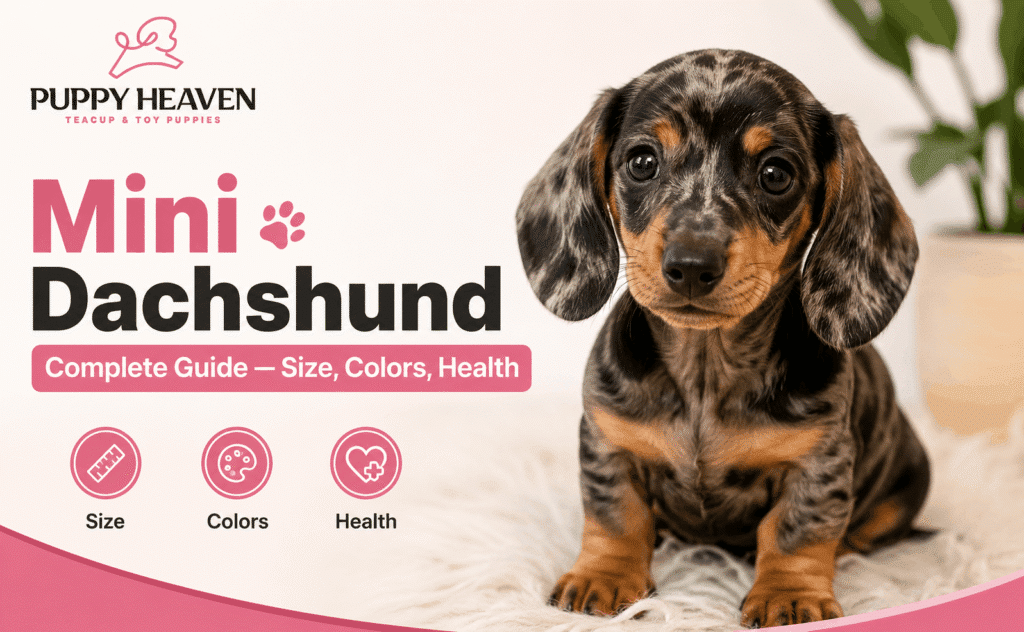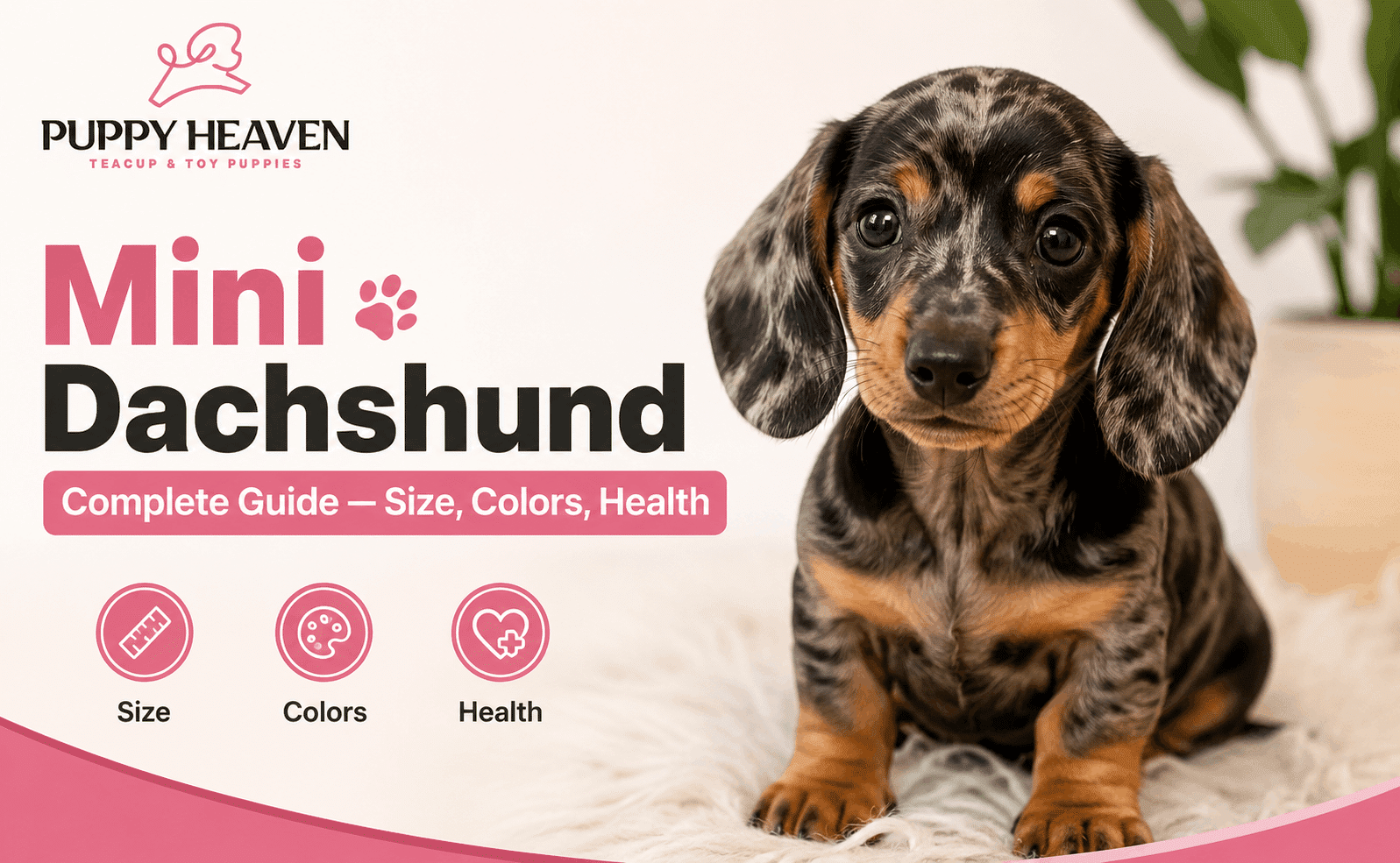
The Mini Dachshund is one of the most recognizable, most loved, and most misunderstood small dogs in the world. Everyone knows the silhouette — the impossibly long body, the short legs, the soulful eyes — but very few buyers actually understand what they’re getting into before bringing one home. This is a dog with a genuine working history as a badger hunter, a body built by genetics that make it both adorable and uniquely vulnerable, and a personality so big it routinely surprises owners who expected a quiet lapdog.
This guide covers everything most “Mini Dachshund” articles skip entirely: the real history behind the “badger dog” name, the actual AKC weight classifications (including the “tweenie” category nobody talks about), all three coat types and the full color and pattern genetics — including the double dapple health warning that responsible breeders take seriously — the complete IVDD prevention protocol with real 2026 surgery costs, a training timeline by age, grooming by coat type, and what a fair price actually looks like this year. All written in plain language, with real numbers, not vague generalities.
🦱 MINI DACHSHUND AT A GLANCE
11 lbs or less
AKC Weight (at 12 months)
5–6 inches
Height at Shoulder
12–16 years
Lifespan
3 Coat Types
Smooth, Long, Wire
~25%
Lifetime IVDD Risk
$1,200–$3,500
2026 Price Range
The Real History: Why a “Badger Dog” Has the Body It Does
The Dachshund’s history goes back to 15th-century Germany, where the breed was developed for a single, brutally specific purpose: chasing badgers into their underground burrows, fighting them, and dragging them out. The name itself tells the story directly — “Dachshund” translates literally to “badger dog” (Dachs = badger, Hund = dog) in German.
Every physical feature that makes the Dachshund instantly recognizable today was engineered for that job. The long, low body and short legs allowed the dog to enter narrow burrow tunnels that no larger hunting dog could navigate. The deep, broad chest — which can look almost disproportionate on such a small frame — provides surprisingly large lung capacity, giving the dog the stamina to pursue prey underground for extended periods. The large, paddle-shaped front paws function almost like shovels, making Dachshunds genuinely excellent diggers — a trait that shows up constantly in modern pet Dachshunds who burrow into blankets, couch cushions, and garden beds with the same instinct that once sent their ancestors into badger setts.
The Miniature Dachshund was developed later as breeders selectively bred smaller individuals — originally to hunt smaller prey like rabbits in even narrower tunnels than badgers required. This is where the lesser-known Kaninchen (Rabbit) Dachshund variety comes from — the smallest official Dachshund size, bred specifically for rabbit-hole hunting and still recognized by German and European kennel clubs today, even though it isn’t a separate AKC classification.
💡 WHY THIS HISTORY MATTERS FOR OWNERS TODAY
Understanding the working-dog engineering behind the Dachshund’s body explains nearly everything about modern ownership: the digging instinct, the surprising stamina and boldness, the prey drive toward small animals, and — most critically — the structural spine vulnerability that comes directly from breeding for an elongated body shape. This isn’t a coincidence or a flaw. It’s the direct biological tradeoff for a dog purpose-built to do something no other breed could do.
Mini Dachshund Size: The Complete Classification Guide
This is one of the most confusing areas for new buyers — and most competitor guides only give you half the picture. Here is the complete, accurate breakdown of every Dachshund size classification.
💡 THE OFFICIAL AKC RULE THAT MATTERS MOST
The AKC’s actual dividing line for Miniature classification is straightforward: a Miniature Dachshund must weigh 11 pounds or less at one year of age. This applies regardless of coat type or color — a smooth, long-haired, or wire-haired Dachshund under 11 lbs at 12 months is a Miniature; one over that weight is classified as Standard (or informally, “Tweenie” if it falls in that 12–16 lb middle zone).
Adult Mini Dachshunds typically stand 5–6 inches tall at the shoulder. Most reach their full adult weight by 12 months, though some continue minor filling out in chest depth and muscle until 18 months. The most reliable predictor of your puppy’s adult size is the documented weight of both parent dogs — ask your breeder for this specifically rather than relying on a puppy’s current size at 8 weeks.
Mini Dachshund Coat Types: Smooth, Long-Haired, and Wire-Haired
All three Dachshund coat types are AKC-recognized and can appear in the Miniature size. Each has genuinely different grooming requirements, slightly different temperament tendencies, and different visual character. Understanding the differences before you buy helps you choose the right fit for your lifestyle.
⚡ Smooth Coat
The original, classic Dachshund look. Short, sleek, shiny fur that lies flat against the body. The coat that shows up on every “sausage dog” postcard.
Grooming: Minimal — weekly brushing, monthly bathing
Shedding: Low
Note: More sensitive to cold due to thin coat — a sweater helps in winter
🍁 Long-Haired
Soft, often slightly wavy coat with elegant feathering on the ears, chest, legs, and tail — described by the AKC as a “veritable flag” on show dogs. Believed to have been developed by crossing early Dachshunds with spaniels for weather resistance.
Grooming: Moderate-high — brushing 2–3x weekly, more during shedding season
Shedding: Low to moderate
Note: Prone to matting around ears and chest if neglected; often perceived as the calmest of the three coat types
🦱 Wire-Haired
The newest of the three coat types historically. Dense, rough, coarse outer coat with a soft undercoat, plus a distinctive beard and bushy eyebrows that give this variety its characteristically scruffy, terrier-like expression.
Grooming: Hand-stripping 2–3x/year (not clipping — clipping damages coat texture)
Shedding: Lowest of the three coat types when properly maintained
Note: Often described as the most terrier-like in temperament — slightly more energetic and mischievous
Mini Dachshund Colors and Patterns: The Complete Genetics Guide
The Dachshund has one of the most genetically diverse color palettes of any small breed. Understanding the difference between a base color and a pattern — and which combinations carry real health considerations — is essential before you fall in love with a specific look.
Base Colors
| Color | Description | Rarity |
|---|---|---|
| Red | Ranges from pale strawberry to deep rust/mahogany; no points (markings) | Most common |
| Cream | Pale golden tone; “ee cream” variant has almost no black hairs | Common |
| Black and Tan | Jet black base with tan points on chest, paws, eyebrows, muzzle | Common |
| Chocolate and Tan | Deep cocoa-brown base with tan points | Moderately rare |
| Blue (and tan) | Dilute of black — steel-grey appearance | Rare — dilute color, see health note below |
| Isabella / Fawn (and tan) | Dilute of chocolate — pale fawn-beige appearance | Rare — dilute color, see health note below |
Patterns (Layered Over Base Colors)
| Pattern | Description |
|---|---|
| Dapple (Merle) | Marbled, mottled patches of lighter color over a darker base. The only Dachshund pattern that can naturally produce blue eyes. |
| Brindle | Tiger-stripe pattern — dark stripes over a lighter base, usually red or cream |
| Piebald | Distinct white patches on a colored base; head is usually solid-colored |
| Sable | Dark-tipped guard hairs over a red base — most common in long-haired Dachshunds |
| Wild Boar | Blended mix of black, brown, and grey hairs — almost exclusively seen in wire-haired Dachshunds |
⚠️ THE DOUBLE DAPPLE WARNING — READ THIS BEFORE BUYING ANY DAPPLE PUPPY
Dapple Dachshunds are visually stunning and consistently among the highest-demand color varieties — but there is a critical breeding safety issue every buyer must understand. When two dapple (merle) Dachshunds are bred together, the resulting “double dapple” puppies carry a dramatically elevated risk of being born deaf, blind, or both. This combination is widely considered inhumane by responsible breed-health organizations and is avoided by every reputable Dachshund breeder.
A single dapple (one merle parent, one non-merle parent) is genetically safe and produces no elevated health risk — the danger is specifically in the double-dapple combination. A double dapple puppy often shows excess white in the coat and may have visibly mismatched or unusually pale eyes — but appearance alone is not a reliable way to confirm this, which is why asking directly matters.
What to ask before buying any dapple puppy: “Were both parents dapple, or only one?” Any responsible breeder will answer this immediately and honestly. If a breeder is vague, defensive, or doesn’t understand the question, that is a serious red flag.
The Dilute Color Health Note
Blue and Isabella (fawn) colors — both genetic dilutes — are associated with a higher risk of Color Dilution Alopecia (CDA), a condition where puppies appear healthy at birth but begin experiencing patchy hair thinning or loss between 6 months and 3 years of age. Not every dilute-colored Dachshund develops CDA, but the association is well-documented enough that responsible breeders disclose it and monitor affected lines. If a striking blue or Isabella coat is part of why you’re drawn to a specific puppy, ask the breeder directly about CDA history in their breeding lines.
Mini Dachshund Temperament: A Huge Personality in a Tiny Body
The Mini Dachshund’s personality does not scale down with its body. This is a dog with genuine working-terrier confidence, sharp intelligence, and a streak of stubborn independence that comes directly from centuries of being bred to make split-second hunting decisions underground without waiting for human direction.
✅ WHAT MAKES MINI DACHSHUNDS WONDERFUL
Playful and devoted
Their playful nature means they can turn almost anything into a game — chasing a dropped item, hunting down the broom while you sweep, or inventing entertainment from nothing. Deeply loyal and affectionate toward their family.
Genuinely entertaining
The Dachshund’s personality is famous for its comedic, dramatic quality. Owners consistently describe them as one of the funniest breeds they’ve lived with.
Adaptable to small spaces
Excellent for apartment living. Exercise needs are real but manageable in compact spaces.
⚠️ WHAT TO BE PREPARED FOR
Stubborn independence
They can be independent and strong-willed, which can make training challenging. Their hunting heritage means they’re bred to think for themselves — not always to comply on command.
Strong digging instinct
This breed has a tendency to dig holes or burrow into blankets and items — a direct, hardwired expression of their original hunting purpose, not a behavioral problem to “fix.”
Can be vocal and territorial
Natural alert barkers with surprising boldness toward strangers and other animals relative to their size.
Mini Dachshunds respond well to positive reinforcement and thrive on consistent training methods. Harsh corrections backfire with this breed — their independence combined with sensitivity means punishment-based training creates avoidance and anxiety rather than compliance. Consistent, reward-based training started early produces the best long-term results.
Mini Dachshund Health: The Complete IVDD Guide and Every Other Condition
No health discussion about Dachshunds can begin anywhere except with IVDD — because no other condition comes close to its impact on this breed, statistically or financially. Everything else matters, but this is the condition that defines responsible Dachshund ownership.
🦱 IVDD (Intervertebral Disc Disease) — The Condition Every Owner Must Understand
IVDD is a spinal condition where the cushioning discs between the vertebrae degenerate, bulge, or rupture, compressing the spinal cord and nerves. The result ranges from mild back pain to complete hind-limb paralysis. Dachshunds account for nearly half to two-thirds of all IVDD cases seen in veterinary practice — a staggering statistic that traces directly to their genetics.
Why this breed specifically: A genetic condition called chondrodystrophy — the same gene mutation responsible for the breed’s short legs — also causes spinal discs to harden and degenerate prematurely, sometimes as early as 1–2 years of age. This means a rupture can be triggered by something as ordinary as jumping off a couch or taking an awkward step. Approximately 1 in 4 Dachshunds will experience an IVDD episode during their lifetime.
The 5 Stages of IVDD:
| Stage | Symptoms | Typical Treatment |
|---|---|---|
| 1 | Mild back pain, reluctance to jump | Rest, medication — usually non-surgical |
| 2 | Pain plus mild weakness, wobbly gait | Strict crate rest, pain management |
| 3 | Significant weakness, difficulty walking | Surgery often recommended |
| 4 | Paralysis, but pain sensation intact | Surgery — ~90% recovery rate if prompt |
| 5 | Complete paralysis, NO pain sensation | Emergency surgery within 24hrs — ~50-60% recovery |
Real 2026 Cost Breakdown:
| Item | Cost Range |
|---|---|
| Diagnostic imaging (MRI gold standard / CT alternative) | $1,500 – $6,000 |
| Surgery itself | $2,000 – $4,000 |
| Anesthesia | $800 – $1,200 |
| Hospitalization (per night) | $100 – $600 |
| Post-op care and rehab | $500 – $1,000 |
| TOTAL “ALL-IN” COST | $5,000 – $12,000+ |
The Complete Prevention Protocol:
- Use ramps or steps for any furniture access — never let your Mini Dachshund jump on or off couches, beds, or chairs
- Always use a harness, never a collar — and support the body properly when picking the dog up (one hand under the chest, one under the hindquarters)
- Maintain a lean body weight — every extra pound adds disproportionate stress to a spine already under genetic pressure
- Block access to stairs with baby gates until you can closely supervise stair use, and limit repetitive stair climbing even in adult dogs
- Discourage standing on hind legs for extended periods (begging, “dancing”)
- Enroll in pet insurance before age 1 — pre-existing condition exclusions mean coverage must start before any back symptoms ever appear
- Know the early warning signs: hesitation on stairs, reluctance to jump, unusual anxious behavior, yelping when touched, or a hunched back posture — get to a vet immediately if you see any of these
Other Significant Health Conditions
🦀 Hip Dysplasia
An inherited condition where the hip’s ball and socket joint doesn’t develop properly, causing rubbing, grinding, and potentially dislocation. Mini Dachshunds are prone to this largely due to their short-leg conformation. Treatment costs: Management with medication and weight control for mild cases; surgical correction $1,500–$4,000 for severe cases.
🦀 Patellar Luxation
The kneecap slips or pops out of its normal position, producing a characteristic skip in the gait — sometimes running on three legs before settling back to four. Treatment costs: Surgery $1,500–$3,000 per knee for moderate-severe cases.
◠️ Obesity
The Mini Dachshund’s body shape makes it genuinely prone to excess weight gain — their short legs make exercise more physically demanding relative to their body, and inadequate diet compounds the risk. This isn’t just a cosmetic issue: excess weight directly accelerates IVDD, hip dysplasia, and patellar luxation. Weight management is one of the single highest-impact things an owner can control.
👁️ Eye Conditions
Mini Dachshunds can be affected by several inherited eye problems:
- Progressive Retinal Atrophy: Degenerative condition affecting the retina’s light-detecting cells, causing night blindness progressing to full vision loss
- Cataracts: Clouding of the lens leading to vision impairment
- Glaucoma: Increased eye pressure causing pain and vision loss
- Distichiasis: Eyelashes growing inward toward the eye, causing irritation
🦷 Dental Disease
Mini Dachshunds are prone to periodontal disease due to small, cramped mouths — leading to bad breath, inflamed gums, difficulty eating, and excessive pawing at the mouth. Daily tooth brushing from puppyhood is the most effective prevention. Professional cleanings every 1–2 years are typically necessary.
Grooming by Coat Type
| Coat Type | Brushing | Bathing | Special Care |
|---|---|---|---|
| Smooth | Weekly, light | Monthly | Sweater in cold weather — thin coat offers little insulation |
| Long-Haired | 2–3x weekly | Every 3–4 weeks | Watch ear and chest feathering for matting |
| Wire-Haired | Weekly | Every 4–6 weeks | Hand-strip 2–3x/year — never clip with machine (damages coat protection) |
Although there are no true hypoallergenic dogs, Mini Dachshunds across all coat types produce relatively low dander and don’t shed excessively compared to many breeds — making them a reasonably good option for mild allergy sufferers, with smooth coats typically producing the least dander overall.
Training a Mini Dachshund: A Timeline by Age
WK
Foundation Window
Crate introduction (positive only), name recognition, basic schedule, gentle handling exercises. Critical at this stage: establish furniture rules from day one — if you don’t want an adult Dachshund jumping on/off the couch (a real IVDD risk), don’t allow it as a cute puppy habit. Socialization with people, sounds, and environments is essential during this peak window.
MO
Core Commands + Housetraining
Sit, Down, Stay, Come, Leave It. Mini Dachshunds can be notoriously stubborn during housetraining — consistent schedule and crate training (never punishment) produce the best results. Their independence means short, high-reward sessions work better than long drilling sessions.
MO
Adolescence — The Independence Test
Their natural stubbornness peaks. Continue consistent positive reinforcement. This is also the window where digging and territorial barking habits get reinforced or redirected — channel digging instinct into an appropriate outlet (a sandbox or designated digging spot) rather than fighting it entirely.
MO
Adult — Maintenance
Personality fully settles. Maintain the spine-protective habits (ramps, harness, weight control) for life — these aren’t puppy phase rules, they’re lifelong management for this breed’s structural vulnerability.
Mini Dachshund Price Guide: 2026 Market Data
| Source / Color | 2026 Price Range | Notes |
|---|---|---|
| Reputable breeder — standard colors | $1,200 – $2,500 | Health-tested, vet-checked, full documentation |
| Dapple / cream / rare colors | $2,500 – $3,500+ | High demand colors command real premiums |
| Rescue / shelter adoption | $150 – $650 | Often includes spay/neuter, vaccines, microchip |
| Private listings under $600 | $200 – $600 | High risk of skipped health testing |
Real Lifetime Cost of Ownership
| Expense | Estimate |
|---|---|
| First year (puppy + supplies + initial vet) | $1,500 – $3,500 |
| Monthly routine costs (food, prevention, vet) | $45 – $300/month |
| Grooming (coat-dependent) | $0 – $80/month |
| Pet insurance (start before age 1 — non-negotiable) | $25 – $50/month |
| IVDD surgery if it occurs (~1 in 4 chance) | $5,000 – $12,000 |
| LIFETIME TOTAL (12–16 years, no major incident) | $12,000 – $20,000+ |
Find Your Mini Dachshund at Puppy Heaven
At Puppy Heaven, we’ve been placing healthy, vet-checked purebred and designer puppies with families across Las Vegas, South Florida, and nationwide for over 21 years. Our boutiques in Las Vegas, Nevada and Sunrise, Florida let you meet puppies in person — and our live video call service connects remote buyers with the specific puppy they’re considering before anything is finalized.
★ EVERY PUPPY HEAVEN PUPPY INCLUDES
✓ Full veterinarian health examination
✓ Vaccinations and deworming — protected from day one
✓ Written health guarantee — in writing
✓ Microchipping registered to you
✓ Parent health and color documentation
✓ 100% puppy financing available
✓ Nationwide delivery — hand or air
✓ Live video call before you commit
Exploring other small breeds too? Browse our full purebred puppy catalog and designer breed selection, or see our complete list of available puppies.
Financing Options |
Contact Our Team
Frequently Asked Questions
How much does a Mini Dachshund weigh?
By AKC classification, a Miniature Dachshund must weigh 11 pounds or less at 12 months of age. Standard Dachshunds weigh 16–32 lbs. Dogs falling between 12–16 lbs are sometimes informally called “Tweenies” — not an officially recognized category.
What is a Rabbit (Kaninchen) Dachshund?
The Rabbit Dachshund is the smallest official Dachshund size, recognized in Germany and Europe, weighing roughly 7–9 lbs (3–3.5 kg) with a chest circumference up to 30 cm. It was bred specifically to hunt rabbits in tunnels too narrow for the Standard or even Miniature size. It is not a separate AKC classification in the US.
How likely is my Mini Dachshund to get IVDD?
Approximately 1 in 4 Dachshunds will experience an IVDD episode in their lifetime. Dachshunds account for nearly half to two-thirds of all IVDD cases seen across all breeds in veterinary practice. Prevention through ramps, harness use, weight control, and avoiding jumping significantly reduces — though cannot fully eliminate — this risk.
What is a double dapple Dachshund and why is it dangerous?
A double dapple results from breeding two dapple (merle) Dachshunds together. These puppies carry significantly elevated risk of being born deaf, blind, or both. A single dapple — one merle parent, one non-merle parent — carries no such risk. Always ask a breeder whether both parents of a dapple puppy were dapple before buying.
How long do Mini Dachshunds live?
The average lifespan is 12–15 years, with exceptionally healthy individuals known to live up to 20 years. Lifespan is heavily influenced by spine and weight management throughout life — keeping a Mini Dachshund lean and protecting their back from a young age meaningfully extends their healthy years.
Which Mini Dachshund coat type sheds the least?
Wire-haired Dachshunds shed the least when properly hand-stripped on a regular schedule (2-3 times per year). Smooth and long-haired coats both shed at low-to-moderate levels naturally, with smooth coats generally producing slightly less dander overall.
How much does a Mini Dachshund cost in 2026?
From a reputable breeder, expect $1,200–$2,500 for standard colors and $2,500–$3,500+ for high-demand colors like dapple or cream. Listings significantly below $600 from private sellers carry real risk of skipped health testing and undocumented breeding.
Ready to Find Your Mini Dachshund?
21+ years of experience, 30,000+ successful placements. Every puppy vet-checked, health-guaranteed, and ready for a loving home.