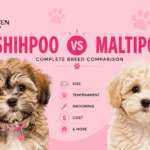
If you’ve been scrolling through puppy photos for the last hour trying to decide between a Shihpoo and a Maltipoo, you are not alone. These two little dogs show up on almost every “best small dog” list, they photograph like teddy bears, and honestly, at a quick glance, a lot of people can’t tell them apart. But they’re not the same dog, and the differences actually matter once you bring one home.
Quick answer: The main difference between a Shihpoo and a Maltipoo is coat and face shape. Shihpoos have a rounder, flatter teddy-bear face and a slightly stockier body from the Shih Tzu side. Maltipoos have a longer muzzle, silkier coat, and a leaner build from the Maltese side. Both are small, affectionate, low-shedding companion dogs that do great with families and first-time owners.
In this guide we’re going to walk through everything: where each breed comes from, how big they get, what their coats actually feel like day to day, which one barks more, which one is easier to train, health concerns to watch for, and — because nobody talks about this honestly enough — what you’ll actually pay for one in 2026. We’ll also tell you flat out which dog tends to suit which type of home, so you’re not just left with “well, it depends.”
Shihpoo vs Maltipoo at a Glance
Before we go deep on each trait, here’s the whole comparison in one table so you can jump straight to what you care about most.
| Trait | Shihpoo | Maltipoo |
|---|---|---|
| Parent breeds | Shih Tzu × Poodle | Maltese × Poodle |
| Adult weight | 7–18 lbs | 5–20 lbs |
| Adult height | 8–12 inches | 8–14 inches |
| Coat type | Fluffy, curly or wavy | Soft, wavy to curly |
| Shedding | Low to moderate | Low, hypoallergenic-leaning |
| Energy level | Moderate, mellow indoors | Moderate to high, playful |
| Trainability | Good, can be a touch stubborn | Very good, eager to please |
| Barking tendency | Moderate (5/10) | Moderate to high, vocal |
| Lifespan | 12–16 years | 10–15 years |
| Grooming needs | High, trim every 6–8 weeks | High, trim every 6–12 weeks |
| Puppy Heaven price | Typically $2,800–$3,500 | Typically $2,800–$3,200 (rare colors up to $5,000+) |
Where Each Breed Comes From
Neither the Shihpoo nor the Maltipoo is an old, established breed. Both are what’s called “designer dogs” — intentional crosses between two purebred parents, done to combine specific traits. Neither is recognized by the American Kennel Club, though both are recognized by hybrid registries like the American Canine Hybrid Club.
The Shihpoo
A cross between the Shih Tzu, a companion breed bred for Chinese royalty centuries ago, and the Poodle, one of the most intelligent breeds in the world. The pairing became popular in the 1980s and 1990s as families started looking for small dogs with lower shedding potential and a bit less stubbornness than a purebred Shih Tzu.
The Maltipoo
A cross between the Maltese, an ancient toy breed known for its silky white coat and gentle nature, and the Poodle. The Maltipoo emerged in the United States in the late 1990s and quickly became one of the most requested designer breeds, largely because of how consistently sweet and low-shedding the litters tend to be.
The Shih Tzu itself has a history stretching back over a thousand years. The breed was kept almost exclusively by Chinese emperors and their households, bred purely for companionship rather than any working purpose — no herding, no hunting, just being a loyal lap dog for royalty. That long history as a pampered indoor companion is part of why the Shih Tzu, and by extension the Shihpoo, tends to be so people-focused and comfortable with a slower, indoor-centered lifestyle.
The Maltese has an even longer documented history, with references to small white lap dogs from the Mediterranean region going back over 2,000 years. Sailors and traders are believed to have carried the breed’s ancestors across the Mediterranean, and it eventually became a favorite of European nobility, prized for its silky coat and gentle nature. That refined, devoted temperament is a big part of what the Maltipoo inherits.
Both the Shihpoo and Maltipoo owe their intelligence and low-shedding coat mostly to the Poodle side. Poodles were originally bred as water retrievers in Germany, later refined in France, and their curly, dense coat was actually functional — it kept them warm in cold water while shedding very little. That same coat trait is what breeders were chasing when they started crossing Poodles with companion breeds like the Shih Tzu and Maltese in the first place.
Because both breeds share the Poodle parent, you’ll notice a lot of overlap in personality and coat quality. The differences mostly come down to what the Shih Tzu brings versus what the Maltese brings — and that’s really the whole story of this comparison.
Size and Appearance
Both dogs land in roughly the same size bracket, so if you’re choosing based on size alone, it’s close. Shihpoos usually run 7 to 18 pounds and stand 8 to 12 inches tall. Maltipoos have a slightly wider range, from 5 to 20 pounds and 8 to 14 inches, mostly because they’re bred in more size variations — teacup, toy, and mini.
The bigger visual difference is in the face and body shape. Shih Tzus have a shorter muzzle and a rounder skull, and that shows up in the Shihpoo as a flatter, more “teddy bear” face with a slightly stockier, compact body. Maltese have a longer, narrower muzzle and a more refined frame, and Maltipoos tend to inherit that — a longer nose, a leaner build, and a slightly more elegant look overall.
Coat color-wise, both breeds show up in a wide range: white, cream, apricot, black, brown, gray, and parti-color combinations. Maltipoos lean toward more white and cream coats because of the Maltese influence, while Shihpoos show a bit more color variety since Shih Tzus carry a broader color range genetically.
Coat, Shedding, and Allergies
This is usually the deciding factor for a lot of families, so let’s be specific instead of just saying “both are hypoallergenic,” which honestly gets said about every Poodle mix on the internet.
No dog is 100% hypoallergenic — that’s a myth no matter which breed guide you’re reading. What actually varies is how much dander and loose hair a dog produces, and both the Shihpoo and Maltipoo tend to do well here because of their Poodle genetics. That said, coat outcome depends heavily on which parent’s genes dominate in an individual puppy, so even littermates can shed differently.
- Shihpoo coats tend to be a bit thicker and fluffier, closer to the Shih Tzu’s double coat in some lines. This can mean slightly more shedding than a Maltipoo, though still far less than a non-Poodle-mix breed.
- Maltipoo coats are usually finer and silkier, single-coated more often, and tend to shed the least of the two — which is part of why they’re so popular with allergy-sensitive households.
If allergies are a serious concern in your home, meeting the specific puppy (or its parents) before committing is always smarter than trusting the breed name alone. That’s something we always recommend, and it’s why we offer video calls and in-person visits before you commit to a puppy.
Temperament and Personality
Here’s where the two breeds genuinely start to feel different in daily life, not just on paper.
Shihpoos tend to be relaxed, affectionate, and happiest curled up next to their favorite person. They’re social without being needy, and they usually do fine with moderate amounts of alone time, though they still prefer company. Shih Tzus were bred purely as companion dogs for centuries, and that laid-back, people-focused temperament comes through clearly in the Shihpoo.
Maltipoos tend to run a little more energetic and a little more vocal. They’re playful, quick to bond, and often described as “velcro dogs” because they like to be wherever their owner is, room to room. They’re also generally quicker to pick up on emotional cues, which makes them great for people who want a dog that feels tuned in to them.
Neither temperament is better — it depends on what you want. If you’re after a calmer lap companion, the Shihpoo usually edges ahead. If you want a dog that’s a bit more playful and interactive throughout the day, the Maltipoo tends to fit better.
Trainability and Intelligence
Both breeds get a real intelligence boost from the Poodle side, which is consistently ranked among the smartest dog breeds in the world. That said, there’s a small but noticeable difference in how each mix approaches training.
Maltipoos are usually a little more eager to please, which makes obedience training and potty training go smoother, especially for first-time owners. Shihpoos are just as capable of learning quickly, but the Shih Tzu side can bring a streak of independence — not stubborn in a difficult way, just a dog that sometimes decides a trick isn’t worth doing again if the reward isn’t good enough.
Positive reinforcement works best for both. Short, upbeat training sessions with treats and praise will get you further than any kind of firm-handed approach, which tends to backfire with both of these sensitive little breeds.
Energy Levels and Exercise Needs
Neither breed needs a backyard or long daily runs. Both do well with a couple of short walks and some indoor playtime, which is a big part of why they’re both such popular apartment dogs.
Maltipoos generally have a bit more get-up-and-go. They enjoy games, chasing toys, and short bursts of zoomies around the living room. Shihpoos are content with less activity and are more likely to nap through the afternoon, though they still enjoy a walk and some playtime when their person is up for it.
Grooming Needs
Both breeds are considered high-maintenance in the grooming department — this is one area where “low shedding” doesn’t mean “low effort.” A coat that doesn’t shed still needs regular brushing and trimming, or it will mat.
| Grooming Task | Shihpoo | Maltipoo |
|---|---|---|
| Brushing | 3–4 times per week | Daily to prevent matting |
| Professional trim | Every 6–8 weeks | Every 6–12 weeks |
| Bathing | Every 2–3 weeks | As needed |
| Face/eye cleaning | Daily (tear staining common) | Daily (tear staining common) |
Both breeds are prone to tear staining around the eyes, so daily wiping with a damp cloth is worth building into your routine early. Dental care matters a lot too — small breeds are more prone to dental issues, so regular brushing or dental chews go a long way.
Health and Lifespan
Designer breeds often benefit from what’s called hybrid vigor — mixing two different gene pools can lower the risk of some inherited conditions that show up more often in purebred lines. That said, both breeds can still inherit health issues from either parent, so it’s worth knowing what to watch for.
Shihpoo Health Watch-Outs
- Patellar luxation (kneecap slipping)
- Dental crowding, common in small breeds
- Eye conditions and tear staining
- Breathing sensitivity in flatter-faced lines
- Skin and allergy sensitivities
Maltipoo Health Watch-Outs
- Patellar luxation
- Hypoglycemia in very small teacup lines
- Dental issues common to small breeds
- Eye conditions and tear staining
- Collapsed trachea in toy-sized dogs
Shihpoos average 12 to 16 years, which is slightly longer than the Maltipoo’s average of 10 to 15 years, though both numbers depend heavily on the individual dog’s genetics and care. Buying from a breeder who health-tests the parent dogs and provides a written health guarantee is one of the most important decisions you’ll make in this whole process, regardless of which breed you choose.
Barking and Noise Level
If you live in an apartment with thin walls, this section matters more than people expect. Both breeds will alert-bark at strangers, doorbells, or unfamiliar sounds, but Maltipoos are generally the more vocal of the two. Shih Tzus were bred as quiet indoor companions, and that tends to carry into the Shihpoo, giving it a slight edge for households that want less noise.
Early socialization and consistent training make a real difference for both breeds. A well-socialized puppy of either breed can learn when barking is appropriate and when it’s not, so this shouldn’t be a dealbreaker on its own — just something to factor in if you have close neighbors.
Good Family Dogs? Kids, Other Pets, and Apartment Living
Both breeds do well with families, including households with children, as long as interactions are supervised — these are small dogs, and rough handling from young kids can accidentally hurt them. Both also tend to get along fine with other dogs and cats when raised together or properly introduced.
For apartment living, both are excellent choices. Neither needs a yard, both adapt well to smaller spaces, and both are portable enough for city life, travel, or frequent moves. If you’re specifically looking at other apartment-friendly options too, our designer breeds collection has several similar small companion dogs worth browsing.
Feeding and Nutrition
Small breeds like the Shihpoo and Maltipoo have fast metabolisms and small stomachs, which means they generally do better on several small meals a day rather than one or two large ones, especially as puppies. Both breeds are also prone to dental crowding, so kibble size and texture matter more than people expect — pieces that are too large can discourage eating, while pieces that are too small can be swallowed without any chewing benefit for the teeth.
Neither breed has unusual dietary restrictions beyond what applies to small dogs generally: a high-quality, age-appropriate food, portion control to avoid obesity (which puts extra strain on those small joints), and fresh water always available. Toy and teacup-sized puppies of either breed can be prone to low blood sugar episodes if meals are skipped, so sticking to a consistent feeding schedule matters more with these breeds than it might with a larger dog.
Expect to budget somewhere between $240 and $600 a year on food for either breed, depending on the quality of food you choose and the adult size your puppy grows into.
How They Compare to Their Purebred Parents
It helps to see the whole family tree side by side, especially if you’re still deciding whether a designer mix is even the right call versus going purebred.
| Breed | Shedding | Grooming Effort | Vocal Level |
|---|---|---|---|
| Shih Tzu (purebred) | Low | High | Moderate |
| Shihpoo (mix) | Low–Moderate | High | Moderate |
| Maltese (purebred) | Very Low | High | Moderate–High |
| Maltipoo (mix) | Low | High | Moderate–High |
| Poodle (purebred) | Very Low | High | Low–Moderate |
What this table really shows is that both mixes land somewhere between their two parent breeds, which is exactly the point of a designer cross — you’re aiming for a blend rather than an exact copy of either parent. If you’d rather see a purebred option directly, it’s worth browsing the Shih Tzu, Maltese, and Poodle pages before deciding.
Common Myths About Shihpoos and Maltipoos
Myth: They’re completely hypoallergenic.
No dog is completely allergen-free. Both breeds produce less dander and loose hair than most, which helps a lot of allergy sufferers, but it’s not a guarantee for everyone.
Myth: Small dogs don’t need training.
Small size doesn’t mean small personality. Both breeds are smart enough to develop bad habits quickly if training is skipped, especially around barking and jumping.
Myth: Designer breeds are automatically healthier than purebreds.
Hybrid vigor can lower the odds of certain inherited conditions, but it’s not a guarantee. Health testing on the parent dogs matters far more than the fact that a puppy is a mix.
Myth: A “teacup” size means a healthier, easier dog.
Teacup-sized dogs of either breed are actually more prone to certain health issues, like hypoglycemia and fragile bones, simply because of how small they are. Toy size is generally the sweet spot between size and durability for most families.
What to Expect in the First 30 Days
Whichever breed you choose, the first month at home looks pretty similar. Here’s a realistic rundown so you’re not caught off guard.
- Week 1: Expect some whining at night and a few accidents indoors as your puppy adjusts to a new environment. Keep the routine simple and predictable — same feeding times, same potty spot, same bedtime.
- Week 2: Potty training starts clicking if you’re consistent. Both breeds pick this up reasonably fast, though Maltipoos often show quicker progress thanks to that eager-to-please streak.
- Week 3: Personality starts coming through more. This is a good time to start short basic obedience sessions — sit, stay, come — using treats and praise.
- Week 4: Most puppies are settling into a rhythm by now. Vet follow-ups for vaccinations should be on the calendar if they haven’t already started, and it’s a good time to schedule that first grooming trim.
Puppy-proofing your home before pickup day makes this whole stretch easier — tuck away loose cords, small objects, and anything chewable, and set up a dedicated space with a crate or pen so your puppy has somewhere safe to settle when you can’t watch them directly.
Shihpoo vs Maltipoo Price: What You’ll Actually Pay in 2026
This is the part most breed comparison articles skip entirely, or they just throw out a vague national average that doesn’t reflect what you’ll actually see from a real breeder. Here’s what pricing looks like at Puppy Heaven specifically, based on current and recent litters.
ShihPoo Pricing
$2,800–$3,500
Toy and teacup-sized ShihPoos typically fall in this range, with tax and any delivery or nanny-service options added on top depending on how you choose to bring your puppy home.
Maltipoo Pricing
$2,800–$3,200
Standard Toy Maltipoos sit in this range. Rare coat colors like red, champagne, or phantom can push pricing to $3,500–$5,000+ depending on availability and demand.
A few things move the price up or down for either breed: coat color rarity, gender (females often run $200–$500 more), how small the adult size is expected to be, and what’s included with the puppy — a full vet exam, vaccinations, deworming, microchipping, a written health guarantee, and a starter kit are all part of what you’re paying for at a reputable breeder, not just the puppy itself.
If you see either breed listed under $1,000–$1,500 from an unfamiliar source, treat that as a red flag rather than a bargain. That price point almost never covers proper health testing or veterinary care, and it often means the puppy came from a high-volume breeding operation rather than a small, ethical one.
You can browse current availability and exact pricing on individual puppies through our ShihPoo puppies for sale page and our Maltipoo puppies for sale page. We also offer simple financing options if you’d rather spread the cost out instead of paying all at once.
Pros and Cons of Each Breed
Shihpoo
Pros
- Calmer, more laid-back temperament
- Quieter than most small breeds
- Longer average lifespan
- Very affectionate and cuddly
Cons
- Can be a bit stubborn in training
- Slightly higher shedding potential
- Prone to breathing sensitivity in flatter-faced lines
Maltipoo
Pros
- Very trainable, eager to please
- Lowest shedding of the two
- Playful and highly interactive
- Wide range of sizes and colors available
Cons
- More vocal, can bark more without training
- Higher daily grooming needs
- Teacup lines can be prone to hypoglycemia
So Which One Should You Choose?
Here’s the honest, practical breakdown instead of a wishy-washy “it depends on you”:
- Choose a Shihpoo if you want a calmer lap dog, you have quieter household needs, you’re okay with a bit of independent streak during training, and you like the rounder, teddy-bear face.
- Choose a Maltipoo if you want a highly trainable, playful companion, allergies are a bigger concern in your home, and you don’t mind a dog that’s a little more vocal and wants to be involved in everything you do.
- If you’re a first-time dog owner, either breed works well, but the Maltipoo’s eagerness to please usually makes the first few months of training slightly smoother.
- If you have young kids, both breeds do fine with supervision, though the Shihpoo’s steadier temperament can be a slightly easier fit for a busy, noisy household.
Honestly, a lot of families end up choosing based on which individual puppy they connect with, rather than the breed on paper — and that’s a completely reasonable way to decide too. Meeting the puppy in person or on a video call usually tells you more than any comparison article can.
Daily Routine, Toys, and Enrichment
Because neither breed needs intense physical exercise, mental enrichment matters just as much as walks. Both Shihpoos and Maltipoos are smart enough to get bored quickly if their day is nothing but naps and meals, and boredom in a smart small dog usually shows up as chewing, barking, or digging through the trash.
A simple daily routine that works well for either breed looks something like this: a short 15 to 20 minute walk in the morning, a puzzle toy or snuffle mat during the day to keep their mind occupied, a five to ten minute training refresher session in the afternoon, and some active playtime in the evening before winding down. Rotating toys every week or two, instead of leaving everything out all the time, also helps keep things interesting without needing to buy new toys constantly.
Maltipoos tend to enjoy fetch, tug, and anything involving chasing, matching their higher energy level. Shihpoos are often just as happy with a good chew toy and some cuddle time on the couch, though they’ll still take you up on a game if you start one. Soft toys with squeakers are popular with both breeds, but keep an eye on durability — small jaws can still tear through cheap stuffing faster than you’d expect.
Questions to Ask Before You Bring a Puppy Home
Whichever breed you land on, the breeder matters more than the breed name. Here are the questions worth asking before you commit, whether you’re looking at a Shihpoo, a Maltipoo, or any small designer breed:
- Have the parent dogs been health tested, and can I see documentation?
- What vaccinations and vet checks has the puppy already had?
- Is there a written health guarantee, and what does it actually cover?
- Can I meet the puppy in person or on a video call before deciding?
- What’s included in the price — starter kit, microchipping, deworming?
- What support is available if I have questions after bringing the puppy home?
A breeder who answers all of these clearly and without hesitation is usually a good sign. Vague answers, pressure to decide immediately, or an unwillingness to let you see the puppy beforehand are red flags worth taking seriously, regardless of how good the price looks.
Frequently Asked Questions
Is a Shihpoo or Maltipoo better for allergies?
Both are considered low-shedding thanks to their Poodle genetics, but Maltipoos generally shed slightly less due to their finer, more Maltese-like coat. No dog is completely hypoallergenic, so if allergies are severe, spending time with the specific puppy first is the safest approach.
Which is calmer, a Shihpoo or a Maltipoo?
Shihpoos tend to be calmer and more content with lower activity levels, largely due to the Shih Tzu’s laid-back companion-dog background. Maltipoos are usually more energetic and playful throughout the day.
Do Shihpoos or Maltipoos bark more?
Maltipoos tend to be more vocal overall. Shihpoos still alert-bark, but generally less frequently, especially with consistent training and early socialization.
Which breed lives longer, Shihpoo or Maltipoo?
Shihpoos average a slightly longer lifespan at 12 to 16 years, compared to 10 to 15 years for Maltipoos, though individual health and care play the biggest role in both.
How much do Shihpoos and Maltipoos cost?
At Puppy Heaven, ShihPoos typically range from $2,800 to $3,500, and Maltipoos typically range from $2,800 to $3,200, with rare colors reaching $3,500 to $5,000 or more. Pricing includes vet checks, vaccinations, and a health guarantee.
Are Shihpoos or Maltipoos better with kids?
Both do well with children when interactions are supervised. Shihpoos’ steadier temperament can be a slight advantage in busier households, but both breeds are affectionate and generally patient with kids who are taught to handle small dogs gently.
Is a Shihpoo or Maltipoo easier to train?
Maltipoos are usually a little easier to train because of their eagerness to please. Shihpoos are just as intelligent but can show more independence, so training may take a touch more patience and consistency.
Which breed sheds less, Shihpoo or Maltipoo?
Maltipoos generally shed the least of the two, thanks to their finer, more Maltese-like coat. Shihpoos still shed lightly compared to non-Poodle-mix breeds, but slightly more than a typical Maltipoo.
Can Shihpoos and Maltipoos be left alone during the day?
Both breeds can handle a normal workday alone once they’re past the puppy stage, though neither does well with long stretches of isolation regularly. Both are companion breeds at heart and thrive with regular attention, so a dog walker or midday check-in is a good idea for full-time work schedules.
Traveling With a Shihpoo or Maltipoo
Small size is a real advantage if you travel often or fly regularly. Both breeds typically fit comfortably in an airline-approved carrier under the seat, and neither needs much space in a car for road trips. That said, a few practical tips apply to both breeds equally.
Get your puppy used to a carrier early, well before any actual trip, so it feels familiar rather than stressful. Short practice car rides help prevent motion sickness and anxiety around travel later on. Pack familiar items — their regular food, a favorite toy, and something that smells like home — since new environments can be unsettling for a small dog that’s used to routine.
If you’re relocating rather than just traveling, both breeds adapt reasonably well to a new home once they have a consistent routine again. The adjustment period is usually shorter for dogs that already have solid training and socialization behind them, which is another reason those first 30 days at home matter so much.
Meet Your Match at Puppy Heaven
Whichever breed feels right for your home, the most important step is choosing a breeder who prioritizes health testing, early socialization, and full transparency about the puppy’s background. At Puppy Heaven, every ShihPoo and Maltipoo puppy comes with a full veterinary exam, vaccinations, deworming, a written health guarantee, and a starter kit to make the first few days at home easier.
We’re a family-run boutique with more than 20 years of experience, boutiques in both Las Vegas, Nevada and Sunrise, Florida, and options for video calls, in-store visits, financing, and nationwide delivery. You can also compare either breed against their purebred parent lines — browse our Shih Tzu puppies, Maltese puppies, or Poodle puppies if you want to see where these designer breeds get their personalities from.
Ready to meet your new best friend?
Browse available ShihPoo and Maltipoo puppies, or reach out and we’ll help you find the perfect match.