The Yorkshire Teacup Dog — better known as the Teacup Yorkie — is one of the most searched, most admired, and most misunderstood small dogs in America. It’s a dog that started life catching rats in industrial mills and somehow ended up as the most glamorous toy dog in the world. A dog that weighs under 4 pounds but carries enough personality for a 40-pound dog. A dog with a coat so fine and silky it’s technically hair, not fur — which is one reason allergy-sensitive households love it.
But finding good information about the Teacup Yorkie specifically — not just the standard Yorkshire Terrier — is harder than it should be. Most guides either skim the surface or focus almost entirely on health warnings without telling you what life with one of these dogs actually looks like day to day. This guide goes deeper. You’ll get the full history, the real genetics behind the coat colors and the hair-not-fur distinction, a complete health breakdown with actual treatment costs, a training timeline by age, the honest scam guide that protects your money, and what responsible sourcing looks like in 2026. Everything in plain language.
What Is a Yorkshire Teacup Dog?
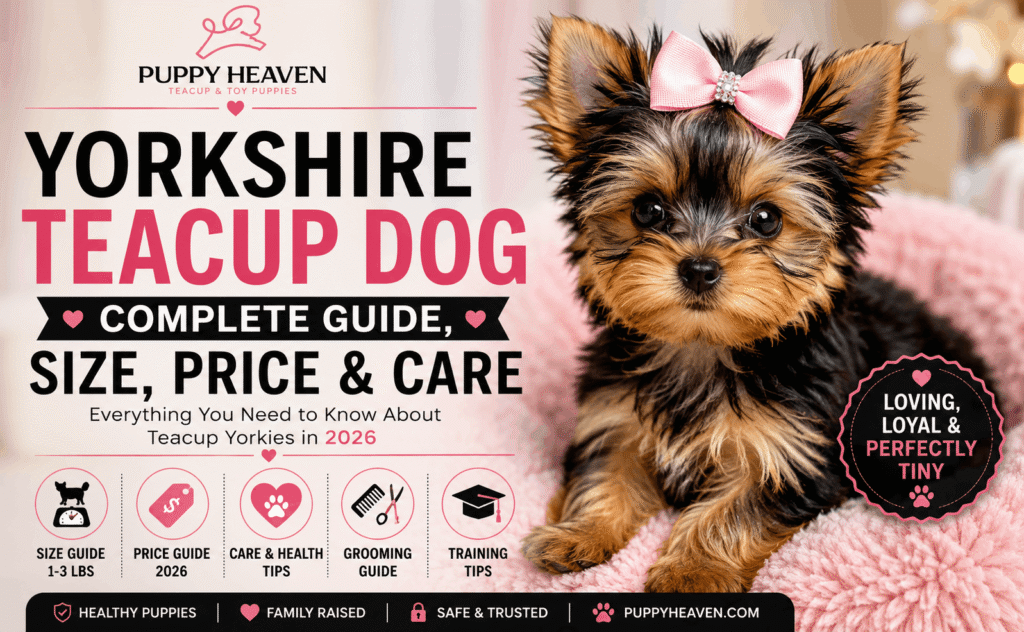
A Yorkshire Teacup Dog — interchangeably called a Teacup Yorkie, Micro Yorkie, Mini Yorkie, or Teacup Yorkshire Terrier — is a Yorkshire Terrier bred specifically to fall below the standard breed weight. The AKC breed standard recognizes Yorkshire Terriers at up to 7 pounds. A Teacup Yorkie is expected to stay under 4 pounds as an adult — typically between 1 and 3 pounds.
The word “teacup” is critical to understand: it is not an AKC-recognized classification, breed category, or official size standard. The AKC recognizes Teacup Yorkies as regular Yorkshire Terriers — because that’s what they are. “Teacup” is a marketing term that emerged to describe dogs bred to be smaller than the already-small breed standard. Knowing this protects you as a buyer — because anyone can call any small puppy a “teacup” regardless of its expected adult size.
📘 THE WORLD’S SMALLEST YORKIE ON RECORD
The smallest Yorkshire Terrier in recorded history was a dog named Sylvia, an English Yorkie who measured just 2.5 inches tall and weighed only 4 ounces. While this is an extreme outlier, it illustrates just how small the natural genetic range of this breed extends. Sylvia’s record stands as a historical testament to the Yorkshire Terrier’s lineage — not a breeding goal to aspire to.
The Real History: From Scottish Mills to Royal Laps
The Yorkshire Terrier has one of the most dramatic breed transformation stories in dog history — from rough working-class rat-catcher to the world’s most elegant toy dog in less than a century.
The Scottish Origins
In the 18th century, Scottish workers began migrating south into Yorkshire, England, seeking work in the booming textile mills and coal mines. They brought their working terriers with them — breeds like the Clydesdale Terrier and the Skye Terrier. These Scottish and English terriers interbred in the Yorkshire region, producing a tough, small, extraordinarily driven black-and-tan terrier. Every black and tan dog in the area for a period was simply called a Yorkshire Terrier.
Huddersfield Bob — The Founding Father
The breed’s modern lineage traces to one specific dog: Huddersfield Bob, born in 1865 in Huddersfield, Yorkshire. A champion working dog and show dog, Bob is credited as the founding father of the Yorkshire Terrier breed as we know it today. A local landowner’s deliberate breeding program around Bob established the size, coat texture, and color that became the foundation of the breed standard.
At this stage in history, the Yorkie weighed 10 to 15 pounds — a solid, muscular working terrier with a job to do. These dogs were sent into mines and textile mills specifically to kill rats and mice. Their small enough to pursue rodents through machinery, bold enough to fight them, and fast enough to catch them. The working-dog feistiness you see in every Teacup Yorkie today comes directly from this heritage.
The Transformation to Lap Dog
As the Victorian era progressed, wealthy women of the upper classes began acquiring Yorkies — not as working dogs, but as fashionable companions. Show dogs became highly coveted. Breeders began selecting progressively smaller dogs with the finest, silkiest coats. The show ring standard at the time favored smaller, more elegant-looking dogs. Within roughly one generation, the Yorkshire Terrier shrank from a 10–15 lb working terrier to the 4–7 lb companion dog the AKC recognized in 1885.
The “teacup” went even further — some breeders began selecting the smallest individuals from each generation, eventually producing the micro-sized Yorkies we see today. The coat became finer, the frame became smaller, but the personality — the terrier confidence, the bold alertness, the fearless attitude — remained unchanged. This is the core paradox of the Teacup Yorkie: a dog that fits in your pocket but doesn’t know it.
Yorkshire Teacup Dog Appearance: Size, Build, Colors and the Hair Science
Size and Build
A full-grown Teacup Yorkie stands between 5 and 7 inches tall at the shoulder and weighs between 1 and 4 pounds. The body is compact, slightly longer than it is tall, with a level back and well-developed chest for their size. Ears are small, V-shaped, and stand erect — pointing upward and slightly forward. Eyes are dark, bright, and full of what the AKC breed standard describes as “keen intelligence.” The tail is traditionally docked (in countries where this is legal) and carried slightly above the level of the back.
The Four Official Color Pairs
Yorkshire Terriers come in four AKC-recognized color pairs. Understanding these helps you verify what you’re buying — and anticipate what your puppy’s adult coat will look like:
| Color Pair | Body Color | Tan Markings | Notes |
|---|---|---|---|
| Blue and Tan | Steel blue (dark blue-grey) | Rich tan on face, chest, legs | Most common; the classic Yorkie look |
| Black and Tan | True black body | Rich tan on face, chest, legs | More common in younger dogs |
| Blue and Gold | Steel blue (dark blue-grey) | Bright golden (deeper than tan) | Seen more in mature dogs |
| Black and Gold | True black body | Bright golden markings | Less common; occasionally seen in puppies |
🌟 THE PUPPY-TO-ADULT COAT COLOR TRANSFORMATION — WHAT NOBODY TELLS YOU
This is one of the most surprising things for new Teacup Yorkie owners: your puppy’s coat color will change dramatically as they grow.
All Yorkshire Terrier puppies are born black and tan. The characteristic blue (steel grey) coloring begins to appear as early as 6 months and continues developing until the dog is fully mature — which can take 1.5 to 3 years. A puppy that looks almost entirely black at 8 weeks will gradually show the blue saddle color from the roots as the adult coat grows in.
The tan markings also shift: puppy tan is often a deeper, richer brown tone that lightens to gold or clear tan as the adult coat develops. If you’re buying a puppy specifically for their color, work with a breeder who can show you photos of the parent dogs’ adult coats — that’s the most reliable predictor of your puppy’s final color.
Parti Yorkies, Biewer Terriers, and Chocolate Yorkies
Beyond the four standard color pairs, you’ll encounter these additional variants in the market:
Parti Yorkie: Three colors — black, white, and tan — in a piebald pattern. Parti is a recessive gene that produces white patches. The AKC recognizes parti Yorkies as purebred Yorkshire Terriers and they can be registered, though they fall outside the show standard. Often produces striking and completely unique coat patterns.
Biewer Terrier: A separate AKC-recognized breed created from parti Yorkies with specific blue, white, and gold/tan coloring in a distinct tricolor pattern. Often confused with parti Yorkies but officially its own breed since 2021. If you see a “Biewer Yorkie” listed, the seller is using imprecise terminology — a Biewer Terrier is not technically a Yorkie.
Chocolate Yorkie: A brown-pigmented Yorkie produced by the recessive b gene. Controversial within the breed community as chocolate coloring is not recognized in the AKC standard. Some believe it can only be produced by introducing outside breeds. If a chocolate Yorkie matters to you, ask for full pedigree documentation.
Why Yorkies Have Hair, Not Fur — And What That Actually Means
This is one of the most distinctive biological facts about the Teacup Yorkie — and one that most guides only mention in passing without explaining.
Most dogs have a coat made of fur — hair follicles that produce a short growth cycle (growing, then falling out repeatedly throughout the year). This is what causes dogs to “shed.” Yorkshire Terriers are one of a handful of breeds that produce hair — follicles with a much longer growth cycle, similar to human hair. This hair continues growing rather than cycling out rapidly.
The practical implications of hair vs fur:
✅ HAIR ADVANTAGES
- Minimal shedding — doesn’t fall out around home
- Lower dander distribution (better for mild allergies)
- Can grow to floor length (the show coat)
- Texture stays silky throughout life
⚠️ HAIR TRADE-OFFS
- Mats and tangles without daily brushing
- Must be trimmed regularly — never stops growing
- More sensitive to temperature extremes
- Requires specialized grooming products
💡 ARE TEACUP YORKIES HYPOALLERGENIC?
Teacup Yorkies are minimal shedders and are considered hypoallergenic — meaning they are less likely to trigger allergic reactions than most breeds. However, no dog is 100% allergen-free. Reactions are triggered by proteins in dander and saliva, not fur alone. The hair-not-fur distinction does mean less dander distribution around your home, making Yorkies one of the better breeds for mild allergy sufferers. If you have significant dog allergies, spend time with the specific dog before committing.
Teacup Yorkie Temperament: The Real Day-to-Day Picture
Understanding a Teacup Yorkie’s temperament requires remembering their origin: these are terriers, not lapdogs by DNA. The lapdog life they’ve lived for 150 years has softened the edges, but the core terrier personality is fully intact — and that makes them more complex than “small and cute” articles suggest.
🔥 THE TERRIER TRAITS (WORKING DOG HERITAGE)
Bold and fearless: The AKC breed standard uses the word “fearless” and means it. A 2-pound Teacup Yorkie will challenge other dogs, bark at strangers, and investigate anything unusual without hesitation. This confidence is a genuine terrier trait, not bravado.
Alert and watchdog-capable: Teacup Yorkies are natural alarm dogs. They notice everything and will communicate about it. This alertness is one of the breed’s most consistently reported qualities.
Energetic and playful: Despite their tiny size, Teacup Yorkies have high energy levels. They love chasing balls, playing games, and staying active. Exercise is essential — not optional.
💕 THE COMPANION TRAITS (150 YEARS OF LAP DOG LIFE)
Deeply people-bonded: Teacup Yorkies attach intensely to their person. They want to be in the same room, involved in whatever you’re doing, and ideally making physical contact. This closeness is one of their most cherished qualities.
Intelligent and aware: Their intelligence makes them perceptive. They learn quickly — including learning which rules they can bend. Consistency in training is more important with this breed than with many others.
Loyal and protective: Yorkies often bond to one person most intensely. They can be slightly territorial about their person and their space, which is a natural expression of their terrier protective instinct.
The Stubbornness Factor — What Most Guides Understate
Yorkies can be stubborn — particularly around housetraining, which is notoriously one of the more challenging aspects of Yorkie ownership at any size. Their intelligence means they understand what you want. Their terrier independence means they sometimes choose not to comply. Patience, consistency, and positive reinforcement are not optional approaches — they are the only approaches that produce reliable behavior in this breed.
Separation Anxiety: The Honest Reality
Teacup Yorkies bond so deeply with their people that extended periods alone can produce genuine distress — barking, destructive behavior, house soiling, and anxiety. If you work 8–10 hours daily away from home with no arrangement for the dog’s company, plan for this before bringing a puppy home: dog walker, doggy daycare, or a companion pet. Crate training from puppyhood is the most effective tool for managing alone time.
Children and Other Pets
Teacup Yorkies can do well with older children who understand gentle handling — but their fragility at 2–3 pounds makes them inappropriate for households with toddlers or children under 5 who cannot reliably control their handling. The dog is not the risk — the size is. With other pets, most Yorkies are social and adaptable when properly introduced. Their terrier instinct may mean some prey-drive toward very small animals like hamsters or birds.
Teacup Yorkshire Dog Health: The Complete Honest Guide
Teacup Yorkies can live 12–15 years with proper care and a responsible breeding background. But this size category carries specific health risks that every owner should understand before the first vet bill arrives — because some of these conditions are emergencies that require immediate action, and knowing the signs in advance is the difference between life and death.
⚡ Hypoglycemia (Low Blood Sugar) — The #1 Emergency Risk
Hypoglycemia is the most common and most immediately dangerous health issue specific to teacup-sized dogs. A Teacup Yorkie at 1–3 pounds has almost no body fat reserves. If blood sugar drops — from a missed meal, unusual excitement, cold exposure, illness, or stress — there’s nothing to buffer the fall.
Signs to recognize immediately: Sudden weakness, trembling or shaking, glazed or unfocused eyes, unusual disorientation, stumbling gait, inability to stand, in severe cases seizures or loss of consciousness.
Emergency protocol — know this before day one: Rub honey, corn syrup, or Karo syrup directly onto the gums. The sugar absorbs through the gum tissue into the bloodstream within minutes — faster than the stomach can process food. Use the amount of a pea for a very small puppy. Get to an emergency vet immediately after administering. Do not wait to see if they improve on their own.
Prevention: Feed Teacup Yorkie puppies every 2–3 hours during the day until 1 year old. Never skip meals. Keep Nutri-Cal gel or honey in the house from the day you bring the puppy home.
💨 Tracheal Collapse — Why You Must Use a Harness
Tracheal collapse is extremely common in Yorkies of all sizes — and especially in teacup-sized dogs whose windpipe cartilage rings are finer and more fragile. The trachea weakens gradually and partially collapses during breathing, producing a characteristic honking cough. Excitement, pulling on a leash attached to a collar, and respiratory infections are all triggers.
Signs: Honking, goose-like cough — especially when excited or after drinking. May worsen at night or during exertion.
Critical prevention: Never use a collar on a Teacup Yorkie. Always use a properly fitted harness that distributes pressure across the chest, not the neck. This is the single most impactful daily decision you can make for this breed’s long-term respiratory health. Severe cases: surgery $1,500–$4,000. Mild-moderate: managed with medication and lifestyle modification.
🦼 Portosystemic (Liver) Shunt — The Yorkie-Specific Liver Condition
A portosystemic shunt is an abnormal blood vessel connection that bypasses the liver — preventing proper toxin filtering. Blood that should be processed through the liver circulates through the body unfiltered. Yorkshire Terriers carry one of the highest breed-specific predispositions to this condition in the dog world.
Signs: Stunted growth compared to littermates, post-meal behavioral changes (disorientation, staggering), seizures, circling, pressing head against walls, poor coat quality, excessive drooling.
Costs: Diagnosis (bile acid panel + ultrasound) $400–$900. Surgical correction $2,500–$6,500+. Medical management (special diet + medication) $600–$2,000/year for non-surgical cases. Annual bile acid testing from age 1 is a meaningful preventive investment.
🦀 Patellar Luxation (Dislocating Kneecap)
One of the most common orthopedic issues in small breeds. The kneecap slips out of its groove, causing the characteristic skip or bunny-hop in the dog’s gait when the leg is affected. Mild cases are monitored; moderate to severe require surgical correction.
Signs: Intermittent skipping when walking or trotting, occasional leg-holding up for a few steps, bunny-hop run. Surgery cost: $1,500–$3,000 per knee.
⚡ Legg-Calvé-Perthes Disease — The Hip Condition Most Guides Skip
Legg-Calvé-Perthes disease is a hip condition specific to small breeds where blood flow to the femoral head (the ball of the hip joint) is disrupted, causing the bone to deteriorate. This leads to pain, lameness, and eventually joint collapse if untreated. Yorkshire Terriers have elevated predisposition compared to many other small breeds.
Signs: Limping in one or both hind legs (usually before 1 year old), reluctance to bear weight, muscle atrophy in the affected leg, pain when hip is manipulated. Treatment: Surgical removal of the femoral head (FHO surgery) is the standard treatment. Cost: $1,000–$3,500 per hip. Most dogs recover excellent mobility post-surgery.
🦷 Dental Crowding and Disease — The Most Preventable Issue
Breeders create teacup-sized Yorkies with extremely small jaws — but the dog still develops a full complement of adult teeth. Those teeth crowd together, trap plaque, and accelerate gum disease far faster than in larger breeds. Crowded teeth can lead to tartar buildup and eventually periodontal disease — inflammation of the gums that could cause jawbone erosion, infections, and tooth loss. In severe cases, infections can spread and cause organ damage.
Prevention: Daily tooth brushing from puppyhood using dog-safe toothpaste. This is the single most impactful health habit for this breed. Professional dental cleanings every 1–2 years. Cost of neglecting this: Full dental cleaning under anesthesia $300–$700; extractions $100–$300 per tooth.
👁️ Eye Conditions — Cataracts, PRA, and Tear Staining
Yorkies’ eyes can tear a lot — daily gentle cleaning with a damp cloth prevents the reddish-brown porphyrin staining that shows up on the face. Beyond cosmetics, Teacup Yorkies can develop progressive retinal atrophy (gradual vision loss), cataracts, and dry eye. Annual eye exams are the most important monitoring step.
Ear note: The Yorkie’s ears grow fur inside and around them which can trap dirt and cause infections. Keep fur trimmed short around the ears even when keeping the rest of the coat long. Weekly ear checks are essential.
Complete Health Cost Reference
| Condition | Urgency | Diagnosis Cost | Treatment Cost |
|---|---|---|---|
| Hypoglycemia | EMERGENCY | $100–$400 | Honey + vet visit; ICU if severe |
| Tracheal collapse | Ongoing management | $200–$600 | Medication or surgery $1,500–$4,000 |
| Portosystemic shunt | Serious — treat promptly | $400–$900 | Surgery $2,500–$6,500+ |
| Patellar luxation | Grade-dependent | $200–$400 | Monitor or surgery $1,500–$3,000/knee |
| Legg-Calvé-Perthes | Surgical when confirmed | $300–$700 | FHO surgery $1,000–$3,500/hip |
| Dental disease | Preventable | Included in annual exam | Cleaning $300–$700; extractions extra |
| Bone fractures | EMERGENCY | $200–$500 X-ray | $1,000–$4,000+ depending on severity |
✅ PET INSURANCE: NON-OPTIONAL FOR THIS BREED
Given the potential costs above — particularly liver shunt surgery ($6,500+), tracheal surgery ($4,000), and emergency hypoglycemia treatment — pet insurance at $35–$65/month is genuinely necessary for Teacup Yorkie owners, not a nice-to-have. A single surgical emergency without insurance can cost more than two years of premiums. Enroll from day one while the puppy is healthy and has no pre-existing conditions.
Grooming a Teacup Yorkshire Dog: The Complete Routine
The Teacup Yorkie’s coat is one of its most defining features — and one of the most demanding to maintain. “Yorkies are famous for their human-like hair and show-worthy coats” as the AKC notes. Understanding that hair grows continuously (like human hair) and doesn’t shed the way fur does means it needs consistent human intervention to stay healthy and manageable.
Daily Grooming Routine
| Task | Frequency | Tools / Method |
|---|---|---|
| Full coat brushing | Daily | Soft-bristle brush or fine-tooth comb; part the coat from root to tip |
| Eye area cleaning | Daily | Damp cloth; gently wipe from inner corner outward |
| Tooth brushing | Daily (minimum 3x/week) | Finger brush or small toothbrush; dog-safe toothpaste only |
| Bathing | Every 2–3 weeks | Mild puppy shampoo; thorough rinse; low-heat blow dry |
| Ear cleaning | Weekly | Vet-approved cleaner; cotton ball; never insert into canal |
| Nail trimming | Every 2–3 weeks | Small dog nail clippers; avoid the quick |
| Professional grooming | Every 6–8 weeks | Full trim, sanitary clip, ear plucking, nail filing |
6 Popular Teacup Yorkie Haircut Styles
Puppy Cut
Uniform 1–2 inches all over. Most practical. Easiest at-home maintenance. Most popular for daily life.
Teddy Bear Cut
Rounded face framing. Body trimmed shorter. The most-requested look for its forever-puppy appearance.
Show Cut (Long)
Full coat grown to floor length. Stunning — but requires daily brushing without exception and frequent professional appointments.
Square Cut
Body trimmed level and neat with squared edges. Clean, tidy appearance. Great for active dogs.
Summer Cut
Very short all over. Ideal for hot climates like Las Vegas or South Florida. Significantly reduces grooming time.
Lion Cut
Longer mane around the neck and head with shorter body. Dramatic and striking on a blue-and-tan coat.
Professional grooming cost: $50–$90 per session for a Teacup Yorkie. Annual grooming budget estimate: $400–$720 at 6-week intervals. Many owners find that maintaining a shorter cut (puppy or summer) between professional appointments reduces brushing time significantly.
Training a Yorkshire Teacup Dog: A Timeline by Age
Teacup Yorkies are intelligent and can be trained to an impressive standard — but their terrier independence means training requires more patience and consistency than more “eager to please” breeds. The right approach, started early, produces excellent results. The wrong approach produces a confident little dog that has decided its opinions matter more than your commands.
WK
Foundation Window — The Most Critical Period
This is the brain’s peak socialization window — more open to new experiences than it will ever be again. Crate introduction (positive only — treats inside, door open first); name recognition (treat every time they look at you when called); Sit (fastest first command to teach); schedule establishment (same feeding times, same outdoor spots). Handle paws, ears, mouth, and body daily — this makes every future vet visit and grooming session dramatically easier. Short sessions: 5 minutes maximum.
MO
Core Commands + Socialization Priority
Sit, Down, Stay, Come. Yorkie tip: keep sessions to 10 minutes maximum — their attention is sharp but short. End every session on a command they know confidently so they feel successful. Socialization: expose to different people, environments, sounds, surfaces. A Yorkie socialized widely at this age becomes the calm, confident adult. One sheltered from new experiences can become reactive and anxious. The terrier boldness is an asset when directed well; without socialization it can become fear-based aggression.
MO
Leave It + Recall + Housetraining Consistency
Leave it is a critical safety command — teacup-sized dogs are at ground level where hazards live. Recall in distraction — practice calling them from increasing distances with high-value rewards. Housetraining note: Yorkies are notoriously more challenging to housetrain than many breeds. Their small bladder, high independence, and indoor-dog heritage mean accidents past 5–6 months are common. Bell training — teaching the dog to ring a bell at the door — works well. Consistent schedule and crate training are the highest-impact tools.
MO
Adolescence — The “I Know But I Won’t” Phase
Hormonal changes between 6 and 12 months produce selective compliance. The terrier stubbornness amplifies during this phase. They know the commands — they’re choosing not to respond. This is normal. Continue consistently. Never raise your voice — Yorkies respond to harsh handling by shutting down or developing avoidance behaviors. Increase exercise to channel energy into something productive. Increase mental stimulation: puzzle toys, training games, new environments. The dog on the other side of this phase is excellent.
MO
Adult — Maintenance and Advanced Work
Teacup Yorkies settle into their adult personality around 12 months. This is when the terrier confidence and companion devotion reach their final balance — producing the dog you’ll be grateful for. This is also when many owners pursue therapy dog certification, agility, and advanced tricks. The Yorkie’s intelligence and their engagement with their person makes advanced training genuinely rewarding at this stage.
💡 YORKIE TRAINING GOLDEN RULE: POSITIVE REINFORCEMENT ONLY
Never use punishment-based methods with a Teacup Yorkie. Their sensitive, terrier-proud nature responds to harsh corrections by shutting down, developing avoidance, or redirecting the confusion into problem behaviors. High-value treats, enthusiastic verbal praise, and play rewards are the only methods that build a Yorkie who genuinely wants to comply — rather than one that complies only under duress.
Exercise, Feeding and Daily Life With a Teacup Yorkie
Exercise: More Than You Might Think
Teacup Yorkies have high energy levels relative to their size. They need 20–30 minutes of daily activity — which can include short walks, indoor play, and mental stimulation games. For puppies: 5 minutes per month of age, twice daily. Never over-exercise a very young puppy — their developing joints are vulnerable.
🔴 CRITICAL: ALWAYS USE A HARNESS — NEVER A COLLAR
Teacup Yorkies need harnesses designed for dogs under 5 pounds — never collars, which risk tracheal damage. Standard “small dog” gear is typically designed for 10+ pound dogs and won’t fit properly. Measure your Yorkie’s chest circumference to select the correct harness size. An ill-fitting harness defeats the purpose — it must be snug enough not to slip but not so tight it restricts breathing or movement.
Feeding Schedule by Age
| Age | Meals Per Day | Interval | Notes |
|---|---|---|---|
| 8–12 weeks | 5–6 times daily | Every 2–3 hours while awake | Critical for hypoglycemia prevention |
| 3–6 months | 4 times daily | Every 3–4 hours while awake | Still essential for blood sugar stability |
| 6–12 months | 3 times daily | Morning, midday, evening | Gradually building longer intervals |
| 12 months+ | 2–3 times daily | Morning and evening (+ midday optional) | Monitor body condition; adjust portions |
Use a high-quality dry kibble formulated specifically for toy breeds — the smaller kibble size is appropriate for tiny mouths. From my experience, teacup Yorkies often need special type of dog food because their GI can become easily upset. If your Teacup Yorkie starts having frequent digestive issues, consult your vet about a limited-ingredient or sensitive-stomach formula.
Home Safety Checklist
- Dog ramps and steps for furniture — jumping from couch height can fracture a 2-lb dog’s leg
- Baby gates to block stairs until the puppy is older and fully coordinated
- Clear floors of cords, small objects, and any chemicals within reach
- Always know where the dog is before sitting down or moving through rooms quickly
- Supervision with children — even loving, well-meaning children can accidentally injure a Teacup Yorkie
- Temperature management — Teacup Yorkies lose body heat quickly; a dog sweater below 45°F is practical, not decorative
- No unsupervised outdoor access in areas with birds of prey — hawks have been documented taking very small dogs
Teacup Yorkie Price Guide 2026: Real Numbers and Scam Red Flags
Current Market Pricing
| Source / Type | Price Range | Notes |
|---|---|---|
| Reputable breeder / boutique — standard colors | $1,500 – $3,500 | Full documentation, vet-checked, health guarantee |
| Rare colors (chocolate, parti, biewer pattern) | $3,000 – $6,000+ | Color rarity premium; verify pedigree |
| Under 2 lbs projected adult (micro) | $4,000 – $10,000+ | Highest demand, most health risk — source with extreme care |
| Rescue / shelter adoption | $150 – $500 | Rare to find as puppies; often adults |
| Online classifieds / listings under $800 | $200 – $800 | HIGH SCAM RISK — see red flags below |
| Annual Expense | Estimate |
|---|---|
| High-quality toy-breed food | $200 – $400 |
| Routine vet care and preventatives | $400 – $700 |
| Professional grooming (every 6–8 weeks) | $400 – $720 |
| Dental care and supplies | $100 – $300 |
| Pet insurance | $420 – $780 |
| Toys, harness, supplies, dog sweaters | $200 – $400 |
| ANNUAL TOTAL | $1,720 – $3,300 |
The 2026 Scam Guide: How to Protect Yourself
Teacup Yorkies are one of the top five most commonly used breeds in online puppy scams. Their photogenic appeal, high price, and emotional buyer investment make them perfect targets for fraudsters. Here are every active tactic you need to recognize:
🚨 ACTIVE SCAM TACTICS IN 2026 — KNOW ALL OF THESE BEFORE YOU SEARCH
1. Prices Too Good to Be True
A Teacup Yorkie from a reputable source costs $1,500–$3,500 minimum. Listings for $300–$700 from private sellers are almost universally fraudulent. The “deal” is bait that triggers an emotional purchase response before critical thinking kicks in.
2. Stolen Puppy Photos
Fraudsters steal photos directly from legitimate breeders’ websites and social media. Before engaging with any listing, right-click each puppy photo and run a reverse image search on Google Images or TinEye. If the same image appears on multiple unrelated sites — it’s stolen.
3. Wire Transfer / Zelle / Cash App Only
Legitimate sellers accept credit cards or financing. Any seller who insists exclusively on untraceable payment methods is a scammer. These transfers offer zero buyer protection and cannot be reversed.
4. The Shipping Emergency Escalation
After your first payment, you receive emails (sometimes impersonating airlines or shipping companies) saying the puppy needs additional payments for insurance, customs, a special crate, or a health certificate. Each payment creates a new demand. Real sellers never operate this way.
5. Refusing Live Video Calls
Any legitimate seller will do a real-time video call showing you the specific puppy in action. If a seller only offers pre-recorded video or refuses a live call — walk away immediately.
6. New Domain or No Verifiable History
Check the website creation date using a WHOIS lookup. If a professional-looking puppy site was created 4–8 weeks ago, it’s almost certainly fraudulent. Search the seller’s name and phone number on the BBB Scam Tracker.
✅ BUYER PROTECTION CHECKLIST — DO ALL OF THESE BEFORE PAYING ANYONE
- Run a reverse image search on every puppy photo
- Do a WHOIS domain age check on the website
- Search the seller on the BBB Scam Tracker
- Verify their physical address on Google Maps Street View
- Request a live video call showing the specific puppy doing something
- Never pay by wire transfer, Zelle, Cash App, or Western Union
- Get the written health guarantee before any payment is complete
- Ask for documented parent weights (not estimates)
- Check for verifiable reviews on Google and Yelp (not just their own website)
What to Ask Before You Buy Any Teacup Yorkie
- What do both parent dogs weigh? Ask for actual documented weigh-in records, not estimates. This is the most reliable predictor of adult size.
- Can I see bile acid liver function test results for the puppy’s parent lines? Liver shunt is breed-specific — proactive testing matters.
- Has the puppy been examined by a licensed veterinarian before sale? A signed health certificate from a licensed vet — not the breeder.
- What vaccinations and dewormings has the puppy received? You need a complete documented record.
- What does the health guarantee specifically cover? Read the exact language. Understand remedies, duration, and what conditions are excluded.
- Can I do a live video call right now to see the puppy? Real-time, not pre-recorded.
- Can I see or meet at least one parent dog? Direct insight into temperament and actual size.
- How many previous litters from this pairing have you produced, and what did they weigh as adults? Documented adult outcomes from the same parents are the most reliable size prediction.
- Do you accept credit card or financing? Legitimate sellers do. Insistence on cash-only methods is a red flag.
- What ongoing support do you provide after the puppy goes home? Responsible sellers stay involved and stay available.
Find Your Teacup Yorkshire Dog at Puppy Heaven
At Puppy Heaven, we’ve been specializing in teacup and toy breeds — including Yorkshire Terrier puppies — for over 21 years across our boutiques in Las Vegas, Nevada and Sunrise, Florida. We understand this breed’s specific needs. We understand the sourcing standards that matter for this size. And we answer every question you have — honestly — before you commit to anything.
★ EVERY PUPPY HEAVEN YORKIE PUPPY INCLUDES
- Full veterinarian health examination
- Age-appropriate vaccinations and deworming
- Written health guarantee — in writing
- Microchipping registered to you
- Parent size documentation provided
- 100% puppy financing available
- Nationwide delivery — hand or air
- Live video call before you commit
- Starter kit — food, pads, toy
- Low-cost delivery to CA, NV, AZ
Also interested in other small Yorkshire-related breeds? Browse our Morkie puppies (Maltese × Yorkshire Terrier) — a popular low-shedding mix that shares the Yorkie’s personality in a slightly larger, more robust frame. Or explore our complete purebred puppy catalog and designer breed selection.
All Available Puppies |
Financing Options |
Contact Our Team
Frequently Asked Questions About Yorkshire Teacup Dogs
How big does a full grown Teacup Yorkie get?
A full grown Teacup Yorkshire Terrier typically weighs between 1 and 4 pounds and stands 5–7 inches at the shoulder. The term “teacup” describes dogs that fall below the AKC breed standard of up to 7 pounds for the standard Yorkshire Terrier. Average teacup individuals typically land between 2 and 3 pounds.
Are Teacup Yorkies hypoallergenic?
Teacup Yorkies are considered hypoallergenic because they have hair rather than fur — a coat that grows continuously rather than cycling through shedding phases. This means significantly less dander distributed through the home. No dog is 100% allergen-free (reactions come from proteins in dander and saliva), but Yorkies are among the better choices for mild allergy sufferers.
Why does my Teacup Yorkie puppy look black when I expected blue and tan?
All Yorkshire Terrier puppies are born black and tan. The adult blue (steel grey) coloring develops gradually starting around 6 months and may continue developing for 1.5 to 3 years. A black-looking puppy at 8 weeks will show the characteristic blue saddle as the adult coat grows in from the roots. This is a normal genetic process, not a health issue or a sign the dog isn’t purebred.
How long do Teacup Yorkies live?
With proper care from a responsible breeding background, Teacup Yorkies typically live 12–15 years. Key factors in longevity include proper nutrition with frequent meals to prevent hypoglycemia, daily dental brushing, using a harness rather than a collar, pet insurance to manage unexpected health costs, and annual veterinary check-ups including liver function testing.
Are Teacup Yorkies good for first-time dog owners?
Generally, a standard Yorkshire Terrier (4–7 lbs) is a better choice for first-time owners than a Teacup. The teacup size requires more frequent feeding schedules, more careful handling, higher veterinary cost awareness, and more consistent training patience than the average new owner expects. That said, a first-time owner who does their research and commits to the specific requirements can absolutely succeed with a Teacup Yorkie.
How much does a Teacup Yorkie cost in 2026?
From a reputable source in 2026, Teacup Yorkies typically cost $1,500–$3,500 for standard colors. Rare colors (chocolate, parti) can reach $3,000–$6,000. Micro-sized dogs projected under 2 lbs as adults can exceed $10,000 from specialized programs. Listings significantly below $1,000–$1,500 from private online sellers should be treated with strong skepticism and verified thoroughly for scam indicators.
What is the difference between a Teacup Yorkie and a Biewer Terrier?
A Biewer Terrier (pronounced “Beaver”) is a separate AKC-recognized breed that was developed from parti-colored Yorkshire Terriers with a specific tricolor (blue/white/gold or black/white/tan) pattern. A Teacup Yorkie is simply a very small Yorkshire Terrier. They are different breeds — though both descended from the same lineage.
What do I do if my Teacup Yorkie shows signs of hypoglycemia?
Immediately rub honey, corn syrup, or Karo syrup directly onto the gums — the sugar absorbs through the gum tissue into the bloodstream within minutes. Use a pea-sized amount for very small puppies. Call your veterinarian or emergency animal clinic immediately after administering. Do not wait to see if the dog improves on their own — hypoglycemia can progress rapidly to seizures and loss of consciousness.
Ready to Find Your Yorkshire Teacup Dog?
21+ years specializing in teacup Yorkies and toy breeds. Every puppy vet-checked, health-guaranteed, and ready for your home in Las Vegas, Florida, or anywhere in the US.