The Maltipoo is one of the most searched dog breeds in America — and one of the most misunderstood. People fall in love with the photos (fair enough, they look like living stuffed animals) and then realize they want actual information: how big do they get, what are they like to live with, how much do they cost, what health risks exist, and where do you find one that was bred properly?
This guide answers every single one of those questions with real data, honest assessments, and zero filler. By the end, you’ll know more about Maltipoos than most people who already own one — and if you decide you’re ready to find a puppy, Puppy Heaven has been placing healthy, vet-checked Maltipoos with families across Las Vegas, South Florida, and the entire US for over 21 years.
What Is a Maltipoo?
The Maltipoo — sometimes spelled Maltepoo, Malt-A-Poo, or Multipoo — is a designer hybrid breed created by crossing a purebred Maltese with a Toy or Miniature Poodle. The crossbreed was likely first developed in the United States during the 1980s or early 1990s, when breeders began pursuing combinations that captured the Maltese’s loving temperament alongside the Poodle’s intelligence and low-shedding coat.
The result exceeded expectations. The Maltipoo is now consistently ranked as one of the most popular designer breeds in the country, appearing at the top of lists on PuppySpot, Lancaster Puppies, and every major puppy marketplace — and with genuinely good reason.
Neither the Maltese nor the Poodle was built for working, hunting, or guarding. Both exist to be companions. The Maltipoo inherits that purpose completely and compounds it with intelligence that makes them one of the more trainable small breeds available.
The American Kennel Club doesn’t recognize the Maltipoo as an official breed, but smaller hybrid registries do — including the American Canine Hybrid Club, the Designer Dogs Kennel Club, and the International Designer Canine Registry.
Maltipoo Appearance: What Do They Look Like?
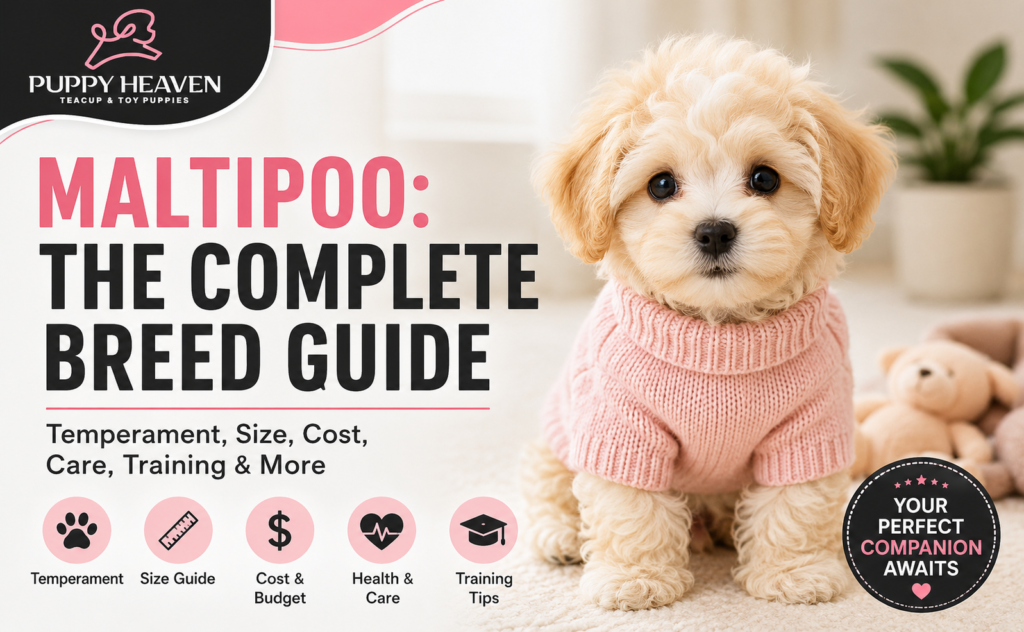
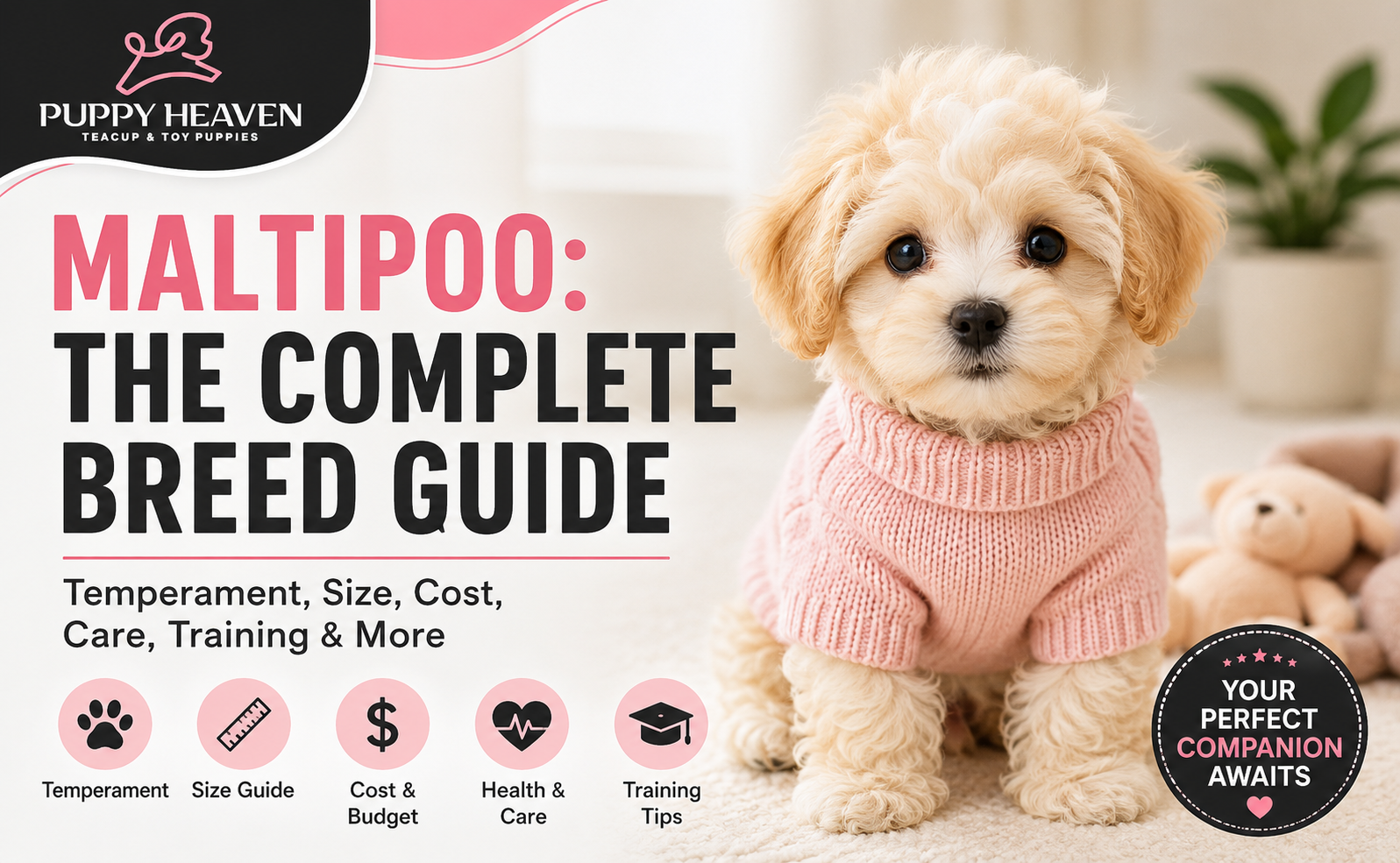
Maltipoos carry a look that makes people stop and stare. A soft, rounded face, floppy ears, and an expression that genuinely looks like a puppy for their entire life. The “teddy bear” comparison gets used a lot and it’s accurate — these dogs are visually disarming.
Size: Full-grown Maltipoos typically stand 8 to 14 inches tall at the shoulder and weigh between 5 and 20 pounds. The weight range is wide because it depends primarily on which type of Poodle parent was used (Toy vs Miniature). More on this in the size section below.
Coat texture: Can range from wavy to curly to silky, depending on which parent’s genetics dominate. Poodle-dominant puppies tend toward tighter curls. Maltese-dominant puppies may have a softer, wavier coat with a slightly silkier texture.
Coat colors: White and cream are most common, directly from the Maltese side. But Maltipoos can also come in apricot, red, chocolate, silver, blue, and parti-color combinations — the Poodle side of the family introduces all of that range.
Shedding: Very low to none, across most generations. This is one of the primary reasons the breed became so popular — the combination of Maltese and Poodle creates one of the most reliably low-shedding small dogs available.
Maltipoo Size: How Big Do They Get?
This is one of the most searched questions about the breed — and the most important to understand clearly before buying.
Full-grown Maltipoos stand 8 to 14 inches tall and weigh between 5 and 20 pounds. The size of the Poodle parent is the primary driver of this range.
Size by Poodle Parent Type
| Type | Poodle Parent | Adult Weight | Adult Height | Fully Grown By |
|---|---|---|---|---|
| Teacup Maltipoo | Tiny Toy Poodle | Under 5 lbs | Under 8 inches | 7–9 months |
| Toy Maltipoo | Toy Poodle | 5–10 lbs | 8–10 inches | 9–11 months |
| Mini Maltipoo | Miniature Poodle | 10–20 lbs | 10–14 inches | 10–12 months |
The most important rule: Ask about the parent dogs’ weights before committing to any puppy. A breeder who knows their lines can give you a realistic adult weight estimate. No one can guarantee an exact number, but a responsible source will narrow the range significantly.
Maltipoo Growth Chart
| Age | Toy Maltipoo Weight | Mini Maltipoo Weight |
|---|---|---|
| 8 weeks (newborn) | 1–2 lbs | 2–4 lbs |
| 3 months | 2–4 lbs | 4–7 lbs |
| 6 months | 4–7 lbs | 7–12 lbs |
| 9 months | 5–8 lbs | 9–15 lbs |
| 12 months (adult) | 5–10 lbs | 10–20 lbs |
Most Maltipoo dogs reach close to their final height by about 9 months, and their final weight by 12 to 14 months. Standard Maltipoos can fill out slightly after that, but for most families, you can think of your dog as fully grown by their first birthday.
The Teacup Maltipoo: What You Need to Know
Teacup Maltipoos — puppies expected to stay under 5 lbs as adults — are among the most in-demand sizes. They’re also the size that requires the most careful sourcing.
The smallest sizes carry more health risks when produced irresponsibly. The phrase “teacup Maltipoo” has been misused by sellers who achieve tiny size through underfeeding puppies, breeding runts repeatedly, or using puppies that are too young. A genuine teacup Maltipoo from a responsible source — where small size comes from naturally small, healthy parent lines — can be a healthy companion. The difference is entirely in the practices behind the breeding.
At Puppy Heaven, we carry teacup and toy Maltipoo puppies from breeders we trust — with parent weight information available for every puppy. Browse our available Maltipoos →
Maltipoo Generations: F1, F1B, F2 Explained
The generation of a Maltipoo affects its coat type, shedding level, and how predictable the puppy’s adult appearance will be. Most guides don’t cover this — here’s the full breakdown:
F1 Maltipoo — First Generation
One purebred Maltese parent, one purebred Poodle parent. The puppy is genetically 50% each.
Benefits: Maximum hybrid vigor — the genetic diversity that makes hybrid dogs statistically healthier than their purebred parents. F1 Maltipoos are typically the most robust generation.
Coat: Usually wavy. Less consistently curly than later generations. Can vary between puppies in the same litter.
Shedding: Low to none for most, though some F1 puppies may inherit slightly more of the Maltese’s minimal shedding tendency.
F1B Maltipoo — First Generation Backcross
An F1 Maltipoo bred back to a purebred Poodle. The puppy is approximately 75% Poodle and 25% Maltese.
Benefits: Curlier, more consistently hypoallergenic coat. The best choice for households with mild-to-moderate dog allergies. More uniform appearance within a litter.
Coat: Typically curly, close to a Poodle coat. Lower shedding than F1.
Considerations: Slightly more Poodle personality — sharper, more energetic, more demanding of mental stimulation.
F1BB Maltipoo
A further backcross — F1B bred back to another Poodle. Approximately 87.5% Poodle.
Benefits: The tightest, most consistently hypoallergenic coat of any Maltipoo generation.
Considerations: Requires the most frequent professional grooming to prevent matting. The Maltese temperament traits are less pronounced.
F2 Maltipoo — Second Generation
Two F1 Maltipoos bred together. Genetically similar to F1 on average, but with wider variation in coat and appearance because both parents are hybrids.
Best for: Families who want good hybrid vigor without necessarily needing the most hypoallergenic coat option.
Summary recommendation:
- Mild allergies in household: F1B or F1BB
- No allergy concerns, want maximum health benefits: F1
- Don’t mind variability, value the balance: F2
Maltipoo Temperament: What Life With One Is Actually Like
The numbers are easy to find. The honest picture of day-to-day temperament is harder.
They Are Genuinely Devoted
The Maltipoo is renowned for its friendly nature, earning a 5-star rating in sociability. They are extremely affectionate dogs that thrive on human companionship. Their sociable personality and love for playtime make them a joy to be around.
This is not marketing language. It’s accurate. Both parent breeds were companion dogs — bred exclusively to be with people. The Maltipoo inherits that history completely. These dogs follow their people, seek physical closeness, and express genuine enthusiasm at your return even if you were only gone for ten minutes.
Intelligent and Very Trainable
Maltipoos are playful and intelligent dogs. They don’t have the always-on-the-go mentality of some breeds but they are smart enough to learn commands quickly and eager enough to please that training sessions are usually enjoyable rather than frustrating.
Poodles are consistently ranked among the most intelligent dog breeds in the world. That intelligence shows up in Maltipoos — they pick up routines fast, learn tricks with minimal repetition, and respond to positive reinforcement almost immediately.
Excellent With Children — With a Note
Maltipoos are great with kids. They enjoy playing as much as they enjoy curling up on a lap. However, even a full-grown Maltipoo is small and delicate, so they’re not a good fit for rough-and-tumble play. They work best with children who understand how to interact gently.
For households with very young children (under 4–5 years old), supervised interaction is essential. Not because the Maltipoo is aggressive — they’re not — but because their small frame makes them genuinely vulnerable to accidental injury from enthusiastic toddlers.
They Bark — Training Helps
Maltipoos are known to bark. While these dogs are small, they are vigilant and vocal, and they’ll bark at the first sign of unusual activity — which can lead to many false alarms.
Early socialization — exposing them to different people, sounds, and environments during puppyhood — significantly reduces anxiety-based barking. Consistent training from day one establishes expectations before barking becomes a habit. A Maltipoo that has been trained and well-socialized is not a problem barker. One that hasn’t been either can be.
Separation Anxiety: The Real Conversation
As companion dogs, Maltipoos bond tightly with their family. As a result, these dogs can experience separation anxiety when left alone. It’s a good idea to teach your Maltipoo puppy to be calm in a crate, which can help them feel safe and happy when you’re away from home.
This isn’t a dealbreaker — it’s a management challenge. A consistent routine, crate training from puppyhood, and midday check-ins for dogs left alone during long workdays are all practical solutions. Dogs that experience separation anxiety can be dramatically improved through consistent training and structure.
Good With Other Pets
Maltipoos generally get along well with other dogs and pets, especially when socialized properly from a young age. Their non-aggressive, social nature makes multi-pet households work well. Cats are typically fine with proper introduction.
Maltipoo vs Cavapoo: Which Is Right for You?
Two of the most popular designer breeds in the US right now — and they’re confused constantly. Here’s a clear side-by-side:
| Feature | Maltipoo | Cavapoo |
|---|---|---|
| Parent Breeds | Maltese + Poodle | Cavalier King Charles Spaniel + Poodle |
| Adult Size | 5–20 lbs | 7–25 lbs |
| Energy Level | Moderate, playful but settles | Moderate, slightly more active |
| Trainability | Very high (Poodle intelligence) | High (both parents trainable) |
| Shedding | Very low to none | Low (F1B lowest) |
| Allergy-Friendliness | Excellent | Good to excellent |
| Barking | Moderate (vocal breed) | Low to moderate |
| Separation Anxiety Risk | Moderate to high | Moderate to high |
| Personality | Affectionate, lively, sometimes bold | Gentle, laid-back, deeply sweet |
| Best For | Active families, city dwellers, first-time owners | Calmer households, seniors, families with kids |
Neither breed is objectively better. The Maltipoo tends to be livelier and slightly more independent. The Cavapoo is notably gentler and more laid-back. Both are excellent for apartments and small homes.
Puppy Heaven carries both. Browse our Cavapoo puppies and Maltipoo puppies side by side and let the specific puppy’s personality guide your decision as much as the breed.
Maltipoo Exercise Needs: What’s Actually Required
Maltipoos are playful and intelligent, but they don’t have the always-on-the-go mentality of some other breeds. A daily walk and some indoor play sessions each day handle most of their physical needs.
Daily requirement: 20–30 minutes of exercise for adults. This can be a single walk, two shorter walks, or a walk combined with indoor play.
Mental stimulation matters: Intelligence breeds boredom. Puzzle toys, training sessions, and interactive games satisfy the mental side and prevent the boredom-driven behaviors (excessive barking, chewing) that develop when smart dogs are under-stimulated.
Temperature sensitivity: Maltipoos are sensitive to extreme hot and cold. In summer, keep outdoor time in shaded areas with water. In winter, 15 minutes outside at a time is typically comfortable, and a dog sweater is genuinely useful — not just decorative.
For puppies: Keep exercise sessions short — 5 minutes per month of age, twice daily. Excessive exercise before joints are fully developed can cause problems. Puppy play sessions of 10–15 minutes are plenty for the first few months.
Grooming a Maltipoo: What to Expect
This is one area that surprises new Maltipoo owners. The low-shedding coat is genuinely low-maintenance in terms of vacuuming — but the coat itself requires consistent grooming to stay healthy and mat-free.
Brushing: Daily brushing is ideal for curly or wavy coats, or at minimum every other day. Their coat tangles easily if neglected, particularly behind the ears, in the armpits, and around the collar. A slicker brush works well for most coat types.
Professional grooming: Every 6 to 8 weeks is standard. A professional trim keeps the coat at a manageable length, prevents serious matting, and keeps the eye area clear. Many Maltipoo owners prefer a shorter “puppy cut” for easier at-home maintenance between appointments.
Eyes and tear staining: The area around the eyes can develop reddish-brown staining, particularly in lighter-coated Maltipoos. Daily cleaning with a damp cloth prevents buildup. Keep the hair around the eyes trimmed to prevent irritation.
Ears: Check and gently clean weekly. Floppy ears trap moisture and create an environment where infections develop easily. Signs of infection include redness, odor, or unusual discharge.
Teeth: This is the single most impactful daily health habit. Small breeds are highly prone to periodontal disease. Every tooth, every surface, every day. Start this routine when your Maltipoo is still a puppy — it becomes a non-negotiable part of their care routine and prevents the dental disease that causes pain, tooth loss, and systemic health issues in later years.
Nails: Every 2–3 weeks, or whenever you hear clicking on hard floors. Small dogs are often resistant to nail trims — introducing this early and making it routine (positive reinforcement, treats) makes the process far easier.
Feeding Your Maltipoo
Feed a high-quality dry kibble specifically formulated for small breeds, meeting AAFCO nutritional guidelines. Small-breed formulas have smaller kibble sizes that are easier for tiny mouths to chew, and are calorie-dense in a way that serves their higher metabolic rate.
Puppies: Feed three to four small meals per day until 6 months old, then transition to twice daily. Use a puppy formula for small breeds until 12 months.
Adults: Most adult Maltipoos do well on ¼ to ¾ cup per day, divided across two meals. Exact portions depend on the specific food’s caloric density and your dog’s weight and activity level.
Weight management: Watch portions carefully. Small dogs gain weight quickly and even a pound of excess weight is proportionally significant on a 10-lb dog. Maintain a body condition where ribs are felt but not seen, with a visible waist tuck from above.
Treats: Limit to 10% of daily calories. High-value, small-sized treats work best for training. Avoid anything with artificial additives or sugar.
A note on hypoglycemia: Toy and Teacup Maltipoos in particular are susceptible to low blood sugar if meals are skipped or widely spaced. Frequent small meals — especially during puppyhood — are a health necessity, not just a preference. Keep a small amount of Nutri-Cal gel on hand for emergencies.
Maltipoo Health: Every Condition You Should Know
Maltipoos are generally healthy dogs. As hybrids, they benefit from genetic diversity (hybrid vigor) that can reduce the concentration of hereditary conditions that affect purebred parent lines. But “can reduce” doesn’t mean “eliminates.”
The average Maltipoo lifespan is 12 to 16 years, with many living longer with proper care. Here are the health conditions to understand:
Dental Disease
The most common and most preventable health issue in Maltipoos. Small mouths mean crowded teeth, which trap plaque and lead to gum disease, bone loss, and tooth loss. Without daily brushing, dental disease is essentially guaranteed over time. Daily toothbrushing from puppyhood is the most impactful single health habit you can build.
Luxating Patella (Dislocating Kneecap)
Common across small breeds. The kneecap slips out of its groove, causing a characteristic skip or bunny-hop gait. Mild cases are monitored; severe cases require surgery. If untreated, chronic pain and arthritis develop. Surgery cost: $1,500 to $3,000 per knee.
Tracheal Collapse
The windpipe weakens and collapses partially during breathing, producing a honking cough. More common in Pomeranian lines but seen in Maltipoos. Using a harness instead of a collar for all walks reduces neck pressure significantly and is one of the simplest preventive measures. Manageable with medication in most cases.
Progressive Retinal Atrophy (PRA)
A genetic eye condition that gradually leads to vision loss. There is no cure, but affected dogs typically adapt well to vision loss. Annual eye exams help detect this early. Responsible breeders screen parent dogs for PRA before breeding.
Legg-Calvé-Perthes Disease
A hip condition affecting small breeds, caused by disrupted blood flow to the femoral head, leading to bone deterioration. Signs include limping or holding up a rear leg. Surgical intervention is usually effective when caught early.
White Shaker Syndrome
A neurological condition that causes generalized body tremors, primarily seen in small white dogs. Not always serious — some cases occur only once or twice in a lifetime — but can be recurring and is manageable with veterinary treatment.
Epilepsy
A predisposed neurological condition seen in Maltipoos. Signs include convulsions, jerking movements, and loss of consciousness. Management with medication is effective for most dogs. For some, seizures may occur only rarely.
Cataracts and Eye Issues
Tear staining, cataracts, and progressive retinal atrophy can occur as dogs age. Annual eye exams with your vet help catch these early.
What this means for buyers: Work with a source that health-tests parent dogs and can share documentation. A vet health examination before placement, a written health guarantee, and vaccination records are the minimum baseline from any responsible breeder or boutique.
At Puppy Heaven, every Maltipoo puppy receives a full veterinarian examination before placement. Our written health guarantee covers every puppy we place. See available puppies →
Maltipoo Price: What You’ll Actually Pay in 2026
Purchase Price
Buy Maltipoo puppy from a reputable breeder can cost anywhere between $1,000 and $4,000, depending on the breeder, bloodline, location, and other factors.
Here’s a realistic breakdown of the full pricing landscape:
| Source | Price Range | Notes |
|---|---|---|
| Reputable boutique or breeder | $1,500 – $4,000 | Health-tested parents, vet-checked, health guarantee included |
| Premium breeder — rare colors or champion lines | $3,000 – $6,000+ | Phantom, parti-color, or specific rare coat colors |
| Teacup Maltipoo (responsibly bred) | $2,000 – $5,000+ | Smaller size, higher demand, more careful sourcing required |
| Rescue or shelter adoption | $300 – $600 | Rare to find, often adults rather than puppies |
| Classified ads / Craigslist | $500 – $1,500 | High risk, no health documentation, no recourse |
What Drives the Price?
Breeder quality — Health testing, home-raised puppies, proper socialization, full vet care, and written guarantees cost real money. Breeders who do all of this charge accordingly — and those costs protect you as the buyer.
Coat color — White and cream are the most available. Apricot, red, chocolate, and parti-color are harder to produce and priced higher. Phantom and rare patterns can push prices to the upper end.
Generation — F1B and F1BB Maltipoos with reliably hypoallergenic coats are often priced slightly higher than standard F1s because the predictability is higher.
Gender — Females typically cost $200–$500 more than males across most Maltipoo sizes and generations.
Size — Teacup and very small Toy Maltipoos command a premium due to higher demand and more careful breeding requirements.
What’s included — A puppy priced at $2,500 that includes vet exam, vaccinations, deworming, microchipping, written health guarantee, and starter kit is a genuinely better value than a $1,500 puppy with none of those items.
Annual Ownership Costs
| Expense | Annual Estimate |
|---|---|
| High-quality small-breed food | $200 – $500 |
| Routine vet care and preventatives | $300 – $500 |
| Professional grooming (every 6–8 weeks) | $480 – $960 |
| Dental care (toothbrush, toothpaste, supplies) | $50 – $150 |
| Toys, treats, and supplies | $200 – $400 |
| Pet insurance (strongly recommended) | $360 – $720 |
| Annual Total | $1,590 – $3,230 |
On pet insurance: Given the luxating patella, dental, and cardiac risks that Maltipoos can be predisposed to, pet insurance at $30–$60/month is worth it. A single patellar luxation surgery can cost $1,500–$3,000 per knee. Insurance makes that manageable from month one.
Is a Maltipoo Right for You?
An honest checklist — not a sales pitch.
A Maltipoo is a strong fit if you:
- Want an affectionate, people-bonded companion dog
- Live in an apartment, condo, or small home
- Have mild dog allergies and need a low-shedding breed (especially F1B or F1BB)
- Are a first-time dog owner looking for a trainable, manageable breed
- Have children over 5 who understand how to handle a small dog gently
- Want a dog with a long lifespan — 13–16 years is realistic
- Can commit to regular grooming maintenance
- Work from home or have someone home for much of the day
Consider carefully if you:
- Work 10+ hours away from home daily with no plan for the dog’s company
- Have very young children (under 4) who play rough
- Cannot commit to daily tooth brushing and regular professional grooming
- Want a low-maintenance dog in terms of attention and bonding
Maltipoo Puppies at Puppy Heaven
At Puppy Heaven, the Maltipoo is one of our most popular breeds — and has been for years. We’ve placed thousands of Maltipoos with families across Las Vegas, South Florida, California, Nevada, Arizona, and beyond.
Every Maltipoo puppy we place comes with:
- Full veterinarian health examination before going home
- Up-to-date vaccinations and deworming — protected from day one
- Written health guarantee — every placement, every time
- Microchipping — registered to you before arrival
- Starter kit — food, wee-wee pads, and toy for the first night
- 100% puppy financing available — quick approval, manageable payments
- Nationwide delivery — personal hand delivery or air shipping across the US and Canada
- Low-cost home delivery to California, Nevada, and Arizona
- Video call available — meet your puppy live before you visit or reserve
- Parent weight information provided — so your size expectations are realistic
Our Las Vegas and South Florida boutiques are open for in-person visits. If you can’t visit in person, our video call option lets you meet the puppy, see the environment, and get every question answered before making any decision.
FAQs
How big does a full-grown Maltipoo get?
Full-grown Maltipoos typically stand 8 to 14 inches tall and weigh 5 to 20 pounds. The size depends primarily on the Poodle parent — Toy Poodle parent produces a smaller Maltipoo (5–10 lbs); Miniature Poodle parent produces a larger one (10–20 lbs).
When is a Maltipoo fully grown?
Most Maltipoos reach close to their final height by 9 months and their final weight by 12 to 14 months. For most practical purposes, your Maltipoo is fully grown by their first birthday.
Are Maltipoos hypoallergenic?
Maltipoos are commonly considered hypoallergenic due to their very low shedding. However, no dog is 100% allergen-free — reactions are triggered by proteins in dander and saliva, not just fur. Most mild-to-moderate allergy sufferers do well with a Maltipoo, especially F1B or F1BB generations. Spending time with the specific dog before committing is always the safest approach for allergy-sensitive households.
How long do Maltipoos live?
The average Maltipoo lifespan is 12 to 16 years. With proper nutrition, regular vet care, daily dental maintenance, appropriate exercise, and weight management, many Maltipoos reach the higher end of that range.
Do Maltipoos shed?
Very little to none for most. The low-shedding coat is one of the primary reasons for the breed’s popularity. F1B and F1BB generations with curlier Poodle-dominant coats shed the least.
Are Maltipoos good for apartment living?
Yes — they’re one of the best apartment breeds available. Low exercise needs, manageable size, low shedding, and strong adaptability to smaller spaces all make the Maltipoo ideal for city living and apartment dwellers.
What is the difference between a Toy Maltipoo and a Mini Maltipoo?
A Toy Maltipoo is bred from a Toy Poodle parent — typically weighing 5–10 lbs as an adult. A Mini Maltipoo is bred from a Miniature Poodle parent — typically weighing 10–20 lbs. Both share the same temperament; the main difference is size and the slightly sturdier build of the Mini.
What is the difference between F1 and F1B Maltipoo?
An F1 Maltipoo is a first-generation cross — 50% Maltese and 50% Poodle. An F1B is a backcross — approximately 75% Poodle and 25% Maltese. F1B Maltipoos have curlier, more consistently hypoallergenic coats and are better for allergy-sensitive households. F1s have broader genetic diversity and typically the strongest hybrid vigor.
How much does a Maltipoo cost?
From a reputable source, Maltipoo puppies typically range from $1,500 to $4,000. Rare colors, championship lines, very small teacup sizes, and F1B generations can push prices higher. Prices significantly below $1,000 from online classifieds or unknown sources should be approached with caution.
Do Maltipoos bark a lot?
They are vocal dogs — they will alert to new people and sounds. With early socialization and consistent training, barking is manageable and not excessive. An untrained, under-socialized Maltipoo can develop problem barking habits. The breed is trainable enough that this is preventable.
Is a Maltipoo or Cavapoo better for a family?
Both are excellent family dogs. The Cavapoo tends to be slightly more laid-back and gentle — a strong fit for calmer households and younger children. The Maltipoo is livelier, more vocal, and slightly more independent. For highly active households or families who want a sharper, more engaged personality, the Maltipoo often wins. For calmer households wanting maximum gentleness, the Cavapoo holds a slight edge. Puppy Heaven carries both — compare them here.
Final Thoughts
The Maltipoo earns its popularity. It’s not hype — it’s a dog with genuine, consistent qualities that work for a wide range of households: small enough for apartment living, smart enough to train easily, low-shedding enough for mild allergy households, affectionate enough to become a true companion, and long-lived enough to be a 12–16 year presence in your life.
The key to a great experience is getting one from a source that does things right. Health-tested parents. Proper early socialization. Full veterinary care before placement. A written guarantee. Someone who answers your questions honestly and stays available after the puppy goes home.
That’s what Puppy Heaven has been doing for over 21 years.