And choosing the wrong size can genuinely affect how happy both you and your dog are — whether that’s a 65-pound Standard who can’t comfortably fit in your apartment elevator, or a tiny Toy who gets overwhelmed by your energetic five-year-old.
This guide breaks everything down without the fluff (pun intended). By the time you’re done reading, you’ll know the exact weight and height ranges for every Goldendoodle size, what drives those differences, and — most importantly — which size actually fits your life.
A Quick Look at the Four Goldendoodle Sizes
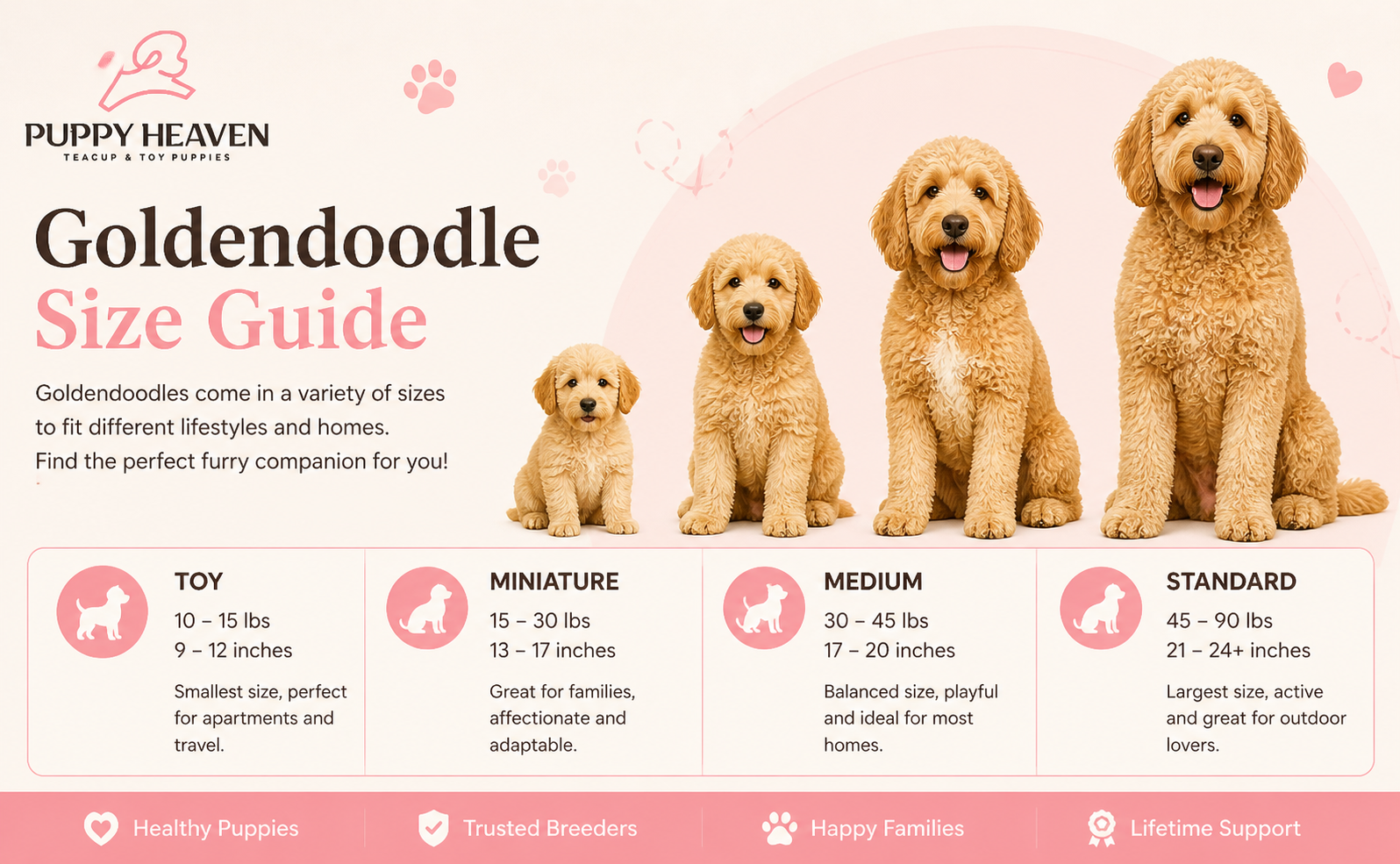
Before we get into the nitty-gritty of each size, here’s your at-a-glance reference. Goldendoodles come in toy, miniature, medium, and standard sizes. A toy Goldendoodle might stay under 15 inches and weigh around 10–25 pounds, while a standard Goldendoodle can easily hit 22–26 inches and weigh anywhere from 50–90 pounds.
| Size | Weight (Adult) | Height at Shoulder | Full-Grown By | Best For |
|---|---|---|---|---|
| Toy / Petite | 10–25 lbs | Under 15 inches | 7.5–11 months | Apartments, singles, seniors |
| Mini (Miniature) | 25–35 lbs | 13–17 inches | 11–13 months | Smaller homes, active individuals |
| Medium | 35–50 lbs | 17–21 inches | 11–13 months | Families, suburban homes |
| Standard | 50–90 lbs | 21–26 inches | 12–18 months | Larger homes, active families |
Keep in mind these are ranges, not guarantees. A puppy’s final adult size depends on multiple factors — genetics, generation, diet, and even whether they’ve been spayed or neutered. We’ll cover all of that below.
Standard Goldendoodle Size
The Standard Goldendoodle is what most people picture when they hear “Goldendoodle” — big, bouncy, and wearing what looks like a permanent smile. These are the dogs that take over the couch and somehow still manage to be charming about it.
Standard Goldendoodles weigh between 50 and 90 pounds and stand 22 to 26 inches tall at the shoulder. Males tend to be on the larger side, while females can be a bit smaller and lighter.
Standard Goldendoodle Size by Generation
The generation of your Goldendoodle matters more than most people expect. For F1 Standard Goldendoodles, you’re looking at 50–90 pounds and 22–26 inches — the classic mix of a Golden Retriever and a Standard Poodle. F1B Goldendoodles (backcrossed to a Poodle) come in slightly smaller at 50–85 pounds and 21–25 inches, since they carry 75% Poodle and 25% Golden Retriever genetics.
Standard Goldendoodles are typically bred from a Golden Retriever parent and a Standard Poodle. Their final weight is heavily influenced by how much they take after each parent — some will look and move like Retrievers, others more like Poodles.
Who Should Get a Standard Goldendoodle?
Standard Goldendoodles are wonderful for active families who have the space and energy to match their dog’s. Standard sizes often need 60–90 minutes of vigorous activity daily. They’re not couch potatoes — they want to run, swim, fetch, and join you on outdoor adventures.
If you have young children, a Standard Goldendoodle’s size means they’re sturdy enough to handle the energy of kids at play without being fragile. They’re famously gentle and patient. Just make sure your home — and your schedule — can genuinely accommodate a large, high-energy dog before committing.
- Space needed: Home with yard strongly preferred; apartments require serious exercise commitment
- Exercise: 60–90 minutes daily minimum
- Grooming cost: Higher — more coat to maintain
- Food cost: More than smaller sizes — budget accordingly
- Lifespan: Roughly 10–13 years
Medium Goldendoodle Size
Here’s an honest truth: the Medium Goldendoodle is the size that most families discover after doing their research. It’s the sweet spot most people land on — and for good reason.
Medium Goldendoodles weigh between 30 and 50 pounds and stand about 17 to 21 inches tall at the shoulder. They’re sturdy enough for outdoor adventures but compact enough for apartment living or smaller spaces. Medium Goldendoodles, the most popular size, balance playfulness and manageability.
How Medium Goldendoodles Are Bred
Getting a Medium Goldendoodle isn’t as straightforward as it sounds. A Medium Goldendoodle is usually the result of breeding a Golden Retriever with a Medium (Moyen) or Small Standard Poodle, or sometimes by mixing a Mini Goldendoodle with a larger parent to hit that middle range.
The “Moyen” Poodle — sometimes called the Klein Poodle — is a size between the Miniature and Standard that isn’t formally recognized by the AKC in the US but is commonly used by breeders targeting the medium Goldendoodle market. Ask your breeder specifically about the Poodle parent’s size when looking at Mediums.
Medium Goldendoodle Sizes by Generation
| Generation | Weight | Height | Poodle % | Predictability |
|---|---|---|---|---|
| F1 | 35–50 lbs | 18–21 in | 50% | Variable |
| F1B | 30–45 lbs | 17–20 in | 75% | Moderate |
| F1BB | 30–40 lbs | 17–20 in | 87.5% | More Consistent |
| F2 | 35–50 lbs | 18–21 in | 50% | Variable |
| Multigen | 30–45 lbs | 17–21 in | Varies | Most Consistent |
The Medium Goldendoodle tends to suit people who want a proper family dog — one that can go on long hikes, play with kids in the backyard, and still curl up next to you on the sofa in the evening without taking up the entire piece of furniture.
Mini (Miniature) Goldendoodle Size
Mini Goldendoodles have become hugely popular over the last few years, and it’s easy to see why. They’re small enough to be manageable in a range of homes, but big enough to have serious personality and keep up with an active family.
Mini Goldendoodles are up to 17 inches and weigh 25–35 lbs. Mini Goldendoodles weigh between 10 and 25 pounds and usually reach their full size by 7–11 months of age. (Note: you’ll see slight variation in ranges depending on whether the breeder classifies their dogs as “small mini” or “large mini” — these sub-categories exist within the Mini label.)
Mini Goldendoodle Sub-Categories
When shopping for a Mini Goldendoodle, you’ll sometimes come across size labels like “small mini,” “medium mini,” and “large mini.” These aren’t official classifications, but many breeders use them to help buyers set accurate expectations:
- Small Mini (15–25 lbs): Perfect for apartments and urban living, easy to transport and handle
- Medium Mini (25–35 lbs): Sturdier and great for active families, balanced energy levels
- Large Mini (35–45 lbs): Closer to a Medium Goldendoodle, better for homes with some outdoor space
Are Mini Goldendoodles Good for Apartments?
Yes — with the right setup. Mini Goldendoodles typically weigh between 15 to 35 pounds and stand 13 to 20 inches tall, and their compact size makes them easier to manage in smaller spaces than larger dogs.
Mini Goldendoodles typically require only 30 to 60 minutes of exercise per day to stay content. Daily walks combined with interactive play sessions indoors can meet their physical needs. That said, they’re social and don’t do well with long stretches of alone time — something to think about seriously if you work long hours.
Apartment Owners Take Note:
Many apartments have weight limits for dogs — commonly 25 or 35 lbs. Always confirm your building’s pet policy before choosing a size. A “large mini” at 40 lbs could technically violate building rules even if the breed itself is allowed.
Toy Goldendoodle Size
The Toy Goldendoodle is the newest and smallest addition to the Goldendoodle family, and their popularity has exploded. They carry the same lovable Goldendoodle personality in a package small enough to fit in a large tote bag (though we don’t recommend that as a transport method).
Toy Goldendoodles who usually weigh about 10 to 25 pounds, and they’re less than 15 inches tall. Toy Goldendoodles generally reach 50% of their adult weight around 3.5 months old and plateau at their full adult weight between 7.5–11 months of age.
How Toy Goldendoodles Are Created
Getting a Goldendoodle down to Toy size requires using a Toy Poodle parent rather than a Miniature or Standard. When a golden retriever is bred with a toy poodle, the resulting puppies typically fall into the mini category — and these are often labeled Toy or Petite by breeders.
Some breeders also create Toy Goldendoodles through multi-generational breeding, working down in size over several litters. This approach tends to produce more predictable adult sizes and healthier outcomes than trying to dramatically miniaturize in one generation.
Health Considerations for Toy Goldendoodles
Very small dogs carry some specific health risks worth knowing about. Smaller sizes face increased health risks including hypoglycemia, dental problems, and injury vulnerability. Toy dogs require more frequent meals and careful monitoring. Fragile bones are also a real concern — a Toy Goldendoodle can be injured by a rough tumble or an overexcited child.
This doesn’t mean Toy Goldendoodles are unhealthy — just that they need owners who understand their size-specific needs and can provide appropriate care.
How Generation Affects Goldendoodle Size
This is the section most blog posts skim over, and it’s genuinely one of the most important things to understand before you commit to a puppy. The generation of your Goldendoodle — whether it’s an F1, F1B, F2, or Multigen — directly affects both how big they’ll get and how predictable that size is.
F1 Goldendoodle (First Generation)
An F1 Goldendoodle is a first-generation cross between purebreds: 50% Golden Retriever and 50% Poodle. This is the classic Goldendoodle — and also the most genetically variable. First-generation Goldendoodles display the widest size ranges within single litters. Littermates can vary by 20–30 pounds at maturity.
If you want a more “balanced” look between Retriever and Poodle, an F1 is often the choice. But if size predictability matters to you, know going in that there’s significant natural variation.
F1B Goldendoodle (First Generation Backcross)
An F1B Goldendoodle is a backcross of an F1 Goldendoodle with a Poodle — commonly resulting in 75% Poodle and 25% Golden Retriever genetics. F1B Goldendoodles show improved size consistency with size variation within litters typically staying within 10–15 pounds.
F1Bs tend to have curlier, lower-shedding coats — a big plus for allergy sufferers — and their increased Poodle genetics often make them run slightly smaller than F1s of the same “size” category.
F2 and Multigen Goldendoodles
An F2 Goldendoodle is the result of breeding two F1 Goldendoodles. Interestingly, this can sometimes increase size variation again, since you’re combining two dogs that are themselves genetically diverse. Multigenerational Goldendoodles offer the most reliable size predictions — breeders can predict adult size within 5–10 pounds for multigen puppies.
| Generation | Genetic Mix | Size Predictability | Coat Type | Best For |
|---|---|---|---|---|
| F1 | 50% GR / 50% Poodle | Lowest (±20%) | Wavy to curly, may shed | Classic look, hybrid vigor |
| F1B | 25% GR / 75% Poodle | Moderate (±15%) | Curlier, low-shedding | Allergy households |
| F1BB | 12.5% GR / 87.5% Poodle | Good | Very curly, minimal shedding | Severe allergy sufferers |
| F2 | 50% GR / 50% Poodle | Variable | Wide range | Unique pups, varied traits |
| Multigen | Varies | Highest (±5–10 lbs) | Consistent low-shedding | Specific size goals |
What Else Affects Goldendoodle Size?
Generation and parent breed are the biggest size drivers, but they’re not the only ones. Here’s what else plays a role:
Parent Size is the Best Predictor
The most reliable size prediction comes from knowing both parent dogs’ weights. Puppies typically fall somewhere between mom and dad in adult size. Ask breeders for exact weights and heights of both parents at full maturity. Any breeder who can’t or won’t provide this information is a red flag.
The Poodle parent typically has more influence over the final size than the Golden Retriever parent. The poodle parent size plays the most significant role in determining offspring height potential.
Male vs. Female Goldendoodle Size
Males are typically 10–15% heavier and taller than females. This gap is most noticeable in Standards — a male Standard might be 75–85 lbs while his sister from the same litter is 55–65 lbs. In Toy and Mini sizes, the difference is less dramatic but still present.
Nutrition During Puppyhood
Proper nutrition directly impacts whether puppies reach their genetic size potential. Quality puppy feeding schedules support optimal growth without causing rapid weight gain that stresses developing joints. Overfeeding or underfeeding during critical growth periods affects final adult size.
This doesn’t mean you can “shrink” a Standard Goldendoodle by underfeeding — malnourishment causes serious health problems and isn’t size management. It means feeding the right food in the right amounts supports natural, healthy growth.
Spaying and Neutering
Timing matters here. Dogs that are spayed or neutered before their growth plates close may grow slightly taller than they would have otherwise, because sex hormones signal the growth plates to stop. Your vet can advise on the best timing for your specific dog based on their size category.
Talk to Your Vet About Timing:
For larger Goldendoodles, many vets now recommend waiting until 12–18 months before spaying or neutering, to allow the growth plates to close naturally. For smaller sizes, the timeline may differ. Always get guidance specific to your dog.
When Do Goldendoodles Stop Growing?
One of the most common questions from new Goldendoodle owners — and the answer varies significantly by size. Like most dog breeds, Goldendoodles do their fastest growing in the first 50% of their adult weight, which generally correlates to the first six months of life.
Months 0–3: Rapid Early Growth
All sizes grow quickly in this phase. Your Goldendoodle is still adjusting to the world — expect rapid weight gain, soft coats, and sleepy days. Short play sessions are all they need; avoid over-exertion on developing joints.
Months 3–6: Growth Spurt Phase
This is often when you notice your puppy seeming to outgrow their collar weekly. Toy Goldendoodles generally reach 50% of their adult weight around 3.5 months old. Mini and Medium sizes hit that halfway point between 3.5–5 months.
Months 6–12: Slowing Down
Growth continues but the dramatic daily changes taper off. They generally reach their maximum height by one year old but can spend a little longer gaining girth and weight. Your dog is starting to look like their adult self.
Year 1–2: Filling Out
Most Goldendoodles reach their full height by one year old, but they may continue to fill out until 18–24 months, achieving their adult weight and muscle structure. Standard Goldendoodles take the longest, often continuing to fill out well into their second year.
Size-Specific Timeline Summary
| Size | 50% Adult Weight | Full Height | Fully Mature |
|---|---|---|---|
| Toy | ~3.5 months | 8–10 months | 7.5–11 months |
| Mini | 3.5–5 months | 10–12 months | 11–13 months |
| Medium | 4–5 months | 11–13 months | 11–13 months |
| Standard | 4.5–6 months | 12–15 months | 12–18 months |
How to Estimate Your Puppy’s Adult Size
You’ve brought home a 10-week-old fluffball and naturally you want to know: how big is this creature going to get? There are a few practical ways to estimate.
The 16-Week Double Method
One of the simplest and most commonly used formulas: double your puppy’s weight at 16 weeks to get a rough estimate of their adult weight. This works reasonably well for Minis and Mediums. For Standards, the formula shifts slightly — Standard Goldendoodles generally reach 50% of their adult weight between 4.5 and 6 months old, so you’d double their weight at around 5 months for a better estimate.
Check the Parents
This is the most reliable method. A reputable breeder will always be able to tell you the exact weight and height of both parents. Since puppies generally fall somewhere between their parents, this gives you a solid target range.
The Poodle parent determines size range more strongly than the Golden Retriever. Standard Poodle crosses produce larger puppies while Miniature or Toy Poodle crosses create smaller adults. So if your breeder tells you both the Poodle and Golden Retriever parent’s sizes, weight the Poodle side more heavily in your estimate.
Understand Generation Variance
Generation affects prediction ranges with F1s having ±20% variation, F1Bs having ±15% variation, and multigens having ±13% variation. In practical terms, an F1 puppy predicted at 40 lbs could reasonably end up anywhere from 32 to 48 lbs at adulthood.
For Toy/Mini Goldendoodles: Adult weight ≈ puppy weight at 8 weeks × 4. For Medium/Standard: Adult weight ≈ puppy weight at 16 weeks × 2. These are estimates only — use them as a starting point, not a guarantee.
Which Goldendoodle Size Is Right for You?
This is the section that matters most. Knowing the size ranges is one thing — knowing which size suits your actual life is another. Let’s be honest and practical about it.
Toy Goldendoodle
The smallest size — gentle, affectionate, and well-suited to calm, indoor-focused households. Requires attentive care due to fragility.
- Studio or small apartment living
- Singles, seniors, or calm households
- Frequent travelers (easiest to transport)
- Limited outdoor space
✓ Best: Apartment dwellers, seniors, remote workers
Mini Goldendoodle
The most popular choice — manageable size, full personality, works in apartments or houses. The versatile option for most buyers.
- Apartment or smaller home
- Active individuals or small families
- 30–60 min exercise daily
- Good with children when socialized
✓ Best: Urban dwellers, first-time owners, families
Medium Goldendoodle
The “just right” size for most families. Athletic enough for adventures, compact enough for suburban homes. Often described as the perfect balance.
- House with or without yard
- Families with children
- 45–60 min exercise daily
- Great hiking and activity companion
✓ Best: Families, suburban homeowners, active owners
Standard Goldendoodle
The full Goldendoodle experience — big heart, big energy, big love. Needs space, exercise, and an active owner who can keep up.
- Home with yard strongly preferred
- Active families, outdoor enthusiasts
- 60–90 min vigorous exercise daily
- Great with kids; gentle giant temperament
✓ Best: Active families, homes with outdoor space
Honest Questions to Ask Yourself
Before choosing a size, sit with these questions honestly:
- Living space: Do you have a yard, or are you apartment-based? What are your building’s pet weight limits?
- Exercise commitment: How much time can you genuinely dedicate to exercise every single day — not on the best days, but on normal, busy days?
- Children in the home: Young children can accidentally injure a Toy or very small Mini; they also bring the kind of chaotic energy that large dogs genuinely enjoy.
- Allergies: Smaller sizes with more Poodle genetics (F1B, F1BB) tend to shed less — but no Goldendoodle is guaranteed hypoallergenic.
- Budget: Larger dogs cost more to feed, groom, board, and vet. A Standard Goldendoodle will cost meaningfully more to maintain annually than a Toy.
- Travel: If you travel frequently with your dog, smaller sizes are significantly easier to manage on planes, trains, and in hotels.
Be realistic about your exercise capacity. Your current lifestyle predicts future behavior more reliably than aspirational goals. Evening homebodies rarely transform into morning joggers after dog acquisition. Choose a size that fits the life you have, not the life you’re planning to have.
Size and Health: What to Know
Different Goldendoodle sizes come with somewhat different health profiles. This isn’t meant to scare you — it’s practical information that helps you be a better-prepared owner.
Lifespan by Size
Smaller dogs generally live longer. Standard Goldendoodles live 10–12 years on average, while smaller sizes like Minis and Toys often live 12–15 years. This is a common pattern across dog breeds — larger body size tends to correlate with shorter lifespan.
Size-Specific Health Risks
Mini Goldendoodles may experience small-breed issues like patellar luxation, while standard Goldendoodles are more prone to hip dysplasia and joint problems. Toy Goldendoodles carry additional risks around hypoglycemia (low blood sugar) and dental crowding due to their small jaw size.
Regardless of size, all Goldendoodles can inherit health conditions from both the Golden Retriever and Poodle sides of their family tree. Common health conditions include hip dysplasia, progressive retinal atrophy, ear infections, allergies, and certain genetic conditions inherited from parent breeds. Regular veterinary check-ups and working with reputable breeders can minimize these risks.
What to Ask Your Breeder
A responsible breeder will conduct genetic health testing on both parent dogs. Here’s what to specifically ask about:
- OFA (Orthopedic Foundation for Animals) hip and elbow clearances for Standard Goldendoodles
- Eye certification (CAER) from a board-certified ophthalmologist
- DNA tests for von Willebrand’s disease, progressive retinal atrophy (PRA), and degenerative myelopathy
- Cardiac clearances for breeding animals
- Written health guarantee and return policy
Frequently Asked Questions About Goldendoodle Size
What is the most popular Goldendoodle size?
Medium Goldendoodles are the most popular size, balancing playfulness and manageability with weights ranging from 30 to 45 pounds. However, Mini Goldendoodles have been closing the gap rapidly as urban living and apartment-friendly pets become more sought after.
Do male Goldendoodles get bigger than females?
Yes. Males are typically 10–15% heavier and taller than females. Male and female goldendoodles show notable height differences within each size category, with males typically standing 1–3 inches taller than females. This difference becomes more pronounced in larger varieties.
Can you predict a Goldendoodle puppy’s adult size?
You can get a reasonable estimate but not a precise number. The most reliable methods are checking both parent dogs’ sizes, using the “double at 16 weeks” formula, and factoring in the generation. F1 Goldendoodles show the most variation (±20%) while multigenerational dogs offer the most consistency, with breeders able to predict adult size within 5–10 pounds.
When is a Goldendoodle fully grown?
Most Goldendoodles reach full height by 12 months but continue filling out until 18 months. Standard Goldendoodles can continue developing muscle and body mass until 24 months. Toy and Mini sizes mature earliest, often reaching their full size by 11–13 months.
Are Mini Goldendoodles good for apartments?
Mini Goldendoodles are well-suited to apartment environments provided they receive adequate daily exercise and mental stimulation. Their compact size makes them easier to manage in smaller spaces. Always confirm your building’s weight restrictions and make sure you can commit to consistent daily exercise, even in a smaller space.
What’s the difference between an F1 and F1B Goldendoodle in terms of size?
An F1B Goldendoodle typically runs slightly smaller than an F1 of the same size category, since the F1B is usually 75% Poodle and 25% Golden Retriever. The size difference isn’t dramatic — often just a few pounds — but F1B litters show significantly less within-litter size variation than F1 litters.
How much does Goldendoodle size affect grooming costs?
Mini Goldendoodles are generally easier and less expensive to groom due to their smaller size. Both need frequent brushing, regular trims, and professional grooming several times per year. A Standard Goldendoodle’s grooming sessions will take longer and cost more — factor this into your annual budget when comparing sizes.
Is a Goldendoodle hypoallergenic regardless of size?
No dog is 100% hypoallergenic. Pups that are 75% Standard Poodle and 25% Golden Retriever (an F1B Goldendoodle) are born with curlier Poodle coats that can be better for allergy-sensitive pet parents. Generation matters more than size here — an F1B Mini will generally shed less than an F1 Mini of the same size.
Conclusion
Goldendoodle size isn’t just a number on a chart — it affects everything from how much space you need, to your exercise routine, to your annual grooming budget. The good news is that every size shares the same core Goldendoodle magic: intelligence, affection, trainability, and that unmistakable teddy bear charm.
The key is matching the right size to the life you actually live. A Mini or Toy is an excellent choice for apartment dwellers, seniors, or anyone who prefers a more manageable dog. A Standard is brilliant for active families with outdoor space who want a full-sized, adventure-ready companion. And the Medium sits comfortably in the middle for everyone in between.
At PuppyHeaven, we work with carefully vetted breeders across the country to connect families with healthy, well-socialized Goldendoodle puppies of every size. Browse our available Goldendoodle puppies or reach out to our team — we’re happy to help you find the size that’s right for your home.
Looking for your perfect match? Browse our full selection of puppies for sale in Las Vegas and find the one that feels right.