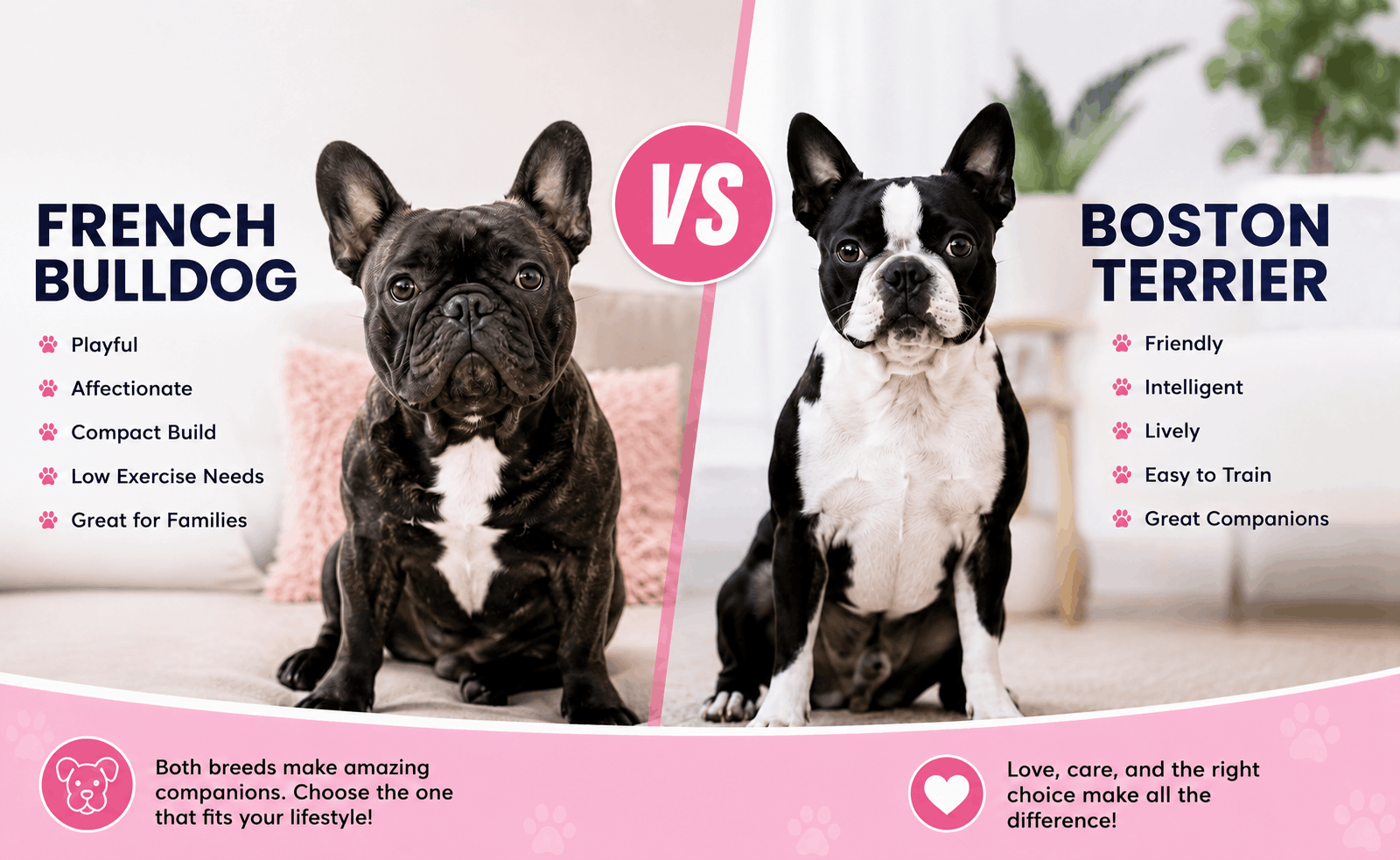
Bat ears, flat face, tuxedo markings, big personality — if you’ve ever squinted at a photo trying to figure out whether you’re looking at a French Bulldog or a Boston Terrier, you’re not alone. These two get mixed up constantly, and honestly, it’s fair; they share a common Bulldog ancestor and a genuinely similar silhouette. But they’re not the same dog, and the differences actually matter once you’re the one feeding, exercising, and living with one.
We went through the deepest comparisons already written on this exact matchup, and most of them do a solid job on looks — ear shape, coat color, weight. What’s consistently missing is the decision-making part: a real cost comparison, an honest breakdown of which breed handles heat and breathing issues better, and a straight answer to “okay, but which one should I actually get.” That’s what this guide adds.
| Trait | French Bulldog | Boston Terrier |
|---|---|---|
| Weight | 16 – 28 lbs | 12 – 25 lbs |
| Height | 11 – 13 inches | 15 – 17 inches |
| Build | Stocky, low center of gravity | Leaner, more athletic |
| Energy level | Lower, more of a lounger | Moderate-high, playful bursts |
| Lifespan | 10 – 12 years | 11 – 13 years |
| Airway severity | More compressed muzzle, higher risk | Slightly longer muzzle, somewhat lower risk |
| Best suited for | Apartment dwellers, calmer households, solo owners | Active families, owners who want a livelier companion |
2. Where each breed actually comes from
Both breeds share a genuinely common ancestor — the old English Bulldog — which is exactly why they look so alike at a glance. From there, their paths split in different directions.
The French Bulldog’s story actually starts in England, not France. Lace workers from Nottingham brought small Bulldogs with them to France during the Industrial Revolution, where the breed was refined into the compact companion dog we know today — and picked up its French name along the way, even though its roots are English.
The Boston Terrier, on the other hand, is genuinely American, developed in Boston in the late 1800s from a cross between an English Bulldog and the now-extinct White English Terrier. It started out bred for pit fighting before quickly transitioning into the beloved companion breed it is now, eventually earning the nickname “The American Gentleman” for its tuxedo-like markings.
3. How to actually tell them apart
Here’s the quick visual cheat sheet, since this is genuinely where most people get stuck:
- Ears: French Bulldogs have wide, rounded “bat ears.” Boston Terriers have smaller, more pointed, upright ears.
- Head shape: Frenchies have a squarer head. Bostons have a rounder skull.
- Body: Frenchies are stockier and more muscular with a lower center of gravity. Bostons are leaner and more athletic-looking, with slightly longer legs.
- Coat colors: Boston Terriers almost always have the classic black-and-white (or brindle/seal-and-white) tuxedo pattern with a white blaze between the eyes. French Bulldogs come in a much wider range — brindle, fawn, cream, white, and combinations — and don’t have the tuxedo requirement.
- Height: Boston Terriers actually stand taller, up to 17 inches, compared to the French Bulldog’s max of about 13 inches, even though Frenchies are often the heavier, stockier-looking of the two.
If you see a black-and-white dog with a distinct white stripe up the face and pointed ears, that’s almost certainly a Boston. If it’s a rounder-headed, stockier dog with wide bat ears in a less “matched” color pattern, that’s your Frenchie.
4. Temperament: the difference that matters most
Both breeds are affectionate, people-oriented, and genuinely good companions — that part isn’t in question. Where they actually diverge is energy and social style.
French Bulldogs are calm, cuddly, and a little headstrong. They bond hard with their family and can be genuinely protective of their people if not well socialized, sometimes translating into wariness around strangers. They’re content to lounge for most of the day and don’t ask for much beyond your company.
Boston Terriers tend to be more outgoing with strangers, generally friendlier right out of the gate with new people and other pets, and noticeably more playful, with real bursts of energy through the day. Both breeds can be stubborn during training, but Bostons are generally considered a touch easier to train, partly because they’re more food and play motivated and slightly less independent-minded than Frenchies.
5. Exercise and energy levels
Frenchies do fine with 30-60 minutes of light activity a day — short walks and some indoor play covers it, and they’re genuinely more prone to just wanting to nap on the couch with you. Boston Terriers need a bit more: they benefit from real playtime and daily movement, and some even enjoy structured activities like agility or flyball as an outlet for that extra energy.
Both breeds share one critical limitation because of their flat faces: neither should be pushed hard in heat or humidity, and neither is built for extended, high-intensity exercise regardless of how playful they seem in the moment.
6. Health: the brachycephalic comparison nobody spells out
This is the section most comparisons gloss over, and it’s genuinely the most useful one if you’re trying to decide between these two.
Both breeds are brachycephalic — flat-faced — which means both carry some degree of airway restriction and heat sensitivity. But it’s not equal between them. The French Bulldog’s muzzle is generally more compressed than the Boston Terrier’s, which in practice means Frenchies tend to snore louder, overheat faster, and carry a somewhat higher risk of needing surgical correction for severe Brachycephalic Airway Syndrome (BOAS) later in life. The Boston Terrier’s slightly longer muzzle gives it a small but real edge on breathing efficiency.
Beyond the airway, each breed carries its own additional risks worth knowing:
- French Bulldogs: spinal issues (including hemivertebrae), skin fold infections from their wrinkles, and a higher rate of needing C-sections during birth due to their narrow hips relative to puppy head size.
- Boston Terriers: more prone to eye injuries and conditions given their prominent, exposed eyes, along with patellar luxation (kneecap slipping) more commonly than Frenchies.
Neither breed’s health profile should be a dealbreaker — but weight management and heat avoidance matter for both, and slightly more urgently for the Frenchie. This is exactly why every puppy we place comes with a full vet check and a written health guarantee.
7. Grooming needs
Both breeds have short, easy-care coats — weekly brushing is genuinely enough for either one. The real grooming difference is in the details: French Bulldogs need regular cleaning of their facial wrinkles to prevent skin infections, something Boston Terriers largely don’t need to worry about given their smoother, less-wrinkled face. Both benefit from regular nail trims and ear checks.
8. Which is better with kids and other pets
Boston Terriers generally have the edge here — they tend to be more outgoing with strangers and get along well with children and other pets right from the start. French Bulldogs are just as loving with their own family but can be a little more protective or reserved around unfamiliar people and pets if socialization was skipped early on.
Both breeds do well with proper introductions and early socialization, and neither carries a meaningful prey drive to manage around cats or smaller pets.
9. Cost comparison
This is where the gap between these two breeds is actually the widest. French Bulldogs are consistently one of the most expensive popular breeds to purchase, often running $2,500-$5,000+, largely driven by demand (they’re currently America’s most popular breed) and the higher veterinary cost of breeding them, including the C-sections mentioned above. Boston Terrier puppies are generally more affordable, typically $1,000-$2,500.
Ongoing costs also lean Frenchie-heavy — more frequent vet visits tied to their airway and spinal risks add up over a lifetime. If cost is a real factor in your decision either way, 100% financing options exist so the upfront price doesn’t have to be what decides it.
10. So which one should you actually get
If you want the direct answer: get a French Bulldog if you want a low-energy, cuddly companion, live in an apartment, and are comfortable budgeting more upfront and for potential vet care down the line. Get a Boston Terrier if you want a livelier, slightly easier-to-train dog that does well with an active family, kids, and other pets, at a generally lower cost of entry.
A simple gut-check question that resolves this for most people: do you want a dog that mostly wants to nap next to you, or one that wants to actively play with you? That single preference tends to point people to the right breed faster than any spec sheet.
11. Red flags when buying either breed
| Red flag | Why it matters |
|---|---|
| No mention of airway or BOAS screening | Given how common breathing issues are in both breeds, a responsible breeder should be able to speak to this directly. |
| Unusually low price for a French Bulldog specifically | Given the high cost of responsibly breeding Frenchies (including frequent C-sections), a bargain price is a real red flag. |
| Won’t do a live video call | You should see the actual puppy, live, before committing to anything. |
| No written health guarantee | Verbal promises don’t protect you if something’s wrong after pickup. |
| No vet records offered upfront | You should see proof of a vet check and vaccinations before paying, not just take someone’s word for it. |
This is exactly why we build our process the way we do: 21+ years in business, 30,000+ successful placements, every puppy vet-checked, microchipped, vaccinated, and sent home with a starter kit.
12. Frequently asked questions
Which is more expensive, a French Bulldog or a Boston Terrier?
French Bulldogs are almost always the pricier of the two, often by a significant margin, driven by high demand and higher breeding costs.
Which breed is easier to train?
Boston Terriers are generally considered a bit easier, largely due to being more food and play motivated and slightly less independent-minded than French Bulldogs.
Do French Bulldogs or Boston Terriers have worse breathing problems?
French Bulldogs generally have a more compressed muzzle and tend to carry a somewhat higher risk of serious airway issues, though both breeds are brachycephalic and need careful heat and exercise management.
Which breed is better for a first-time owner?
Both work well for first-timers. Boston Terriers may be slightly easier due to trainability and sociability, while French Bulldogs suit owners who want a calmer, lower-energy companion.
Can French Bulldogs and Boston Terriers be mixed?
Yes, this cross does happen and is sometimes called a “Frenchton.” It’s not officially standardized, so traits from either parent can show up unpredictably.
Ready to meet your puppy? Every puppy is vet-checked, microchipped, vaccinated, and backed by a written health guarantee, with a starter kit included and nationwide delivery available. You can do a live video call before you commit. Browse French Bulldog puppies or Boston Terrier puppies, check our financing options, or reach out through our contact page with any questions before you decide.