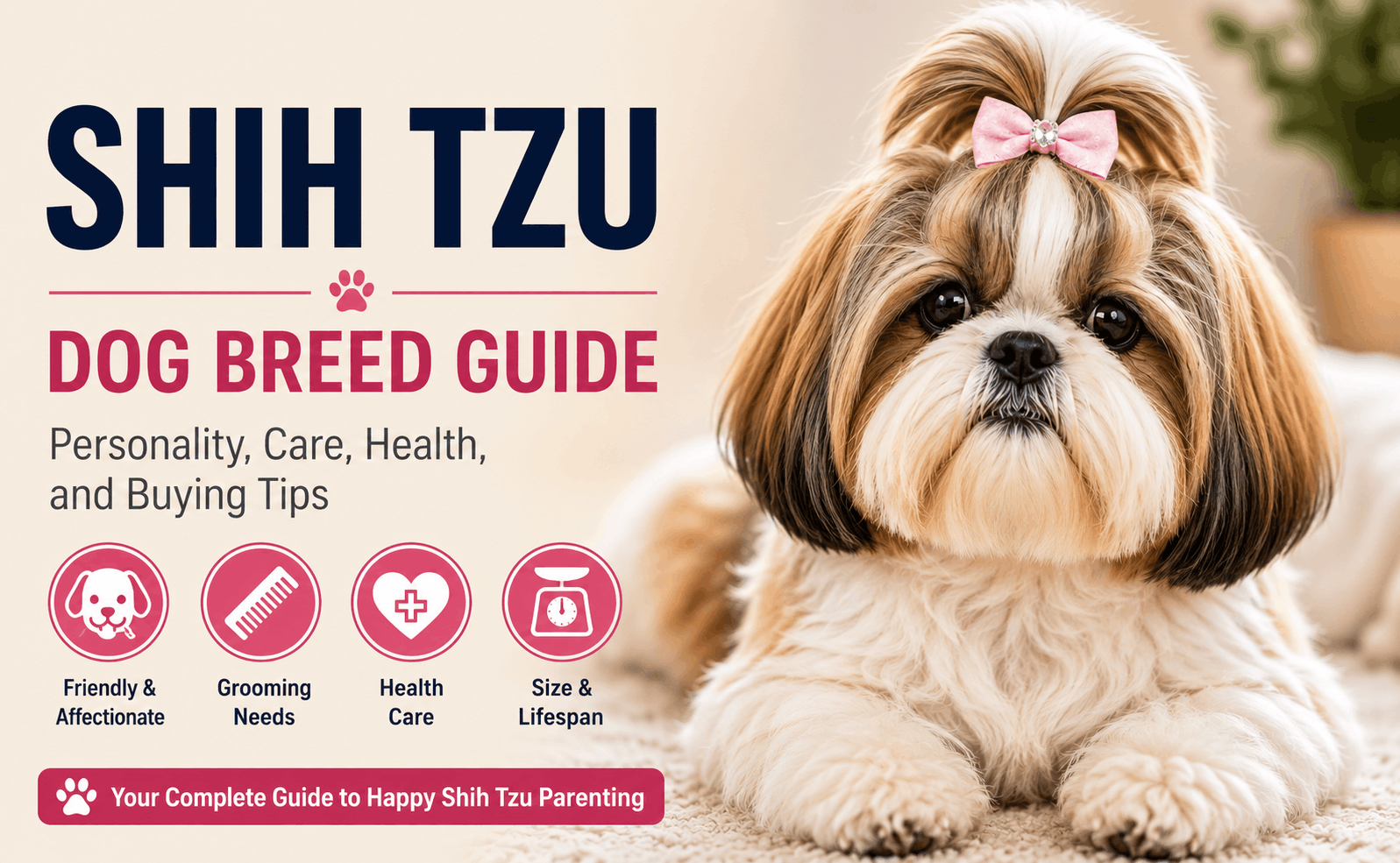
“Little lion dog” is a funny name for something that spends most of its day trying to get into your lap. That’s the whole story of the Shih Tzu, really — a dog literally bred for Chinese royalty to do nothing but be adored, and one that still takes that job very seriously today.
We went through the deepest Shih Tzu guides already out there — the vet sites, the breed pages, the temperament deep-dives — and most of them do a good job on history and personality. What’s consistently missing is the buying side: the brachycephalic health risks explained in a way that actually helps you make a decision, an honest word on “teacup” Shih Tzus, and a real cost and red-flag breakdown. That’s what this guide adds.
1. What is a Shih Tzu, really
“Shih Tzu” translates to “lion dog” in Mandarin, and the resemblance was intentional — ancient breeders in Tibet and China shaped this dog to echo the lion imagery seen throughout Chinese art and mythology. For centuries, Shih Tzus lived almost exclusively within Chinese imperial courts, treated as prized companions to royalty rather than working dogs of any kind.
The breed nearly vanished when political upheaval in China disrupted breeding programs in the mid-20th century. What saved it was a small number of dogs bred in England between the 1930s and 1950s — nearly every Shih Tzu alive today traces back to that narrow founding group. The AKC recognized the breed in 1969, and it’s been a fixture of small-dog popularity in the US ever since.
What all that history left behind is a dog whose entire genetic purpose is companionship. There’s no working instinct hiding underneath, no job this breed is secretly itching to do. A Shih Tzu’s job has always been exactly what it looks like: being near you.
2. Size, weight, and lifespan
| Trait | Typical range |
|---|---|
| Weight | 9 – 16 lbs |
| Height | 8 – 11 inches |
| Lifespan | 10 – 16 years |
| Reaches adult size | Around 10 months |
Shih Tzus are one of the longer-lived small breeds, with plenty living comfortably into their mid-teens when kept lean and given regular vet care. Like most toy breeds, they hit adult size fast — usually by around 10 months old — so what you see close to that age is close to what you’ll get for the next decade-plus.
3. Temperament: what they’re actually like
Shih Tzus are consistently described the same way across every source we looked at, and for good reason: happy, friendly, affectionate, and genuinely easygoing. They’re not a nervy or high-strung breed. Most Shih Tzus greet new people, new dogs, and new situations with curiosity rather than suspicion, especially with early socialization.
They don’t ask for much beyond your attention. Exercise needs are low, but attention needs are high — this is a breed that wants to be in the room with you, ideally on you, and doesn’t do particularly well being left alone for long stretches. Some Shih Tzus develop a habit of digging or nuisance barking when bored, which is really just misdirected energy from a dog that’s not getting enough engagement.
4. The flat face: what “brachycephalic” actually means for you
This is the single most important health concept for any Shih Tzu owner to actually understand, not just skim past. Shih Tzus are a brachycephalic breed — meaning they have a shortened muzzle and flattened face — and that structure comes with real, practical consequences.
The short version: a Shih Tzu’s airway is more compressed than a dog with a normal muzzle length, which makes breathing less efficient and heat regulation harder. Dogs cool themselves primarily by panting, and a shortened airway makes that process less effective. That’s not a minor detail — it directly changes how you should manage this dog day to day.
- Heat is genuinely dangerous for this breed. Avoid exercising a Shih Tzu in hot or humid weather, and never leave one in a parked car, even briefly.
- Weight matters more here than in most breeds. Extra weight puts additional pressure on an already-compressed airway, making breathing problems noticeably worse.
- Watch for snoring, snorting, or labored breathing beyond what seems normal for the breed — in more severe cases, this can indicate Brachycephalic Airway Syndrome, which sometimes requires surgical correction.
- A harness beats a collar for exactly the same reason it does with other short-muzzled or small breeds: less pressure on an already-sensitive airway.
None of this means a Shih Tzu is a fragile or unhealthy choice — it means this is a breed where a few specific management habits (climate control, weight, exercise timing) matter more than they would with a longer-muzzled dog.
5. Teacup Shih Tzus: the honest truth
You’ll see “teacup Shih Tzu” advertised fairly often, usually alongside an even more irresistible price or photo. Here’s the straightforward answer: teacup isn’t an official size classification for this breed. It’s a marketing term applied to Shih Tzus bred to be smaller than the breed standard, often without much regard for the health consequences of doing so.
Breeding for extreme smallness tends to concentrate exactly the health risks this breed already carries — breathing difficulty, hypoglycemia, fragile bones, and a generally higher-risk pregnancy and birth process for the mother. A smaller Shih Tzu isn’t automatically a less healthy one, but “teacup” as a marketed category should be treated as a flag to ask more questions, not a bonus feature to pay extra for.
6. Other health issues to know about
Beyond the brachycephalic concerns above, a few other conditions show up often enough in this breed to be worth knowing before you buy:
- Progressive Retinal Atrophy (PRA) — a hereditary condition where the retina gradually deteriorates, eventually leading to blindness. Responsible breeders test their breeding dogs for this.
- Dry eye — the Shih Tzu’s large, prominent eyes are more exposed and prone to irritation and inadequate tear production, which can lead to discomfort or damage if untreated.
- Intervertebral Disc Disease (IVDD) — less commonly discussed for this breed than for Dachshunds, but a real risk given their proportionally longer torso.
- Periodontal disease — small, crowded mouths mean tartar and dental issues build up faster than owners expect.
None of this is a reason to avoid the breed — it’s a reason to ask the right questions before you buy. That’s exactly why every puppy we place comes with a full vet check and a written health guarantee.
7. Grooming and coat care
The Shih Tzu’s long, flowing double coat is genuinely beautiful and genuinely high-maintenance if you keep it long — daily brushing is non-negotiable to prevent painful mats, and most owners eventually opt for a shorter “puppy cut” specifically to cut down on upkeep. Either way, a professional groom every 4-6 weeks keeps things manageable.
Because of their prominent eyes and short muzzle, daily face cleaning matters more for this breed than most — tear staining and food debris around the mouth build up fast otherwise. Regular ear checks (their floppy ears trap moisture) and nail trims round out the routine.
One upside worth mentioning: their coat sheds relatively little, since loose hair tends to stay trapped in the coat rather than falling out, which is part of why Shih Tzus are sometimes described as a good option for people with mild allergies — though no dog is truly hypoallergenic, and it’s worth spending time with the breed before committing if allergies are a concern.
8. Exercise, training, and daily life
Exercise needs here are genuinely low — a couple of short walks and some indoor playtime is plenty, and that suits apartment living well. What they can’t skip is mental engagement: puzzle toys, short training sessions, and simply spending time with their people. A Shih Tzu without enough engagement tends to express that boredom through digging or barking rather than destructive chewing, since their short muzzle makes chewing less of a natural outlet.
Training-wise, they’re generally eager to please, though house-training can take a bit longer than average with this breed — consistency and patience matter more than any particular technique.
9. Are Shih Tzus good with kids and other pets
Yes, generally — this is one of the more consistently kid-friendly and pet-friendly toy breeds, largely a byproduct of centuries of breeding purely for companionship rather than any working drive. With that said, their small size still means supervision matters with very young children, simply to avoid accidental injury during rough play.
With other dogs and cats, Shih Tzus tend to adapt well, especially with early socialization. There’s no meaningful prey drive to manage here the way there is with hunting-bred breeds.
10. What a Shih Tzu puppy actually costs
Shih Tzu puppies typically run $1,000-$2,500+ depending on lineage, coloring, and breeder reputation. That price should reflect real groundwork: eye and health testing on the parents, a vet check on the puppy, first vaccinations, and microchipping — not just an appealing photo.
If the upfront cost is what’s holding you back rather than the decision itself, 100% financing options exist so budget doesn’t have to be the deciding factor.
11. Red flags when buying a Shih Tzu puppy
| Red flag | Why it matters |
|---|---|
| “Guaranteed teacup” marketing | Extreme-small breeding often comes at the expense of the puppy’s (and mother’s) health. |
| No eye testing information | Given how prone this breed is to eye conditions, a responsible breeder should have real answers here. |
| Won’t do a live video call | You should see the actual puppy, live, before committing to anything. |
| No written health guarantee | Verbal reassurance isn’t worth much if something’s wrong after pickup. |
| Price that seems unusually low | Almost always means health testing or vet care got skipped somewhere. |
This is exactly why we build our process the way we do: 21+ years in business, 30,000+ successful placements, live video calls before purchase, and every puppy vet-checked, microchipped, vaccinated, and sent home with a starter kit.
12. Frequently asked questions
Are Shih Tzus good for first-time dog owners?
Yes, generally. Their low exercise needs, friendly temperament, and adaptability make them a solid choice, as long as you’re prepared for the grooming commitment and heat sensitivity.
Are Shih Tzus hypoallergenic?
No dog is truly hypoallergenic, but Shih Tzus shed very little since loose hair tends to stay trapped in their coat rather than falling out, which some allergy sufferers find more manageable.
How much exercise does a Shih Tzu need?
Not much — a couple of short walks a day plus indoor playtime is typically enough, though mental stimulation matters just as much as physical exercise for this breed.
Why do Shih Tzus snore so much?
It’s a direct result of their brachycephalic (flat-faced) structure, which compresses the airway. Mild snoring is common and generally normal, but heavy snorting or labored breathing should be checked by a vet.
Are teacup Shih Tzus a good idea?
Approach with caution. “Teacup” isn’t an official size category, and breeding for extreme smallness often increases health risks rather than offering any real benefit.
Ready to meet your Shih Tzu? Every puppy is vet-checked, microchipped, vaccinated, and backed by a written health guarantee, with a starter kit included and nationwide delivery available. You can do a live video call before you commit. Browse available Shih Tzu puppies, check our financing options, or reach out through our contact page with any questions before you decide.