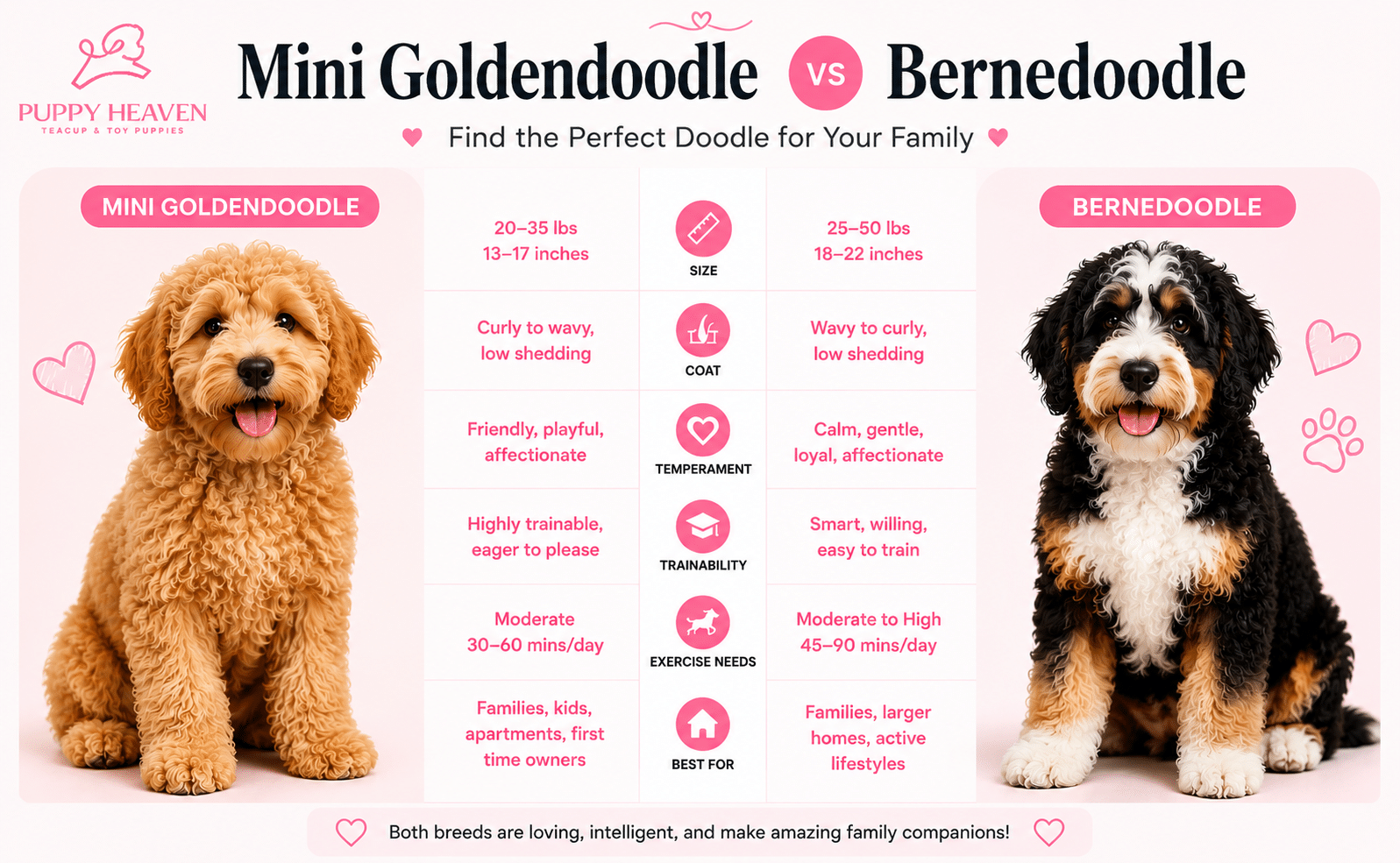
Mini Bernedoodle: Slightly larger, calmer, and strikingly tri-colored — best for families who want a loyal, gentle, and laid-back companion.
Both are intelligent, low-shedding, and absolutely adorable. Keep reading — we break down every single difference so you know exactly which one fits YOUR life.
You’ve fallen in love with doodles. You’re down to two finalists: the Mini Goldendoodle and the Mini Bernedoodle. Both are fluffy, smart, low-shedding, and make your heart melt at first glance. But they are not the same dog — and choosing the wrong one for your lifestyle can be frustrating for both you and your pup.
I’ve spent years researching designer dog breeds, talking to breeders, and studying what real owners say about living with these two. This guide gives you everything you need: size, temperament, grooming, health, cost, training, and a clear verdict on which breed wins for different types of families.
Let’s get into it — no fluff, just facts (well, maybe a little fluff — these are doodles after all).
🐕 Both the Mini Goldendoodle and Mini Bernedoodle share one parent: the Miniature Poodle. That’s why they’re so similar in many ways — intelligence, low-shedding coats, and people-loving personalities. The big differences come from the other parent: the Golden Retriever (for Goldendoodles) vs. the Bernese Mountain Dog (for Bernedoodles).
1. Origins — Where Did These Breeds Come From?
Mini Goldendoodle — The All-American Sweetheart
The Mini Goldendoodle (also called Mini Groodle, Mini Goldenpoo, or Mini Goldiepoo) is a cross between a purebred Golden Retriever and a Miniature Poodle. Goldendoodles first appeared in the United States in the late 1960s, originally bred as hypoallergenic guide dogs. By the 1990s, they had exploded in popularity as family pets, thanks to their irresistible personalities and low-shedding coats.
The “mini” version came about by swapping the Standard Poodle parent for a Miniature Poodle — giving families all the charm of a Goldendoodle in a smaller, apartment-friendly package. Today, the Mini Goldendoodle is one of the most popular designer dog breeds in the United States.
If you want to learn more about the full-size version, check out our detailed guide on Goldendoodle puppies on PuppyHeaven.
Mini Bernedoodle — The Swiss-Canadian Charmer
The Mini Bernedoodle (also called Mini Bernese Poodle or Mini Berniedoodle) is a cross between a purebred Bernese Mountain Dog and a Miniature Poodle. This breed was first deliberately created in Canada in the early 2000s by breeder Sherry Rupke, who wanted to combine the calm, gentle Bernese personality with the Poodle’s intelligence and low-shedding coat.
The Bernese Mountain Dog itself has roots in the Swiss Alps, where it was bred as a farm dog — herding cattle, pulling carts, and keeping farmers company. That working-dog loyalty and calm strength shows up in the Bernedoodle today. Though newer than the Goldendoodle, the Mini Bernedoodle has quickly become one of the most sought-after breeds among families who want a calm, beautiful, and devoted companion.
We have a full breed profile available in our Bernedoodle puppies section if you want to go deeper on this breed.
2. Size & Appearance — Who’s Bigger?
Here’s where the first real difference shows up. Despite both being called “mini,” these two breeds are not the same size.
| Feature | Mini Goldendoodle Golden Retriever × Mini Poodle | Mini Bernedoodle Bernese Mountain Dog × Mini Poodle |
|---|---|---|
| Height | 13–20 inches | 18–24 inches |
| Weight | 15–35 lbs | 25–50 lbs |
| Build | Lean, compact, athletic | Stockier, broader, more substantial |
| Face | Soft, teddy-bear expression | Expressive, slightly “rugged” look |
| Size Winner | Mini Goldendoodle is consistently smaller. Mini Bernedoodle is sometimes closer to a “medium” dog. | |
One thing to keep in mind: because both are mixed breeds, their exact size can vary quite a bit from puppy to puppy — even within the same litter. A Mini Bernedoodle that takes more after its Bernese Mountain Dog parent could end up on the larger end, while one favoring the Miniature Poodle will be more compact.
The same goes for Mini Goldendoodle puppies — the parent dogs’ genetics play the biggest role in the final adult size.
3. Coat, Colors & Grooming — Who Needs More Work?
Mini Goldendoodle Coat
Mini Goldendoodles can have three coat types depending on which parent they favor more:
- Wavy/Fleece coat — The most common. Soft, low-shedding, and easy to manage. Most people love this coat.
- Curly/Poodle coat — More hypoallergenic, almost no shedding, but requires more frequent grooming to prevent matting.
- Straight coat — Less common. May shed more than the wavy/curly types.
Colors: Cream, gold, apricot, red, caramel, and sometimes a mix of these. Their coats tend to be one solid or two-toned color — warm, sunny, and inviting.
Mini Bernedoodle Coat
Mini Bernedoodles are famous for their gorgeous tri-color coat — typically a combination of black, white, and brown that mirrors their Bernese Mountain Dog parent. It’s one of the most visually striking coat patterns in the doodle world. Their coat type also varies:
- Curly coat — Minimal shedding, great for allergy sufferers.
- Wavy coat — Moderate shedding, softer texture, easier to brush.
Some Bernedoodles also come in merle patterns, phantom, bi-color (black and white), or sable. Their coat variety is genuinely wider than the Goldendoodle’s.
Grooming Needs — Side by Side
| Grooming Task | Mini Goldendoodle | Mini Bernedoodle |
|---|---|---|
| Brushing | 2–3 times per week | 3–4 times per week (more coat to cover) |
| Professional Grooming | Every 6–8 weeks | Every 6–8 weeks |
| Shedding Level | Low to very low | Low to very low |
| Hypoallergenic? | Mostly, especially with curly coats | Mostly, especially with curly coats |
| Mat-Prone Areas | Behind ears, legs, armpits | Behind ears, under collar, belly |
| Cost at Groomer | $50–$90 per session | $60–$100+ per session (larger dog) |
Both breeds need regular ear cleaning (their floppy ears trap moisture and can lead to infections), nail trims every 3–4 weeks, and dental care. Don’t skip the dental hygiene — small dogs especially are prone to tartar buildup.
Looking for grooming advice? Our dog grooming tips guide covers everything from brushing techniques to finding a great local groomer.
🏆 Coat & Grooming Verdict
Mini Goldendoodle Slight Edge — Generally a bit easier to groom due to smaller size. But if you love a dramatic, show-stopping coat, the Bernedoodle’s tri-color pattern is absolutely stunning and worth the extra brushing.
4. Temperament & Personality — The Biggest Difference
This is where these two breeds really diverge. Both are loving, people-centered dogs — but they express that love in very different ways. Getting this right is the most important part of your decision.
🌟 Mini Goldendoodle Personality
Think of the Mini Goldendoodle as the social butterfly of the doodle world. They are outgoing, enthusiastic, and love absolutely everyone — strangers, children, other dogs, and even the mailman. They’re the dog that will greet your guests before you even open the door.
They’re always “on” — ready to play, explore, cuddle, or show off a new trick. Their energy is infectious, and they thrive on interaction. If you leave a Mini Goldendoodle alone for too long, that pent-up energy can turn into mischief — chewed shoes, knocked-over plants, or a very loud protest.
Best described as: Joyful, enthusiastic, social, playful, and endlessly affectionate.
Mini Bernedoodle Personality
The Mini Bernedoodle is the “wise and gentle” member of the doodle family. They’re affectionate and loving, but in a quieter, more deliberate way. Where a Goldendoodle might zoom around the room excited to see you, a Bernedoodle will walk over calmly, lean against your leg, and look at you with those soulful eyes.
They form deep, intense bonds with their family — sometimes described as “velcro dogs” for how closely they follow their people around. They tend to be a little more reserved with strangers at first but warm up quickly with proper socialization. Early socialization is especially important for Bernedoodles — without it, they can become overly cautious or even anxious around new people and environments.
Bernedoodles can also be slightly stubborn — a trait inherited from the strong-willed Bernese Mountain Dog. They’re not difficult, but they’ll test your patience occasionally.
Best described as: Calm, loyal, gentle, goofy with family, slightly reserved with strangers.
| Personality Trait | Mini Goldendoodle | Mini Bernedoodle |
|---|---|---|
| Energy Level | High ⚡⚡⚡⚡ | Moderate ⚡⚡⚡ |
| With Strangers | Immediately friendly — loves everyone | Cautious at first, warms up quickly |
| Affection Level | Very high — cuddles on demand | Very high — deep, loyal bonding |
| Independence | Low — hates being alone | Low — prone to separation anxiety |
| Stubbornness | Minimal — eager to please | Mild — occasional independent thinking |
| Goofy / Playful | Constantly | Yes, especially with trusted family |
| Watchdog Ability | Poor — too friendly to be a watchdog | Better — will alert you to strangers |
5. Training & Intelligence — Which Is Easier to Train?
Both breeds are smart — that’s the Poodle influence coming through. But “smart” doesn’t always mean “easy to train.” Here’s the honest breakdown:
Mini Goldendoodle Training
Mini Goldendoodles are often called one of the easiest breeds to train, period. They’re eager to please, they love praise, and they pick up new commands incredibly fast. Their Golden Retriever heritage gives them that “I just want to make you happy” attitude that makes training sessions feel more like play than work.
They’re great for first-time dog owners. They respond brilliantly to positive reinforcement — treats, praise, and play. They do well in obedience classes, agility training, and even therapy dog work. The Mini Goldendoodle was literally bred from guide dogs, so following human cues is in their DNA.
Mini Bernedoodle Training
Mini Bernedoodles are equally intelligent, but they come with a splash of Bernese Mountain Dog independence. This can show up as occasional stubbornness — they may understand exactly what you’re asking them to do and simply decide they’d rather not right now. This isn’t defiance so much as confidence and self-assurance.
The key to training a Bernedoodle is consistency, patience, and making it fun. Keep sessions short, positive, and rewarding. They’re sensitive dogs — harsh corrections backfire immediately. Positive reinforcement is non-negotiable with this breed. The good news? Once a Bernedoodle decides they’re committed to something, they’re all in. They make excellent therapy dogs and emotional support animals.
🏆 Training Verdict
Mini Goldendoodle Winner for First-Timers — Easier and more intuitive to train, especially for new dog owners. The Mini Bernedoodle is still highly trainable, but requires more consistency and patience. Both thrive on positive reinforcement — never use punishment-based methods with either breed.
Want to get a head start? Read our guide on how to train a puppy — it covers the basics that work for both breeds.
6. Exercise & Energy Levels — How Much Activity Do They Need?
This is a significant factor in choosing between these two breeds, especially if you have a busy lifestyle or limited outdoor space.
| Exercise Factor | Mini Goldendoodle | Mini Bernedoodle |
|---|---|---|
| Daily Exercise Needed | 60–90 minutes minimum | 45–60 minutes |
| Energy Level | High — needs vigorous activity | Moderate — enjoys but doesn’t demand intense exercise |
| Favorite Activities | Fetch, swimming, running, hiking, agility | Walks, play sessions, moderate hikes, cuddle sessions |
| Good for Apartment? | Yes, with enough daily exercise | Yes, even more adaptable to indoor life |
| Happy with Lazy Days? | Occasionally — but will get restless | Yes — more content to hang out indoors |
| Mental Stimulation | Essential — boredom leads to destruction | Important — but slightly less demanding |
The Mini Goldendoodle loves swimming, running alongside bikes, and playing fetch for an hour straight. If you’re a jogger, hiker, or active family, a Mini Goldendoodle will be your perfect adventure partner. However, if you skip exercise days regularly, expect to deal with a very bouncy, possibly destructive dog in the house.
The Mini Bernedoodle is more adaptable. They enjoy exercise and activity, but they’re equally happy spending a rainy afternoon curled up on the couch with you. That Bernese Mountain Dog calmness means they can adapt to less intense lifestyles without becoming neurotic — though they still need their daily walk and playtime.
7. Health & Lifespan — Which Breed Is Healthier?
Both breeds benefit from something called “hybrid vigor” — the genetic advantage that comes from crossing two unrelated breeds. Mixed-breed dogs tend to be healthier than their purebred parents because they have a wider genetic pool, reducing the chance of inheriting recessive genetic conditions.
That said, they’re not immune to health issues.
Common Health Issues — Mini Goldendoodle
- Hip Dysplasia — Abnormal hip joint development, can cause pain and mobility issues.
- Elbow Dysplasia — Similar joint issue affecting the front legs.
- Eye Conditions — Progressive Retinal Atrophy (PRA), cataracts, and glaucoma are possible.
- Subvalvular Aortic Stenosis (SAS) — A congenital heart condition more common in Golden Retrievers and their mixes.
- Von Willebrand’s Disease — A genetic blood clotting disorder inherited from either parent breed.
- Separation Anxiety — Not a physical health issue, but very common and worth managing early.
Common Health Issues — Mini Bernedoodle
- Hip & Elbow Dysplasia — Shared with Goldendoodles, especially in larger individuals.
- Eye Problems — Genetic eye conditions from both parent breeds.
- Cancer Risk (Reduced) — Bernese Mountain Dogs have one of the highest cancer rates of any breed (around 45–50%). Crossing with a Poodle significantly reduces this risk through hybrid vigor, giving Bernedoodles a meaningful health upgrade.
- Von Willebrand’s Disease — Same genetic blood clotting disorder risk.
- Skin conditions — Some Bernedoodles can be sensitive to allergies.
Lifespan Comparison
| Lifespan Factor | Mini Goldendoodle | Mini Bernedoodle |
|---|---|---|
| Average Lifespan | 12–15 years | 13–17 years (mini size) |
| Why Minis Live Longer | Smaller dogs consistently outlive larger ones. Choosing the mini size of either breed adds years to their life compared to the standard. | |
| Hybrid Vigor Benefit | Moderate benefit over Golden Retrievers | Large benefit over Bernese Mountain Dogs (dramatic lifespan increase) |
🏆 Health Verdict
Mini Bernedoodle Slight Edge — Because Bernese Mountain Dogs have more severe health issues than Golden Retrievers, the hybrid vigor benefit is more dramatic for Bernedoodles. Mini Bernedoodles also tend to live slightly longer. That said, both breeds are generally healthy with proper care from responsible breeders.
8. Kids, Other Pets & Families — Who’s the Better Family Dog?
Great news: both breeds are excellent family dogs. This is genuinely a strength they share. But there are subtle differences worth knowing.
Mini Goldendoodle with Kids
Mini Goldendoodles are famously gentle and patient with children of all ages. They tend to be especially careful and aware around toddlers — their size is manageable, and their gentle nature means they’re rarely too rough. They love to play games, chase, fetch, and be part of every family activity. Their high energy actually matches well with kids who want an active playmate.
Mini Bernedoodle with Kids
Bernedoodles are affectionate and loyal with their family’s children — they form deep bonds and are incredibly patient. However, because they can be slightly more reserved and sometimes unintentionally knock over very small children due to their larger size and exuberant tail-wagging, they may suit slightly older children (5+) better than homes with very young toddlers.
With Other Pets
Both breeds generally get along well with other dogs and cats when properly introduced and socialized. The Mini Goldendoodle’s outgoing nature makes it a natural social butterfly even at the dog park. The Bernedoodle does well too, but may need a slightly longer adjustment period with new animals.
🏆 Family Verdict
Mini Goldendoodle Slight Edge for Young Kids — Consistently better with toddlers and very young children due to their smaller, more manageable size and immediately open personality. Mini Bernedoodles are wonderful family dogs too, but shine brightest with slightly older children who can handle a bigger, more exuberant pup.
9. Price & Cost of Ownership — What Should You Budget?
Purchase Price
Both breeds sit in the premium designer dog price range. Here’s what you can realistically expect to pay from a reputable breeder:
| Cost Factor | Mini Goldendoodle | Mini Bernedoodle |
|---|---|---|
| Puppy Price | $1,500–$3,500 | $2,000–$5,000+ |
| Why the Difference? | Bernedoodles are newer, have smaller litters, and are rarer — driving up demand and price. | |
| Annual Food Cost | ~$400–$700/year | ~$500–$900/year (larger dog = more food) |
| Grooming (Annual) | ~$600–$1,000/year | ~$700–$1,200/year |
| Vet Costs (Annual) | ~$500–$1,000 | ~$600–$1,200 |
| Pet Insurance | ~$15–$25/month | ~$25–$50/month (size premium) |
| Lifetime Cost Estimate | $15,000–$30,000+ | $20,000–$40,000+ |
The Goldendoodle is the more budget-friendly option over a lifetime, primarily because it’s smaller (lower food and grooming costs) and slightly more widely available. However, if the Bernedoodle is the right fit for your family, the extra cost is well worth it — these are long-lived, deeply loyal companions.
Be very cautious about unusually cheap puppies. Prices far below average are often a red flag for puppy mills or irresponsible breeders who cut corners on health testing. Visit our guide on how to avoid puppy scams before you buy.
10. Which One Is Right for You? — The Honest Verdict
Let’s make this simple. After all the research and comparison, here’s exactly who each dog is best for:
✅ Choose a Mini Goldendoodle if you…
- Are a first-time dog owner who wants an easy, forgiving dog to train
- Have young children (toddlers) in the house
- Live in an apartment or smaller home and need a reliably compact size
- Are an active person who wants a workout partner — running, hiking, swimming
- Want a dog that’s immediately friendly with everyone they meet
- Are working with a tighter budget for both purchase price and ongoing costs
- Want a dog for therapy or emotional support work
✅ Choose a Mini Bernedoodle if you…
- Want a calmer, more laid-back companion who’s happy with moderate activity
- Love the idea of a strikingly beautiful tri-color coat that turns heads everywhere
- Have older children (5+) and a family that wants a deeply loyal, gentle dog
- Work from home and want a “velcro dog” who loves being close to you all day
- Are comfortable with a slightly higher purchase price and ongoing costs
- Want a potentially longer-lived dog with excellent hybrid vigor benefits
- Are willing to commit to thorough early socialization
🏆 Overall Winner?
There is no single “better” dog between these two — it entirely depends on your lifestyle. The Mini Goldendoodle wins for busy families, active people, and first-timers who want an easy, bubbly companion. The Mini Bernedoodle wins for those who want a calmer, more majestic, deeply bonded dog who’s a bit of a couch companion mixed with an outdoor enthusiast.
Both are outstanding dogs. The real winner is whichever one matches YOUR life.
Ready to find your puppy? Browse our available Mini Goldendoodle puppies for sale and Mini Bernedoodle puppies for sale — all from health-tested, responsible breeders on PuppyHeaven.
Frequently Asked Questions — Mini Goldendoodle vs Bernedoodle
Q: Are Mini Goldendoodles or Mini Bernedoodles more hypoallergenic?
Both breeds are considered low-shedding and good for allergy sufferers — especially with a curly coat. Neither is 100% hypoallergenic (no dog truly is), but both are far gentler on allergy sufferers than most breeds. If allergies are a serious concern, look specifically for F1B generation puppies (75% Poodle), which have the curliest, lowest-shedding coats.
Q: Which breed is better for separation anxiety?
Both breeds can struggle with being left alone, as they’re both deeply people-oriented. The Mini Bernedoodle can be particularly prone to separation anxiety due to its intense family bonding. If you work long hours away from home, you’ll need to invest in crate training, a dog walker, or doggy daycare for either breed. Read our guide on managing separation anxiety in dogs for proven strategies.
Q: Which is more expensive — Mini Goldendoodle or Mini Bernedoodle?
Mini Bernedoodles are generally more expensive upfront, typically ranging from $2,000–$5,000+ compared to $1,500–$3,500 for a Mini Goldendoodle. They also cost slightly more to own over their lifetime due to their larger size (more food, higher grooming bills, larger vet medication doses). However, Mini Bernedoodles may live longer, giving you more years of companionship per dollar spent.
Q: Do Mini Goldendoodles or Mini Bernedoodles shed more?
Both shed very little compared to most breeds, thanks to their Poodle genetics. The amount of shedding depends more on which coat type a specific dog inherits than on breed alone. Curly-coated dogs of either breed shed the least. Wavy-coated dogs shed slightly more, and straight-coated dogs shed the most — and straight coats are more common in Goldendoodles than Bernedoodles.
Q: Can both breeds live in apartments?
Yes — with the right amount of daily exercise. The Mini Goldendoodle’s smaller, more consistent size makes it a slightly better fit for apartment living. The Mini Bernedoodle can also thrive in an apartment, especially because of its calmer nature, but needs plenty of outdoor time. Both breeds need mental stimulation inside as well — puzzle toys and training games are a great supplement.
Q: What generation (F1, F1B, F2) should I get?
F1 (first-generation: 50% Poodle, 50% other breed) gives the best hybrid vigor but more variable traits. F1B (first-generation backcross: 75% Poodle) gives curlier, more hypoallergenic coats and more predictable size. For allergy sufferers, F1B or multigen puppies are usually recommended. Visit our guide on doodle generations explained for the full breakdown.
Q: Which dog is better for emotional support or therapy work?
Both breeds excel as therapy and emotional support animals. The Mini Goldendoodle’s naturally outgoing personality makes it an excellent therapy dog in public settings — hospitals, schools, and nursing homes. The Mini Bernedoodle’s calm, empathetic nature makes it an outstanding emotional support animal for personal one-on-one bonds. You genuinely can’t go wrong with either for this purpose.
Quick-Reference Summary Table
| Category | Mini Goldendoodle | Mini Bernedoodle | Winner |
|---|---|---|---|
| Size | 13–20 in | 15–35 lbs | 18–24 in | 25–50 lbs | Goldendoodle (smaller) |
| Coat Beauty | Warm, teddy-bear colors | Striking tri-color | Bernedoodle (unique) |
| Grooming Ease | Slightly easier | Slightly more work | Goldendoodle |
| Trainability | Easiest to train | Very trainable, mild stubbornness | Goldendoodle |
| Energy Level | High | Moderate | Depends on you |
| With Young Kids | Excellent | Very good | Goldendoodle |
| Lifespan | 12–15 years | 13–17 years | Bernedoodle |
| Health | Good hybrid vigor | Excellent hybrid vigor | Bernedoodle |
| Purchase Price | $1,500–$3,500 | $2,000–$5,000+ | Goldendoodle (lower cost) |
| Strangers | Loves everyone immediately | Cautious, warms up | Depends on preference |
| Apartment Life | Great (with exercise) | Good (calmer indoors) | Goldendoodle (smaller) |
| Overall for Active People | ⭐⭐⭐⭐⭐ | ⭐⭐⭐⭐ | Goldendoodle |
| Overall for Calm Families | ⭐⭐⭐⭐ | ⭐⭐⭐⭐⭐ | Bernedoodle |
🐾 Ready to Find Your Perfect Doodle Puppy?
At PuppyHeaven, we work only with responsible, health-tested breeders. Every puppy comes with health certificates, vaccination records, and breeder support.
Questions? Our puppy experts are here to help you find the right match for your family.